Chanko Nabe: The Sumo Hot Pot, What Goes In It, Who Cooks It, and a Recipe, from a Former Rikishi
The first time I ate chanko nabe, I had not yet passed the entrance exam for new sumo recruits. I was still being treated as a guest, and at the meal several senior wrestlers stood and served me.
The air in the room was so tense that, to be honest, I barely remember what my first chanko nabe tasted like. What I do remember, vividly, is the thought that ran through my head.
“So this is the world of sumo wrestlers.”
Hello, I’m Shinzaburo, a former sumo wrestler.
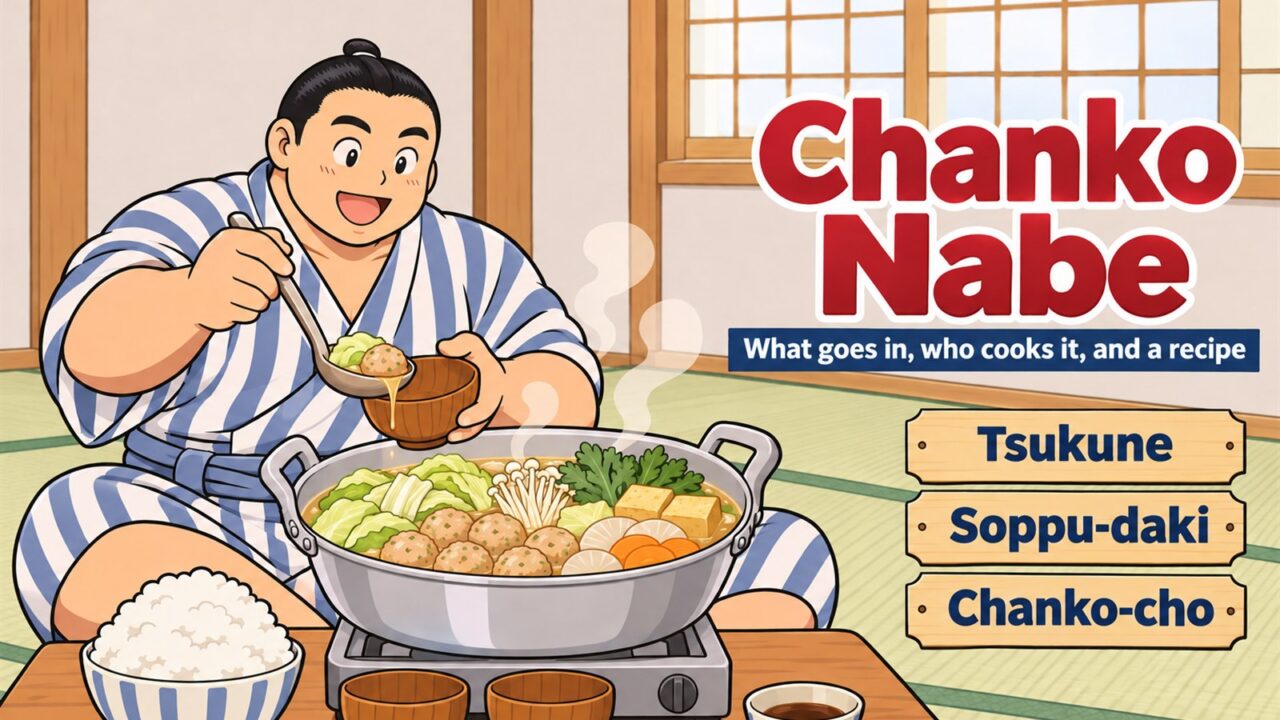
Chanko nabe is the hot pot that sumo wrestlers cook and eat together in their stable, and there is no single recipe for it. In English it is sometimes called sumo stew or sumo hot pot, and it is easy to picture one fixed dish, but the seasoning and the ingredients change from stable to stable. So what do wrestlers really put in the pot?
This article explains what goes into chanko nabe, how the pot ends, who cooks it, and a recipe for making one at home, with what I ate and cooked at my own stable.

I’ve never had the real thing, and I’d love to try it!
I once made a pot at home by copying a video, but I couldn’t tell whether it tasted the way it should.

What is chanko nabe?
Chanko nabe has no rule saying that a certain ingredient must go in. Meat, seafood, vegetables and tofu are combined freely, with an eye on nutrition and on what is in season.
On top of that, each stable has its own touches and its own traditions, so two pots that share the name can taste quite different.
Chanko is more than the hot pot
In a sumo stable, the word chanko covers more than the pot. Any food the wrestlers cook for themselves and eat together is chanko, whether it is grilled fish, a stir-fry or even curry rice.
Chanko nabe is one of the main dishes within that. The amount is easy to adjust, and so is the balance of what goes in.
How much wrestlers eat, and how a day of meals runs in a stable, I explain in more detail here.
Soy sauce, miso, salt, and two ways to dip
The seasoning varies as much as the ingredients, but three broths are the base.
- Soy sauce is the clean, classic taste that anyone finds easy to eat
- Miso is rich and deep, and it goes with a wide range of seafood and meat
- Salt is light yet brings out the flavor, and it suits chicken and tsukune (chicken meatballs) especially well
There is also a way of eating in which the pot itself is hardly seasoned at all. The ingredients are simmered in plain stock, and each person dips them in a sauce. Two styles are typical.
- Mizutaki is chicken, seafood and vegetables simmered in the broth and dipped in ponzu (citrus soy sauce). Typical additions to the ponzu are grated daikon with chili, shredded green onion and yuzu kosho (a paste of citrus peel and chili)
- Yudofu is tofu, chicken skin and vegetables simmered and eaten with a sauce of raw egg yolk mixed with soy sauce, mirin, bonito flakes and green laver
In the sumo world, yudofu with this yolk sauce is a standard, and it is my own favorite chanko nabe. The reason is the sauce. Coat a piece of hot tofu in it and the taste is simple but deep, and I can’t put my chopsticks down.
A pot like this is hard to picture from words alone. The Nihon Sumo Kyokai, the sumo association, has a video of Dewanoumi stable making its yudofu pot. It is in Japanese, but you can follow what goes into the pot just by watching.
Where chanko nabe came from
As for how the pot became stable food, the answer is a practical one. Chanko nabe entered stable meals in the Meiji era (1868 to 1912), because it could feed a large group while keeping the cost of ingredients low and the nutrition balanced.
Source: Nihon Sumo Kyokai, Kokugikan food guide (May 2026 tournament, in Japanese)
Three classic chanko pots
Within all that variety, some pots are tastes handed down for generations, and others were worked out to keep up with young wrestlers’ appetites.
Among them, the three below are classics that many stables have enjoyed for a long time.
Soppu-daki
Soppu-daki is a chicken pot in a soy sauce broth. It stands for stable tradition so strongly that people say chanko means soppu-daki.
The pot even gave sumo a word for a body type. A lean, muscular wrestler is called soppu-gata, a “soppu build,” because he looks as thin as the chicken bones that make the stock. Soppu comes from the Dutch word for soup and came into use in Japan in the Edo period (1603 to 1868). The opposite, a round and heavy build, is called anko-gata.
Source: Sumo Daijiten, 4th ed. (Kanazashi Motoi, Gendai Shokan), entry for soppu-gata
- Main ingredients are chicken-bone stock, chicken thigh, onion, burdock root, carrot, konnyaku (a firm yam jelly), cabbage, komatsuna (a leafy green), bok choy, fried tofu and kinkan, the unlaid eggs found inside a hen
- The broth is chicken-bone stock with soy sauce, sweet and salty at once
The aroma of the burdock and the flavor of the vegetables melt into that broth, so the pot is light and still has strength to it.
Isenoumi stable makes this pot on its own channel, in a video whose title calls its soppu-daki a tradition that has lasted 200 years. The video is in Japanese, and the cooking needs little translation.
Chicken salt chanko
The second pot keeps the chicken and changes the broth to salt. Chicken and tender tsukune take center stage, with the vegetables adding sweetness. The result is light but filling.
- Main ingredients are tsukune or chicken thigh, long green onion, burdock root, daikon, napa cabbage, shiitake and enoki mushrooms, leafy greens and thick fried tofu
- The broth is chicken-bone or kombu (kelp) stock seasoned simply with salt
Pork belly miso chanko
The third is the heavy hitter. The fat of the pork belly and the flavor of the root vegetables melt into a base of blended miso.
- Main ingredients are pork belly, cabbage, long green onion, daikon, burdock root, carrot, potato, enoki mushrooms, garlic chives and thick fried tofu
- The broth is a full-bodied blend of miso
It was valued most for filling the stomachs of young wrestlers, and it goes very well with white rice.
Chicken seems to turn up in so many of these pots.
Is there a reason for that?
Why so much chicken
There is a saying behind the chicken. A former wrestler who runs a chanko restaurant in Odawara, where the signature pot is a chicken salt chanko, has explained it in his own words.
Quotations in this article that come from Japanese-language sources are my English translations.
“For luck, I use chicken, which stands on two legs. A fish has neither hands nor feet. Cows and pigs are said to have their hands on the ground.”
In sumo, a wrestler whose hand touches the ground has lost the bout, so an animal that walks on all fours is the unlucky one. Still, this is a way of courting luck and not a rule. Pork and fish go into chanko too, as the miso pot above shows.
What goes in chanko nabe: my top 20 ingredient picks
So much for the classic pots. The ranking below is strictly personal, built from what I ate as a wrestler and from my own tastes.
On a phone, swipe sideways to see the whole table
| Rank | Ingredient | Why I like it |
|---|---|---|
| 1 | Tsukune (chicken meatballs) | Nutrition, taste and volume in one. A sure favorite at the table |
| 2 | Noodles, meaning udon, Malony (a brand of potato-starch noodles) or kuzukiri (kudzu starch noodles) | Udon is the classic way to finish the pot, and the other two are loved for their slippery texture |
| 3 | Chicken thigh | The mainstay of chanko. Its strong flavor holds up the broth, and it is the star of soppu-daki |
| 4 | Cabbage | Unusual in a home hot pot, but excellent in salt chanko. Its sweetness melts into the broth and some bite remains |
| 5 | Sardine tsumire (fish balls) | The flavor of the fish seeps into the broth. We were sometimes given sardines in bulk, and we made the balls by hand |
| 6 | Oysters, scallops | The stars of a seafood chanko. They turn the pot into a feast at once |
| 7 | White fish such as cod | Popular in winter. It holds its shape, tastes light and is good with ponzu |
| 8 | Pork belly | The sweetness of its fat adds body to the broth, above all with miso. Add garlic and it becomes even more of a wrestler’s favorite |
| 9 | Potato | Fluffy and filling. Very good in pork belly miso chanko |
| 10 | Tofu | Firm tofu holds together in the pot. For yudofu with yolk sauce, silken tofu suits better |
| 11 | Shiitake mushrooms | Full of umami. They give the broth depth, especially a soy sauce broth |
| 12 | Enoki mushrooms | Crisp, quick to cook and easy to pair with anything |
| 13 | Onion | Adds sweetness and body, and melts as it simmers. Good in soy sauce or miso chanko |
| 14 | Long green onion | Sweetness and aroma together. At home in any pot |
| 15 | Daikon | Sweeter the longer it simmers, and it soaks up the broth. A winter standard |
| 16 | Burdock root | Aroma and a texture of its own. It pairs well with chicken |
| 17 | Fried tofu | Soaks up the broth and spreads the flavor. Fits a miso pot or a soy sauce pot alike |
| 18 | Napa cabbage | The standard chanko vegetable. It grows sweeter as it simmers and suits any seasoning |
| 19 | Bean sprouts | Cheap and handy for adding bulk, with a crisp bite |
| 20 | Konnyaku or shirataki, its noodle form | Low in calories, high in fiber, and it takes on the taste of the broth |
The top of the list is chicken and noodles, and most of the lower half is vegetables and tofu that take up the broth. The entry that surprises people is number four.
After I retired, I made chanko at home, and the cabbage sometimes got a reaction.
“You put cabbage in a hot pot?”

I loved chanko nabe, and tsukune most of all.
After my nap one day, I sneaked some tsukune that was left in the pot. I still haven’t forgotten that taste.
Gifts that changed the pot
A few ingredients are missing from the ranking because they reached us only as gifts. During the Kyushu tournament, held in Fukuoka in November, the stable was given kue, a longtooth grouper that is also called ara and counts as a luxury fish.
Its flesh was firm and full of flavor, and it was delicious. I left it off the list only because it was not something we could eat regularly.
Monkfish and turban shells came as gifts as well. The turban shells, though, never went into the pot. We grilled them in their shells and enjoyed them that way.
How chanko nabe ends
When the ingredients are gone, the broth is still there, and the question becomes what to finish it with. Ramen, udon and zosui, rice simmered in the leftover broth, are the usual candidates. This last course of a hot pot is called the shime.
At my stable, the shime was mostly noodles. We had udon, somen (thin wheat noodles) in hot broth, and Malony or kuzukiri. Chinese-style ramen noodles almost never appeared. We ate a lot, so I think what mattered was how easily the noodles went down without much chewing.
Of these, Malony was the most popular. Handing out the shime, however, was the job of the lowest-ranked newcomer. By the time I had carried it around the tables and come back, it had all been eaten, and I hardly remember eating it myself.
Whether there was a shime at all depended on the menu and on what was in stock. Rice was the base of every meal, so the stable rarely bought noodles just for the end of the pot, and they mostly arrived as gifts.
Even then, the gift was not used up on the day it came. The chanko-cho, the head of the cooking crew, or the okamisan, the stablemaster’s wife, kept track of the stock and decided when to bring the noodles out. Udon and somen were given to us fairly often. Malony was quite rare, so when it did appear everyone went for it, and the younger wrestlers often got none.
Rice with the broth poured over
Zosui may be what people picture at the end of a sumo hot pot. At my stable, we hardly ever made zosui as a shime. What we did as a matter of course was simpler. We put a little rice in a bowl and poured the broth from the pot straight over it.
- It is ready at once, with no simmering
- Each person can adjust the amount of rice
- It goes down so smoothly that you end up eating more
For young wrestlers trying to get bigger, I think it was a very practical way to eat. I also liked it better than zosui, because the rice kept its texture.
It helped on the hard days, too. When practice had been so tough that food would not go down, slippery noodles and rice with broth were what I could still manage. If I didn’t eat, my weight would drop, so I kept my chopsticks moving.
Zosui on tournament mornings
Zosui did have its place, though. At my stable it was eaten during a basho, a tournament, by the wrestlers of makushita, the third division, and the divisions below it who had a bout that day.
Their bouts came in the morning or around noon, which pushed lunch back. So on the morning of a bout they ate a light bowl of zosui to put some energy in beforehand.
You can’t step onto the dohyo, the ring, with a full stomach, and on an empty one the strength isn’t there. Zosui fills you up, yet to me it felt quick to digest.
That zosui tasted so good that one tournament morning I ate way too much.
My stomach felt heavy, my body wouldn’t move the way I wanted, and I lost that day’s bout completely.
Who cooks chanko nabe: the chanko-ban and the chanko-cho
All of this cooking is done by the wrestlers themselves. The duty is called chanko-ban, and at my stable a crew of five or six took it on for a week before handing over to the next crew.
The sekitori, the wrestlers in the top two divisions, are taken off the duty. It falls to the wrestlers in makushita and below.
What a chanko-cho does
The chanko-cho is the leader of that crew, and at my stable the role covered far more than cooking.
- Deciding the menu from the ingredients and stock on hand
- Buying and managing ingredients within a set budget
- Teaching the juniors how to cook, how to season and how to organize the work
- Keeping the whole crew moving, from cooking through serving to cleanup
The chanko-cho also passed on what the stablemaster and the okamisan wanted to the juniors. In that sense the role was a link between the top of the stable and the bottom.
At my stable, the job often went to a wrestler in sandanme, the fourth division. By then a wrestler has experience and juniors under him, while a wrestler who reaches makushita is closing in on sekitori rank and concentrating on his sumo. That, I think, is why.
There was no pay for being chanko-cho at my stable. I never heard from wrestlers at other stables that the role brought extra pay either, though I have not checked every stable.
A chanko-cho appears on SUMO PRIME TIME, the association’s English channel. Its episode about chanko nabe was made at Arashio stable and introduces the stable’s chief chanko chef.
The episode dates from April 2024 and runs about 13 minutes. Arashio Stable comes at 0:56, the chief chanko chef at 1:39, a refrigerator count at 3:29, the cooking at 4:10 and the wrestlers’ thoughts on chanko nabe at 10:12.
Arashio is also the stable that lets visitors watch morning practice from outside, through a window. I have put together a guide to visiting it.

Running the kitchen myself
I served as chanko-cho too. From here on, this is about my own time on the cooking crew.
Of all the work I was given after I entered sumo, chanko-ban was one of the jobs I was worst at. I was no good at cooking, and standing for hours outside of practice really wore me down.
Being chanko-cho was heavier still. No other job made me so careful, or tied my stomach in such knots.
■What weighed on me
- The menu had to be worked out from the fridge and the stock, with nutrition and the budget in mind
- When a senior or a sekitori told me “the taste is thin” or “there isn’t enough,” I grew afraid of my next turn at chanko-ban
- Wrestlers eat a great deal, so running short was a serious problem, while cooking too much wasted food and money
- Even basics, like how much seasoning to add or how long to simmer something, left me unsure
The worst was being handed a dish I had no idea how to make. More than once I quietly asked a senior for help, and honestly, I was so grateful to have people who would cover for me.
■One remark that made up for it
Then there were the days when a senior or a sekitori said just one thing.
“Today’s chanko is good.”
That alone made it all feel worth it. Because the job was so hard, a passing remark like that has stayed with me.
The crew’s work did not end when the meal did. Chanko nabe was lunch, eaten after practice, so whatever was left was remade into miso soup for dinner or simply reheated and served as a soup.
Finishing those leftovers fell to the newcomers in their first three years or so. Only when that was done did they get to the dinner dishes.
I could never remember the seasoning or how to cook things, so I kept asking the senior who was our chanko-cho. Every time, he snapped, “I just told you!”
Looking back, he had to watch us juniors and keep the whole kitchen running, so it must have been really tough for him.
How to make chanko nabe at home
A home pot does not need a stable’s kitchen. Here is a classic chicken salt chanko that I recommend trying first. The tsukune in it are made from ground chicken and pork.
Chicken salt chanko (serves 2 generously)
You do not need any stock for this one. The vegetables and the tsukune give the water plenty of flavor on their own.
The amounts of water and salt are only a guide, because everyone’s taste is different. Add the salt a little at a time while tasting the broth. The vegetables soften and sink as they simmer, so the water does not need to cover everything at first. If the pot looks short of water, add a little more as it cooks.
- 1/2 head of cabbage
- 1/3 of a daikon radish
- 1 carrot
- 1 medium onion
- 1/2 bunch of shungiku (edible chrysanthemum greens)
- 1 bunch of enoki mushrooms (any mushroom works)
- 1 to 2 blocks of atsuage (thick deep-fried tofu)
- Salt, about 1 teaspoon to start
- Sesame oil, as needed
For the tsukune
- 350 g (about 12 oz) ground chicken
- 150 g (about 5 oz) ground pork
- 1 egg yolk
- Juice from 1 large knob of ginger
- 2 tablespoons miso
- Salt and pepper, as needed
- Put about 1 liter (about 4 cups) of water in a pot over the heat. Cut the daikon and the carrot into bite-size chunks and add them right away. Slice the onion about 1 cm thick and add it too. The water takes a while to boil, so move on to the next step, and turn the heat down once it boils.
- Mix the tsukune ingredients and knead until the mixture turns sticky. If it feels too loose, add a little potato starch (katakuriko). More ginger is fine if you like it.
- Shape the mixture into bite-size balls and drop them into the pot. Cook them until the center reaches 165°F (74°C), then skim off the foam.
- Add the enoki and the atsuage. Tear the cabbage into bite-size pieces by hand (a knife is fine too) and add it. Season with salt and simmer for about 5 minutes.
- When the vegetables are tender and the broth tastes well seasoned, drizzle sesame oil around the pot in one or two circles. Last, cut the shungiku crosswise into about five sections, add the firm stems first and then the leaves, simmer briefly, and the pot is ready.
That 165°F (74°C) is the U.S. safe temperature for chicken, ground chicken included. If you make the yolk sauce, use pasteurized eggs, or use ponzu instead if you would rather avoid raw egg.
Source: FoodSafety.gov, Safe Minimum Internal Temperatures / U.S. Food and Drug Administration, What You Need to Know About Egg Safety
Changing the pot once you have made it
I picked salt because it is the easiest broth to start with. A salt pot goes with noodles and with rice, so it rarely lets you down when you haven’t decided how to finish.
If you would rather leave the pot unseasoned, change the sauce instead. Ponzu on one day and the yolk sauce on another give you two different pots from the same ingredients.
- Taste the broth once before the shime. Miso and soy sauce grow saltier as the pot boils down, so thin it with a little water or stock, and stop while it still seems slightly weak
- Boil the noodles in a separate pot and keep them a little firm
- Add the noodles to the broth just before eating, and do not simmer them for long
Where to eat chanko nabe at a sumo tournament
There is also a way to eat chanko made by a stable without cooking anything. During the tournaments held in Tokyo, the Kokugikan, the sumo arena, serves chanko in a large hall on its basement floor.
- It is served in the large hall on floor B1
- The hall is open from 11:00 a.m. to 4:30 p.m.
- A bowl costs ¥500, tax included
These details are as of 2026. The stable that makes the chanko can change from one tournament to the next, and it is made by hand at the arena every day. More than 2,000 bowls are sold each day, making it one of the most popular foods in the arena.
The flavor can change partway through a tournament, too, and from one tournament to the next. At the May 2026 tournament, Days 1 to 8 served soy sauce chanko, with salt chanko from Day 9 to the final day. Check the association’s food guide for the tournament you plan to attend.
One thing to know beforehand is that the chanko cannot be carried out. It is eaten inside the hall.
Source: Nihon Sumo Kyokai, Kokugikan food guide (May 2026 tournament, in Japanese)
As for getting into the arena in the first place, how to buy tickets in English and which seats to choose are in my guide to sumo tickets.

FAQ: Chanko nabe
Q1. Is chanko nabe healthy?
A. The pot itself gives you plenty of meat and vegetables at once, and the sumo association describes it as an ideal meal for wrestlers. In a stable, though, it is eaten in large amounts together with a lot of rice. How healthy a pot at home is depends on what you put in it and how much you eat.
Q2. What do you eat with chanko nabe?
A. White rice. At my stable we also finished the pot by pouring its broth over a little rice in a bowl.
Q3. What happens to leftover chanko nabe?
A. At my stable, what was left from lunch was remade into miso soup for dinner, or reheated and served as a soup.
Q4. What is the best ingredient for chanko nabe?
A. On my own list, tsukune comes first, noodles second and chicken thigh third. That is only my own order, and no ingredient is required.
Summary
To me, chanko nabe is more than a hot pot. It is part of how wrestlers cook, eat and live together in a sumo stable. The only pots I truly know are the ones from my own stable, and the ranking in this article is one former wrestler’s taste.
I still can’t tell you what my first chanko nabe tasted like. What has stayed with me instead is a senior or a sekitori saying the chanko was good on a day when I was in charge of it.
The next time a hot pot is in front of you, at home or in the hall under the Kokugikan, think for a moment about the people who stood in the kitchen before it reached the table.

The kitchen is a place to train, too.
Fill the stomachs, keep the room running, move the people. That builds a wrestler outside the ring.