Sumo Stable Visit: How to Watch Morning Practice in Tokyo, Free at Arashio Beya or on a Tour, from a Former Rikishi
Back when I was wrestling, I tightened up without even trying on mornings when there were visitors at practice.
“I’ve got to show them something good today.”
My focus sharpened, of course, but I was also fired up, and honestly, my body just moved better. Those were the mornings I was in better form than usual.
So to me, a visitor is not just someone watching from the side, but one of the people who set the mood of the practice room that morning.
Hello, I’m Shinzaburo, a former sumo wrestler.
A sumo stable visit means watching morning practice, keiko, at a heya, the stable where wrestlers live and train. Arashio Beya (Arashio stable) in Tokyo publishes a viewing guide in English, and watching there is free, needs no reservation and is done from outside, through a window. Still, how do you watch without getting in the way of men who are training in earnest?
This article explains whether you can visit a sumo stable at all, how to watch practice at Arashio Beya for free, what a guided tour adds, and which manners the wrestlers actually notice, from my years on the side that welcomed visitors.
I’d love to see it, but wouldn’t a tourist just be in the way?
And I’d hate to be rude without even knowing it.
Can you visit a sumo stable?
A heya is where sumo wrestlers live, train, eat and sleep. A stable is both a home and a workplace, so the first thing to check is whether it lets visitors watch at all.
The answer depends on the stable. Some open their morning practice to the public, some keep it closed, and some open it only to members of their supporters’ association.
Source: Zenbu Wakaru Ozumo Guide (Tanaka Akira, Seibido Shuppan, 2019), p.18
If you want to see practice at a particular stable, joining its supporters’ association or fan club is one way. What members get differs from stable to stable, and some stables plan practice viewing for them, so check what is offered before you join.
Source: Ozumo Shireba Shiru Hodo (“Sumo” editorial dept., Baseball Magazine Sha, 2015), p.121
For a first visit in Tokyo, there are two straightforward ways to watch. You can go on your own to Arashio Beya, or, on the dates when one is offered, you can join a guided tour that takes you inside the same stable.
Before going further, I should be clear about where I stand.
I have never visited Arashio Beya. What I write about it comes from the stable’s official guides. What I can add is the other side of a stable visit, because as a wrestler I was one of the people welcoming the visitors.
Dates and times change, so check the stable’s calendar before you set out. As of November 8, 2026, Arashio Beya has left Tokyo for the November tournament in Fukuoka, and there is no practice in Tokyo until December.
Arashio Beya: watch sumo practice in Tokyo for free
Arashio Beya is a sumo stable in Nihonbashi-Hamacho, in Tokyo’s Chuo-ku, and it lets visitors watch its practice for free. Viewing runs from 7:30 a.m. to about 9:00 a.m., no reservation is needed, and the stable publishes its viewing guide in English.
The stable does not promise practice on any given day, and practice can be called off at short notice. To keep visitors up to date, the official page carries a Google Calendar of the practice schedule. Check that calendar the day before, then once more on the morning you set out.
Phoning or emailing will not help, because the stable cannot give out more than the calendar shows.
Source: Arashio Beya, Sumo training schedule
You can get a feel for the stable before you go, too. The Nihon Sumo Kyokai, the sumo association, made an episode there for its English channel, SUMO PRIME TIME.
In it, the announcer Hiro Morita visits Arashio Beya. The episode runs a little under nine minutes and dates from August 2022. Arashio Stable comes at 0:31, basic exercises at 1:13, Hiro takes a lesson at 1:24, big meals at 4:37 and taking a nap at 6:55.
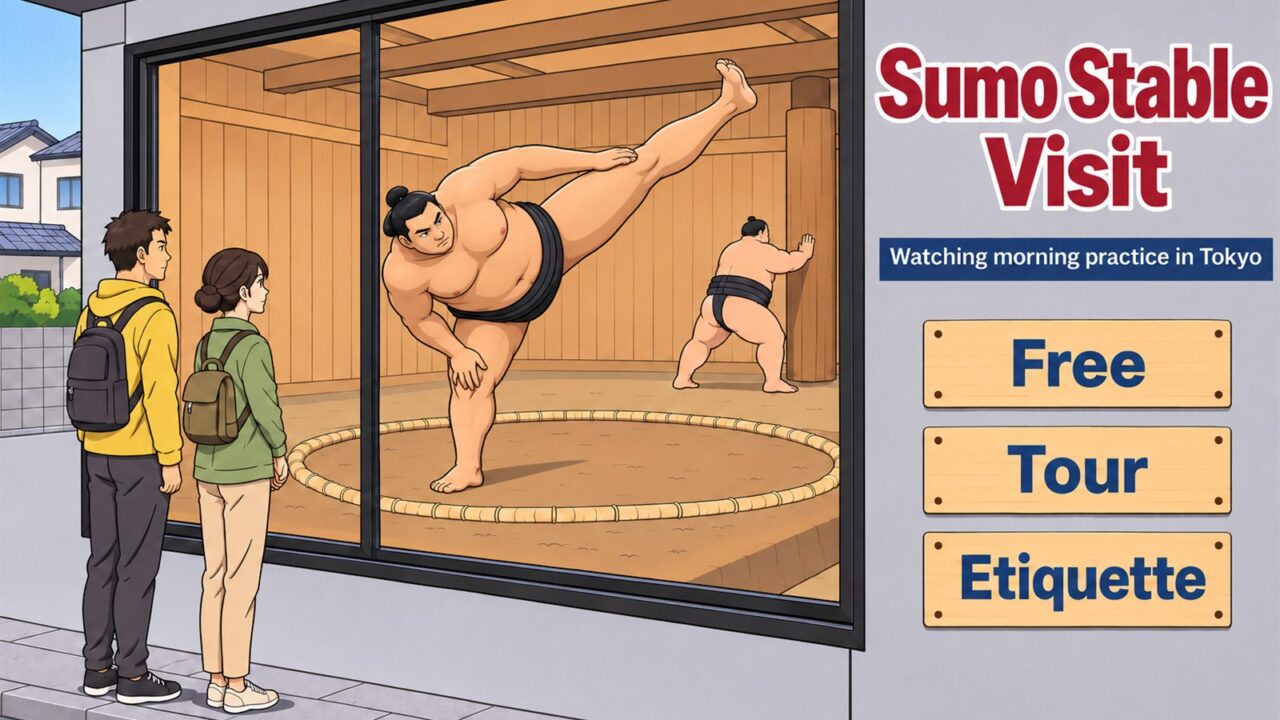
Through the window, not inside
Free viewing does not take you inside the stable. You watch from outside, through a full-length window. Viewing is open to women and men alike.
Source: Arashio Beya, practice viewing guide (in Japanese)
Standing outside may sound like being kept at arm’s length. From the side that welcomed visitors, though, it does not look that way to me.
At my own stable, during the tournaments away from Tokyo, lots of people stood and watched from outside the windows or from the street. Our practice spaces at the regional lodgings were simple, more like tents or prefab buildings, and there was little room to sit, so I think standing just became the natural way to watch. Our stable in Tokyo, by contrast, was part of a house, so it was built differently from the start.
Seen from that side, a window is not a way of keeping visitors out. It is one ordinary way of letting people see practice as it is.
The four requests
Watching from the street has manners of its own, set out as four requests in the English guide.
- Please keep quiet
- No flash
- Please refrain from eating and drinking
- Please do not sit on the stairs of our neighbor’s house
The fourth is the most specific. Since you wait outside, the steps beside you may well lead into someone’s home.
When the stable is not in Tokyo
All of this applies only while the stable is in Tokyo. Tokyo stables move to lodgings in the region for the tournaments held in March in Osaka, July in Nagoya and November in Fukuoka, and they practice there for the weeks around each one. For the March tournament, Arashio Beya lodges at Otori Taisha, a shrine in Sakai, Osaka. March 2026 was its fifth year there.
Source: Arashio Beya, notice on the March 2026 tournament (in Japanese)
The sekitori, the wrestlers of the top two divisions, also leave the stable with their attendants during the jungyo, the regional tours. Stables sometimes leave Tokyo for training camps as well.
Put together, these are the times you cannot count on practice in Tokyo.
On a phone, swipe sideways to see the whole table
| When | Where the stable is | Can you watch in Tokyo? |
|---|---|---|
| The March tournament and the weeks around it | Lodgings for the March tournament, held in Osaka | No |
| The July tournament and the weeks around it | Lodgings for the July tournament, held in Nagoya | No |
| The November tournament and the weeks around it | Lodgings for the November tournament, held in Fukuoka | No. As of November 8, 2026, there is no practice in Tokyo until December |
| The regional tours | The sekitori and their attendants are on tour | Check the practice calendar |
| Training camps | At the camp | No |
Read the other way, the weeks before the January, May and September tournaments, the three held in Tokyo, are when the stable is at home. Even then, some days have no practice.
How long the stable is away follows a pattern. A stay at the regional lodgings usually runs from just before the banzuke, the ranking sheet, comes out until a week after the final day, more than a month in all. That puts the wrestlers away from Tokyo from around late February to late March, late June to late July and late October to late November. Many stables, it seems, also take the week after the final day off. These are general patterns described in 2015, and every stable keeps its own timing.
Source: Ozumo Shireba Shiru Hodo (“Sumo” editorial dept., Baseball Magazine Sha, 2015), p.120
For the exact days, the 2027 tournament dates and the months of the regional tours are in my guide to the sumo schedule.

Getting to Arashio Beya
Arashio Beya stands at 2-47-2 Nihonbashi-Hamacho, Chuo-ku, Tokyo. Hamacho Station is the closest, and Ningyocho and Suitengumae stations are within walking distance too. Each station has its own exit and walking time.
On a phone, swipe sideways to see the whole table
| Line | Station and exit | On foot |
|---|---|---|
| Toei Shinjuku Line | Hamacho Station, Exit A2 | 1 min |
| Tokyo Metro Hibiya Line | Ningyocho Station, Exit A1 | 6 min |
| Toei Asakusa Line | Ningyocho Station, Exit A3 | 8 min |
| Tokyo Metro Hanzomon Line | Suitengumae Station, Exit 7 | 8 min |
Source: Arashio Beya, access (in Japanese)
Parking is another matter. The road in front of the stable is a no-parking zone, so if you come by car, use a car park nearby, such as the ward-run underground car park at Hamacho Park.
One minute from Hamacho Station sounds easy enough, even for a first-timer like me.
The early start is the hard part. I’d better look at that calendar the night before.
Going inside: guided sumo morning practice tours
Free viewing keeps you on the street side of the glass. If you would rather sit inside and have someone explain what you are watching, there is a guided tour of Arashio Beya’s morning practice, run by the Tokyo Chuo City Tourism Association. The stable’s English page links to the tour’s booking page.
The tour costs ¥15,000 per person, tax included, and takes up to six people. Children under 11 cannot take part. Bookings close seven days before the date, and the full price is paid in advance. If you cancel for personal reasons, the fee is not refunded. If the tour itself has to be cancelled, the organizer tries to offer another date or itinerary, and otherwise refunds the fee.
On the day, the group meets at 7:45 a.m. at Exit A2 of Hamacho Station, at street level, and reaches the stable at 8:00 a.m. You watch from seats inside, while a guide on the other side of a glass wall explains through earphones. After practice, there may be a chance to take photos with the wrestlers.
Sitting inside also means following the tour’s own rules.
- Stay seated and quiet, and do not leave your seat
- No video. Photos only with the shutter sound off, and no flash
- No eating or drinking
- Take off sunglasses and hats
- Anyone feeling unwell cannot take part
Set beside the free viewing, the differences look like this.
On a phone, swipe sideways to see the whole table
| Free viewing | Guided tour | |
|---|---|---|
| Where you watch | Outside, through the window | Seats inside the stable |
| Commentary | None | A guide behind the glass, through earphones |
| Booking | Not needed | At least seven days ahead, paid in full |
| Price | Free | ¥15,000 per person, tax included |
| Age | Not mentioned in the stable’s guide | Not open to children under 11 |
| Photos and video | No flash | No video. Photos with the shutter sound off, no flash |
Source: Tokyo Chuo City Tourism Association, Sumo Morning Practice Tour in Arashio Stable
As of November 9, 2026, the booking page shows the tour as sold out, and its list of dates still shows four days in October 2026. The page also says the tour is not held in odd-numbered months, the months of the grand tournaments. For the next dates, check the booking page itself.
With the city’s tour, the money is not for the practice itself. Watching Arashio Beya’s practice costs nothing, so the ¥15,000 pays for the guided experience, a seat inside with live commentary, and perhaps a photo with the wrestlers afterwards. If you want to understand what you are seeing, or would feel unsure going alone the first time, that may well be worth it. Some travel companies also sell their own tours to watch sumo practice.
Sumo stable etiquette, from the side that welcomed visitors
Whichever way you watch, one idea sits under all the manners. Anything that distracts the wrestlers from serious practice goes against the etiquette of watching. Practice is not entertainment, and it is not fan service either, so go with the feeling that you are being allowed to see it.
Source: Zenbu Wakaru Ozumo Guide (Tanaka Akira, Seibido Shuppan, 2019), p.19
I saw those manners from the other side of the room. From here on, this is about my own stable, in the years I was wrestling.
This was more than 20 years ago. At the stable I belonged to, there were more than 25 wrestlers at the busiest times. Morning practice started early, too, sometimes around 4:30 a.m., with the lower-ranked wrestlers going first.
Even we overslept every so often, and yet some keen visitors came to watch from the very start.
Visitors came in quietly through the front entrance and sat on the raised tatami floor overlooking the ring. When they arrived, one of the lower-ranked wrestlers, or a gyoji (referee), a yobidashi (ring attendant) or a tokoyama (hairdresser), would bring them a zabuton, a floor cushion. That was just how things were.
As far as I remember, wrestlers and visitors were close, and we talked quite naturally. The whole stable had a friendly feel, and I feel fans were nearer to us back then.
From time to time, though, a visitor would talk to us far too much, or sit with their legs stretched out, and that was a problem. When it happened, one of us lower-ranked wrestlers had to deal with it before a senior wrestler had to say anything. If we didn’t, we could get scolded, so honestly, we were pretty careful about it.
Sit properly
If you are ever shown to a raised floor inside a stable, how you sit matters. Sit in seiza, kneeling with your legs folded under you, or sit cross-legged, and do not stretch your legs out in front of you.
That is a matter of manners, and it is also about your own safety. During practice a wrestler can come flying out of the ring, and sitting properly helps keep you from getting hurt when something unexpected happens. Sitting that way also keeps your feet from pointing at the ring or the wrestlers, which is another thing to avoid. Wherever you are seated, follow the stable’s instructions.
Keep quiet, and no flash
Quiet means more than not talking loudly. A whisper grates more than you might expect, and a mobile phone should be switched off, not just set to silent.
Photos are a different matter. My own view is that a photo does no harm as long as there is no flash and no clicking shutter, but I think the rules differ from one stable to another. More than once, fans have given me photos they took during practice.
Still, that is how I feel, not a rule. Arashio Beya and the guided tour each set the limits described above. At other stables, the safe course is to hold back on photos, ask first if you want to take any, and skip the flash even when you are given the go-ahead.
Whatever my own view, the rules of the place you visit come first.

It was nice having people come to watch. Honestly, though, little noises and whispering in the practice room could break my focus sometimes.
Thinking back on that, having people watch from outside the window makes sense to me.
Do not call out to the wrestlers
Calling out to a wrestler during practice is a no. He is concentrating on what he is doing, and breaking that concentration can lead to a serious injury.
Source: Tokyo Chuo City Tourism Association, Sumo Morning Practice Tour in Arashio Stable
The same goes for the way out. Even if you want to say thank you as you leave, I would go with a quiet bow. A word at the door can still break the concentration of someone in the middle of practice. If you are watching from outside the window, I think it is fine to simply step away quietly.
If you are watching inside a stable, a few more points are worth checking before you set out. If you are watching from outside the window, the four requests above are the ones to follow.
- Do not eat or drink
- Stay in your seat, and go to the toilet beforehand
- Take off your hat and sunglasses
- Keep out of the ring and the practice area, where shoes are never worn
- Stay home if you are feeling unwell
What you’ll see at sumo morning practice
Asa-geiko, morning practice, generally runs from around 6:00 a.m. until a little after 10:00 a.m. The lower-ranked wrestlers start first, and the sekitori join from a little after 8:00 a.m. The details differ from stable to stable.
Source: Zenbu Wakaru Ozumo Guide (Tanaka Akira, Seibido Shuppan, 2019), p.19
The length of the morning differs as well. Some stables finish a little after 8:00 a.m., while others keep going past noon.
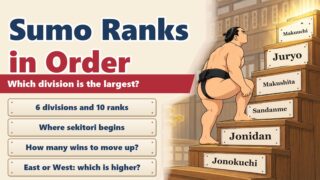
The ranks behind that order, from the lowest division up to yokozuna, are laid out in my guide to sumo ranks.
Shiko, suriashi and teppo
Among the basic exercises, three are worth knowing by name before you go.
- Shiko, the leg-stamping, raising each leg in turn and bringing it down hard
- Suriashi, moving forward with the feet sliding along the ground, never lifted
- Teppo, thrusting the palms against a wooden pillar, again and again
The Association’s English channel has a guide that takes the three one at a time.
It runs a little over nine minutes and dates from August 2024. Shiko comes at 1:09, suriashi at 4:22 and teppo at 6:37.
Sanban-geiko, moshiai and butsukari-geiko
Practice with a partner comes in several forms, and three of them have names you will hear in the practice room.
In sanban-geiko, two wrestlers close in strength take each other on bout after bout, sometimes 20 or 30 times in a row.
Moshiai is a winner-stays format. The winner stays in the ring and names his next opponent, while the loser steps out.
Butsukari-geiko pairs a wrestler who charges with one who receives. The charging wrestler drives into his partner’s chest again and again and pushes him across the ring, then is rolled over at the end to learn how to fall without getting hurt.
Source: Sumo Daijiten, 4th ed. (Kanazashi Motoi, Gendai Shokan), entries Sanban-geiko, Moshiai, Butsukari-geiko
Traditionally, wrestlers do all of this before the first meal of the day, on an empty stomach. What they eat once practice is over, and why breakfast is skipped, is in my article on the sumo wrestler diet.

FAQ: Sumo stable visits
Q1. Can tourists visit a sumo stable?
A. Yes, at stables that open their practice to the public. Arashio Beya in Tokyo has a viewing guide in English and asks for no booking. Visitors from abroad came to my stable too, and I never gave it much thought.
Q2. Is a sumo stable visit free?
A. At Arashio Beya, yes. Watching from outside through the window costs nothing and needs no reservation. The guided tour that takes you inside costs ¥15,000 per person.
Q3. What time should I arrive?
A. At Arashio Beya, viewing runs from 7:30 a.m. to about 9:00 a.m. Check the practice calendar the day before and again that morning, because practice can be called off at short notice.
Q4. Can women and children visit?
A. Women can watch at Arashio Beya on the same terms as men. The stable’s guide says nothing about children. The guided tour does not take children under 11.
Q5. Can I take photos or videos?
A. At Arashio Beya, the request is no flash, and the guide says nothing more about photography. On the guided tour, video is not allowed, and photos must be taken with the shutter sound off and no flash. At any other stable, ask before you take a picture.
Q6. How can I be sure to see practice?
A. At Arashio Beya, there is no guaranteed way, because the stable does not promise practice on any given day. Check its calendar the day before and on the morning itself. At another stable, one option is to join its supporters’ association or fan club. Some stables plan practice viewing for members, but what members get differs, so check first.
Practice is one side of sumo, and the bouts of a grand tournament are another. How to buy tickets for those in English, and which seat to pick, are in my guide to sumo tickets.

Final thoughts
A practice room has an air all its own. I spent years inside one, and just picturing myself walking up to one as a visitor is enough to make me nervous.
Having been on the other side, I also know what a visitor brings into that room. On mornings when someone was watching, I felt it, and my body moved more easily than usual, even though all the visitors did was sit and watch.
So if you find yourself outside that window in Hamacho on a practice morning, or in a seat inside on the tour, there is nothing special you need to do for the wrestlers. Keep still and keep quiet. Watching in silence, you are already part of that morning’s practice.

When you go, look at the wrestlers’ feet.
Strength begins at the ground.