Heaviest Sumo Wrestler Ever: The Biggest Sumo Wrestler in History at 292.6 kg (645 lb), and What It Was Like to Face Him, from a Former Rikishi
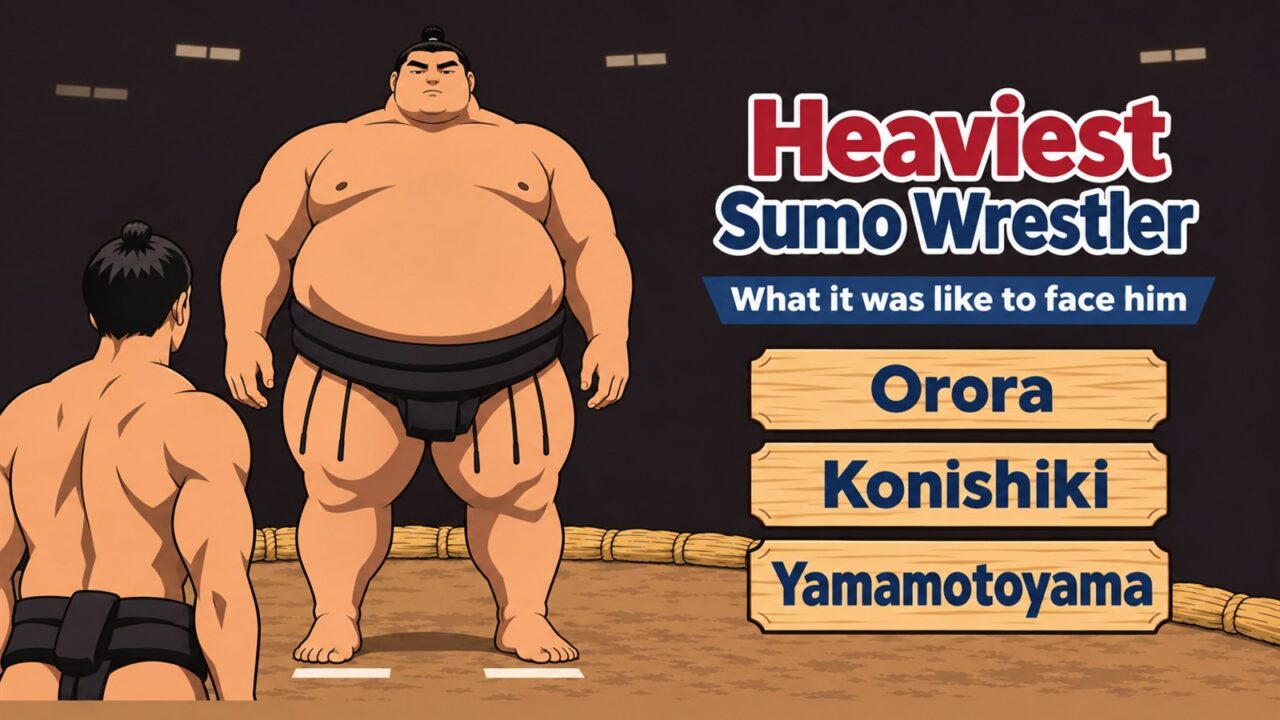
In my years as a wrestler I faced big men many times. The one I cannot forget is Orora.
His heaviest recorded weight was 292.6 kg (645 lb). On paper that number may not mean much, but when I stood across from him on the dohyo, the ring, he was a wall. To be honest, the tachiai, the initial charge, scared me quite a bit. I weighed about 86 kg (190 lb) at the time.
The first thing I thought when I stepped down from the ring was that I was glad I had not been hurt.
Hello, I’m Shinzaburo, a former sumo wrestler.
The heaviest professional sumo wrestler on record is Orora, who weighed 292.6 kg (645 lb) at a health check in August 2018. So why does the same wrestler turn up at one weight in one place and at a different weight in another?
This article looks at who the heaviest sumo wrestler ever is, who the biggest sumo wrestlers in history are, why their numbers do not always agree, and what happened when I faced Orora in the ring myself.

645 lb? I can’t even picture that.
It’s like three or four copies of the biggest guy at my gym, all standing in one spot.

Who is the heaviest sumo wrestler ever?
The heaviest sumo wrestler ever recorded is Orora Satoshi, a rikishi (professional sumo wrestler) from Buryatia in Russia. At a health check in August 2018 he weighed 292.6 kg (645 lb), a weight no one else in professional sumo has on his record.
He was also the first rikishi to come from Russia. He arrived in Japan at the end of 1999 through Paul Maki, a comedian who was a friend of the former yokozuna Kitanoumi, and he was scouted by Kitanoumi, who was running his own stable as an oyakata, a stablemaster. Yokozuna is the highest rank in sumo. Orora’s first tournament was March 2000.
Both halves of his ring name come from those two men. Orora, written 大露羅, was chosen by Paul Maki with the aurora in mind, and the given name Satoshi, 敏, is one character taken from Kitanoumi’s own real name.
Source: Guinness World Records, “Heaviest sumo wrestler” / Sports Hochi, “Former Orora, sumo’s heaviest ever, loses 100 kg” (April 17, 2020, in Japanese)
Orora’s profile
Orora retired in 2018, and his official profile still carries the following figures.
On a phone, swipe sideways to see the whole table
| Item | Orora |
|---|---|
| Ring name | Orora Satoshi |
| Real name | Anatoly Mikhakhanov |
| Born | April 26, 1983 |
| From | Buryatia, Russia |
| Height | 191 cm (6 ft 3 in) |
| Weight | 292.6 kg (645 lb) |
| Stable | Yamahibiki stable (Kitanoumi stable at his debut) |
| Debut | March 2000 |
| Highest rank | Makushita 43 |
| Retired | September 2018 |
Source: Nihon Sumo Kyokai, profile of Orora (in Japanese)
The weight on that profile is the figure from one health check. It is not what he weighed throughout his career.
The day the scale read 292.6 kg
On August 27, 2018, the active wrestlers had their regular health check at the Kokugikan, the sumo arena in Tokyo. Orora was 35. When he stepped on the scale it read 292.6 kg (645 lb), and no wrestler in professional sumo had ever been measured above 290 kg (639 lb) before.
The record he broke that day was his own. At the same health check a year earlier he had weighed 288.8 kg (637 lb), which had already taken him past the 285 kg (628 lb) of the former ozeki Konishiki. Ozeki is the second-highest rank.
Orora himself, however, was not satisfied. Two days earlier, by his own account, a scale had shown him at 295 kg (650 lb), and he put his disappointment like this (quotations from Japanese-language sources in this article are my own translations).
“I thought it would be higher. It’s strange. I won’t go past 300 kilos.”
He added that late on the night before the check he had eaten two onigiri, rice balls, and only afterwards remembered that the check was coming.
Kitanoumi had always told him to be number one at something, and to pass Konishiki. Having done both, Orora said what the record meant to him.
“It’s fun. You can’t do this unless you’re a sumo wrestler. For a yokozuna or an ozeki, it’s about winning. For me, it’s enough if my name stays forever for my weight.”
Source: Daily Sports, “Orora hits 292.6 kg, the first ever over 290” (August 28, 2018, in Japanese)
The biggest sumo wrestlers in history
Orora is at the top, so how do the other famously heavy wrestlers compare? No official list ranks every wrestler in history by weight. What I did instead was look up official profiles one wrestler at a time, and the table below holds the eight I checked, in order of the weight each profile lists. It is those eight, not an all-time top eight.
On a phone, swipe sideways to see the whole table
| Ring name | Listed weight | Highest rank | From |
|---|---|---|---|
| Orora | 292.6 kg (645 lb) | Makushita 43 | Buryatia, Russia |
| Konishiki | 275.0 kg (606 lb) | Ozeki | Hawaii, USA |
| Yamamotoyama | 266.0 kg (586 lb) | Maegashira 9 | Saitama, Japan |
| Dewanojo | 252.0 kg (556 lb) | Makushita 44 | Tochigi, Japan |
| Musashimaru | 235.0 kg (518 lb) | Yokozuna | Hawaii, USA |
| Akebono | 233.0 kg (514 lb) | Yokozuna | Hawaii, USA |
| Kenho | 228.0 kg (503 lb) | Makushita 59 | Miyagi, Japan |
| Ichinojo | 219.0 kg (483 lb) | Sekiwake | Mongolia |
Source: Nihon Sumo Kyokai, official rikishi profiles, starting with Konishiki (retrieved November 12, 2026)
Reading down the rank column, three of the eight, Orora, Dewanojo and Kenho, stopped in makushita and never became sekitori, the salaried wrestlers of the top two divisions. Two of the eight are yokozuna, Musashimaru and Akebono, and both come from Hawaii.
Konishiki, the heaviest in the top division
Among the wrestlers who fought in makuuchi, the top division, the heaviest is the former ozeki Konishiki, who is also from Hawaii. His official profile lists 275.0 kg (606 lb).
During his career, though, he was measured at 285 kg (628 lb), and that figure is the record for the top division. It stood as the heaviest weight in all of professional sumo until Orora passed it in August 2017.
Source: The Japan Times, “Sumo 101: Large rikishi” (May 22, 2019)
Yamamotoyama, the heaviest Japanese-born wrestler
Third in the table, and the heaviest Japanese rikishi in history, is Yamamotoyama at 266 kg (586 lb). He came out of Nihon University, turned professional in 2007 and climbed to maegashira 9, maegashira being the rank that most top-division wrestlers hold. After his dismissal from professional sumo for match-fixing he moved to the United States, where he became known simply as Yama. By January 2020 he had appeared on many television shows there, in music videos for Ed Sheeran and One Direction, and in one of the John Wick films alongside Keanu Reeves.
Source: The Japan Times, “Yama succeeds after sumo” (January 18, 2020)
Why the numbers differ from site to site
The same wrestler can carry two different weights, and both can be correct. The weight on an official profile is the result of one measurement on one day, so it is not always the heaviest that wrestler ever was.
Two men from the table show how that works.
- Konishiki is listed at 275.0 kg (606 lb) on his profile, but he was measured at 285 kg (628 lb) during his career
- Orora weighed 288.8 kg (637 lb) in August 2017, then 292.6 kg (645 lb) in August 2018
Which figure you meet depends on which day it was taken from. For that reason the table above uses one yardstick for everybody, the weight on the official profile, and I would not set a profile weight for one wrestler against a career-high weight for another.
I’d seen two weights for the same wrestler and assumed somebody had typed one in wrong.
My own weight isn’t the same in the morning and at night, so I should have guessed.
Outside professional sumo
One name from outside the professional ranks comes up whenever the biggest sumo wrestlers are discussed. Emmanuel Yarbrough, from Virginia in the United States, competed in amateur sumo and was world champion in 1995. He stood 203 cm (6 ft 8 in), weighed as much as 400 kg (882 lb) and held the Guinness record for the heaviest athlete. He died in 2015.
Yarbrough was never a rikishi in professional sumo, however, so his weight belongs to a different record from Orora’s.
Source: The Japan Times, “Sumo 101: Large rikishi” (May 22, 2019)
Who is the heaviest sumo wrestler right now?
Among active wrestlers, the answer comes with a date. The banzuke, the ranking sheet, is rewritten for every tournament, and the heaviest name can change with it. What follows is as of the November 2026 tournament.
Across all six divisions, the heaviest active wrestler is Hakuomaru at 222.7 kg (491 lb), ranked sandanme 49. Sandanme is the fourth of the six divisions. I went through the official profiles of all 593 wrestlers on the banzuke, and only three of them are listed at 200 kg (441 lb) or more.
- Hakuomaru 222.7 kg (491 lb), sandanme 49
- Hogasho 204.9 kg (452 lb), makushita 56
- Kazuma 202.0 kg (445 lb), juryo 4
Juryo is the second division, one step below makuuchi. Even Hakuomaru is about 70 kg (154 lb) lighter than Orora was in August 2018.
In makuuchi itself, nobody reaches 200 kg (441 lb). The heaviest wrestler there is Atamifuji at 198 kg (437 lb), who holds the rank of sekiwake, the third-highest in sumo.
Source: Nihon Sumo Kyokai, official rikishi profiles (retrieved November 12, 2026)
As for the rest of the top division, I have put together a guide to sumo wrestler weight, with the average of all 42 makuuchi wrestlers and the ten heaviest and ten lightest among them.
How big is 292.6 kg in the ring?
A weight like Orora’s is hard to picture from a table, so here he is on the dohyo. The bout below is from the final day of the November 2017 tournament, about three months after the health check at which he weighed 288.8 kg (637 lb).
<千秋楽>序二段取組。大露羅 突き倒し 上戸。#sumo pic.twitter.com/EudW5xUx30
— 日本相撲協会公式 (@sumokyokai) November 26, 2017
The caption gives the result, a win for Orora by tsukitaoshi, a thrust-down. The part to watch comes before that, in the moment when the two men stand facing each other.
His opponent, Kamito, was a jonidan wrestler like Orora, jonidan being the second-lowest of sumo’s six divisions, and he was in his first year as a professional. Kamito’s profile for the November 2026 tournament lists him at 178 cm (5 ft 10 in), 155.1 kg (342 lb), though what he weighed on the day of this bout I do not know.
Source: Nihon Sumo Kyokai, profile of Kamito (in Japanese)
Sumo has no weight classes, which is how a pairing like this one comes about. It is also how I came to face him.
Heavier does not mean higher
For all that weight, Orora’s highest rank was makushita 43. Makushita is the highest division in which wrestlers receive no monthly salary, and he never crossed into the salaried ranks above it.
What he did instead was keep going. From his debut in March 2000 to his retirement in September 2018, he stepped onto the dohyo for eighteen and a half years.
For most of those years his stablemaster was Kitanoumi. Soon after Orora came to Japan, his father died back home, and he asked his stablemaster whether he could call him Oyaji, Dad. From then on he did. Kitanoumi died on November 20, 2015. A year before that, Orora had promised him that he would keep wrestling until Kitanoumi reached the retirement age of 65, a birthday that would have fallen on May 16, 2018.
Orora announced his retirement on September 21, 2018. He had lost his first six bouts of that tournament, and he won the seventh, his last. That day he said this about his stablemaster.
“I came from abroad and I was never strong, but getting into Kitanoumi stable was the best thing. It’s what I’m most grateful for.”
Source: Daily Sports, “Orora, the heaviest rikishi ever, retires” (September 21, 2018, in Japanese)

Sumo is hard on the knees and the lower back at any weight. Mine complained, and I was one of the small ones.
I can’t imagine carrying his weight up there for that long.
Where makushita and jonidan sit among the six divisions is something I explain in more detail in my guide to sumo ranks.
What it was like to face the heaviest sumo wrestler
From here on, this is not about records. It is about what I felt on the dohyo when I faced Orora, and the numbers are few. I weighed about 86 kg (190 lb) at the time. I do not know what Orora weighed on the day we met, but his record of 292.6 kg (645 lb) is about 3.4 times that.
At the tachiai I went in head first. I could not feel my force reaching him at all. I was the one doing the pushing, and yet it felt as if I was the one going backward.
Even so, I hit him and pushed, hit him and pushed, again and again. Little by little, that brought him to the edge of the dohyo.
At the edge I took a shitate, an inside grip on his mawashi, the belt, and went for a throw.
He was so heavy that his body did not move. My fingers slipped clean out of his mawashi, and I ended up with my back turned to him.
“This is bad.”
I spun around at once to fight on. But Orora had already lost his balance, and both of his hands were on the dohyo. I never saw the moment it happened, because I was facing the other way.
For a long time afterwards I believed that bout had ended in a hikiotoshi, a pull-down. I had no sense at all of having thrown him.
That feeling of force going nowhere is one I also met in practice, with a different opponent. However hard I charged, the impact seemed to be soaked up before it got through, and when I pushed, the force spread out instead of driving him back. Practicing with him left me very tired.
When I stepped down after facing Orora, relief came before any happiness at having won. I still shudder when I think of a body that size coming down on top of me.
Ending up with your back to the other man is the scariest shape there is. If he pushes you then, there’s nothing you can do.
My shoulders went stiff just reading that.
Orora after sumo
After his retirement in September 2018, Orora went home to Buryatia. The next figure for his weight comes from Orora himself. In April 2020 he posted on his own Twitter account that he weighed 190 kg (419 lb), along with footage of his training with weights and logs.
“My weight is now 190 kilos!”
That was about 100 kg (220 lb) less than his record. When he first arrived in Japan in December 1999 he had weighed 193 kg (425 lb), so as of April 2020 he was back to almost exactly the body he came with.
The reports that follow are about his work, not his weight. In an interview published in December 2025, he said he was living in Buryatia. After going home he had run a business and had then become what he called an “intellect trainer”. He and his wife, whom he met in 2024, were thinking about work as hosts for ceremonies and events. In February 2026 a local outlet reported that he had started a blog on Telegram and was traveling around Buryatia.
Source: Sports Hochi, “Former Orora loses 100 kg” (April 17, 2020, in Japanese) / Aginskaya Pravda, interview with Anatoly Mikhakhanov (December 5, 2025, in Russian) / MK Ulan-Ude (February 24, 2026, in Russian)
FAQ: Heaviest sumo wrestler
Q1. Who is the biggest sumo wrestler in the world?
A. In professional sumo, it is Orora, a former rikishi from Buryatia in Russia. He was measured at 292.6 kg (645 lb) in August 2018, the heaviest weight recorded there. If amateur sumo is included, Emmanuel Yarbrough of the United States was heavier, at as much as 400 kg (882 lb).
Q2. How much did the heaviest sumo wrestler weigh in pounds?
A. Orora weighed 645 lb, which is 292.6 kg, or 46 stone 1 lb. A year earlier he had weighed 637 lb (288.8 kg).
Q3. Who is the heaviest Japanese sumo wrestler?
A. Yamamotoyama, from Saitama, at 266 kg (586 lb). His highest rank was maegashira 9 in the top division.
Q4. Who is the heaviest yokozuna?
A. On official profiles, it is Musashimaru at 235 kg (518 lb), just ahead of Akebono at 233 kg (514 lb). Both are former yokozuna from Hawaii.
Q5. Is there a weight limit in sumo?
A. No. Sumo has no upper weight limit and no weight classes. That is how I, at about 86 kg (190 lb), could be matched with Orora, whose heaviest recorded weight was 292.6 kg (645 lb).
Summary
292.6 kg (645 lb) is a number that was read off a scale on one day in August 2018. Around that day lie eighteen and a half years on the dohyo, a stablemaster he called Oyaji, and a final bout that he won.
I know none of that from the inside. What I know is the short time I spent facing him, when my charge went nowhere, my fingers came out of his mawashi, and I turned around to find him already down. And I know how relieved I was to step off the dohyo unhurt.
The next time a list of the biggest sumo wrestlers comes your way, check the date beside each weight before you compare them.

He never reached the salaried ranks. His name remains all the same.
Find the one thing you can be first at.