Sumo Wrestler Weight: How Much Sumo Wrestlers Weigh, Heaviest to Lightest, from a Former Rikishi
I entered sumo at 78 kg (172 lb), small for a wrestler, and I left seven years later at 96 kg (212 lb). That is about 60% of what the average top-division wrestler weighs today. So why did I stop there? Looking back, I think I took eating too lightly.
Hello, I’m Shinzaburo, a former sumo wrestler.
A sumo wrestler’s weight, averaged across makuuchi, the top division, comes to about 159 kg (350 lb) as of the November 2026 tournament. But how heavy is the heaviest, how light is the lightest, and does more weight mean a higher rank?
This article uses the official profiles of all 42 top-division wrestlers to work out the average and find the heaviest and lightest, looks at what a wrestler’s body is actually made of, and tells how I gained my own 18 kg (40 lb) as a wrestler.

350 lb is the average? The biggest guy at my gym is maybe half of that.
Now I really want to know what the heaviest one weighs.

- How much does a sumo wrestler weigh?
- The heaviest and lightest sumo wrestlers right now
- Not just fat: what a sumo wrestler’s body is made of
- The heaviest sumo wrestlers in history
- How sumo wrestlers gain weight
- From 78 kg to 96 kg: my own weight as a wrestler
- FAQ: Sumo wrestler weight
- Q1. What is the average weight of a sumo wrestler?
- Q2. Who is the heaviest sumo wrestler ever?
- Q3. Who is the lightest wrestler in the top division right now?
- Q4. Are there weight classes in sumo?
- Q5. How much weight do sumo wrestlers gain after joining?
- Q6. How tall is the average sumo wrestler?
- Q7. Do sumo wrestlers lose weight after they retire?
- Summary
How much does a sumo wrestler weigh?
The answer moves a little every two months, because the banzuke, the ranking sheet, is rewritten for each tournament and the 42 wrestlers in the top division change with it. The numbers below are all for one moment in time.
Before the numbers, one bout shows how wide the range is. On the final day of the September 2026 tournament, Atamifuji 熱海富士, now the heaviest man in the division at 198 kg (437 lb), met Fujinokawa 藤ノ川, one of the lightest at 125 kg (276 lb). Both are sekiwake, the third-highest rank, on the November banzuke.
The footage is from the Nihon Sumo Kyokai’s official channel. Now to how the other 40 are spread out between those two.
The average in the top division is about 159 kg (350 lb)
I took the 42 wrestlers listed in makuuchi on the current banzuke and looked up each one’s official profile. Added up and divided, they come to this.
- Average weight 158.8 kg (350 lb)
- Average height 184.6 cm (6 ft 1 in)
- Heaviest Atamifuji, 198 kg (437 lb), sekiwake
- Lightest Asasuiryu 朝翠龍, 120 kg (265 lb), maegashira 13
- As of the November 2026 tournament (banzuke released October 26, 2026, profiles retrieved November 3, 2026)
Source: Nihon Sumo Kyokai, official rikishi profiles (retrieved November 3, 2026)
Maegashira 13 sits in the lower half of the division. Between the heaviest man and the lightest there is a gap of 78 kg (172 lb), which happens to be exactly what I weighed on the day I entered sumo.
Most wrestlers fall between 140 and 180 kg
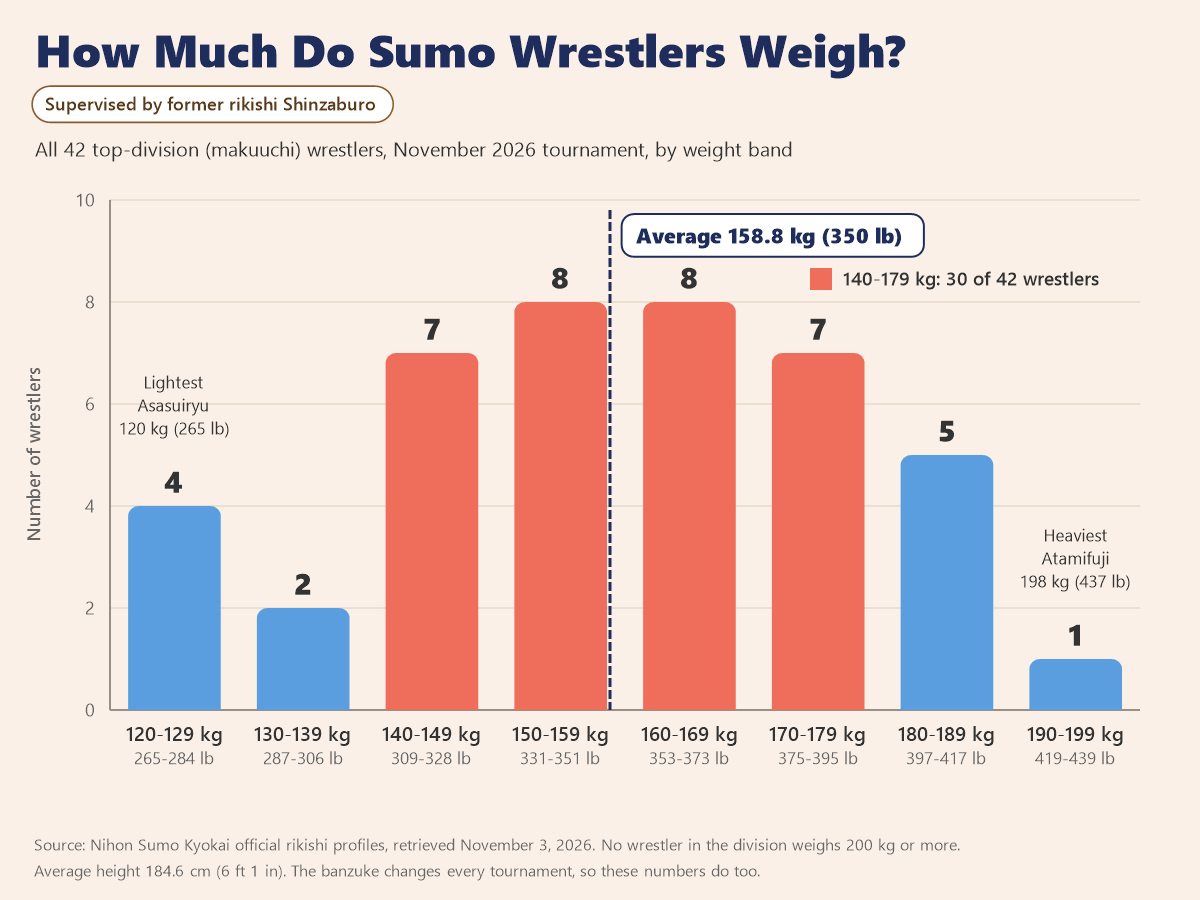
An average on its own hides how the 42 are spread out, so here they are in 20 kg (44 lb) steps.
On a phone, swipe sideways to see the whole table
| Weight band (kg) | Weight band (lb) | Wrestlers |
|---|---|---|
| 120 to 139 | 265 to 306 | 6 |
| 140 to 159 | 309 to 351 | 15 |
| 160 to 179 | 353 to 395 | 15 |
| 180 to 199 | 397 to 439 | 6 |
| 200 and over | 441 and over | 0 |
Thirty of the 42, about seven in ten, sit between 140 and 179 kg (309 and 395 lb). Only six are under 140 kg (309 lb), and nobody in the division is at 200 kg (441 lb) or above this tournament. The same spread in finer steps looks like this.
There are no weight classes
Unlike judo, boxing or Olympic wrestling, sumo has no weight classes. Atamifuji at 198 kg (437 lb) and Fujinokawa at 125 kg (276 lb) hold the same rank of sekiwake this tournament, and as the video above shows, nothing in the rules keeps them apart. Who you face is decided by rank and by how the tournament is going, not by weight. The standing restrictions are about who you are, not what you weigh. Wrestlers from the same stable are not paired, and neither are close relatives such as brothers, even when the brothers belong to different stables, except in a playoff for the championship.
Source: Sumo Daijiten, 4th ed. (Kanazashi Motoi, Gendai Shokan), entry “Heya-betsu soatari-sei” (the same-stable rule, in force since January 1965), and Nihon Sumo Kyokai, Grand Sumo Quiz No. 674 (in Japanese): no regular bouts between relatives within the fourth degree of kinship
For how that banzuke is built, from yokozuna at the top down to the lowest divisions, see my guide to sumo ranks.

The 2013 measurement gave almost the same average
The 158.8 kg (350 lb) above comes from profiles. A measurement taken for research also exists. In December 2013, a university sports medicine team weighed and measured 25 top-division wrestlers and found an average height of 186.3 cm (6 ft 1 in) and an average weight of 161.2 kg (355 lb).
Source: Keio University Sports Medicine Research Center, Newsletter No. 16 (March 2014, in Japanese)
The two averages are close, but they were not taken the same way. One is 42 official profiles in 2026 and the other is 25 wrestlers on a research scale in 2013, so I would not read them as proof that nothing has changed in 13 years. What they do show is that an average somewhere around 160 kg (353 lb) is not a one-off.

Seen as a chart like that, I was way down at the left end.
Back in the practice ring, finding someone smaller than me was the hard part.
The heaviest and lightest sumo wrestlers right now
Now to the two ends of that chart. Both lists come from the same official profiles as above, for the November 2026 tournament, and like the average they will change at the next banzuke.
Heaviest 10 in the top division
The top of the list is the sekiwake we have already met.
On a phone, swipe sideways to see the whole table
| # | Ring name | Rank | kg | lb |
|---|---|---|---|---|
| 1 | Atamifuji | Sekiwake | 198 | 437 |
| 2 | Onosato | Yokozuna | 188 | 414 |
| 3 | Oho | Maegashira 10 | 185 | 408 |
| 4 | Fujiryoga | Maegashira 1 | 184 | 406 |
| 5 | Shishi | Maegashira 10 | 182 | 401 |
| 6 | Kinbozan | Maegashira 7 | 181 | 399 |
| 7 | Tamawashi | Maegashira 15 | 178 | 392 |
| 8 | Kotozakura | Ozeki | 177 | 390 |
| 9 | Takanosho | Maegashira 11 | 176 | 388 |
| 10 | Takayasu | Maegashira 3 | 173 | 381 |
Below Atamifuji, the ranks run from yokozuna Onosato, who holds the highest rank in sumo, down to Tamawashi at maegashira 15, in no particular order.
Lightest 10 in the top division
The other end of the division is the list worth reading twice.
On a phone, swipe sideways to see the whole table
| # | Ring name | Rank | kg | lb |
|---|---|---|---|---|
| 1 | Asasuiryu | Maegashira 13 | 120 | 265 |
| 2 | Asakoryu | Maegashira 9 | 122 | 269 |
| 3 | Arashifuji | Maegashira 16 | 123 | 271 |
| 4 | Fujinokawa | Sekiwake | 125 | 276 |
| 5 | Tokihayate | Maegashira 14 | 135 | 298 |
| 6 | Ura | Maegashira 2 | 138 | 304 |
| 7 | Kotoeiho | Maegashira 6 | 140 | 309 |
| 8 | Hiradoumi | Maegashira 5 | 142 | 313 |
| 8 | Aonishiki | Ozeki | 142 | 313 |
| 10 | Hoshoryu | Yokozuna | 148 | 326 |
Source: Nihon Sumo Kyokai, official rikishi profiles (retrieved November 3, 2026)
Fujinokawa at 125 kg (276 lb) is a sekiwake. Aonishiki at 142 kg (313 lb) is an ozeki, the second-highest rank. Hoshoryu at 148 kg (326 lb) is a yokozuna.
Put the two tables side by side and the heaviest list has one yokozuna and one ozeki, and so does the lightest. The order by weight and the order on the banzuke do not match. Weight is one weapon among several, and the two sekiwake, 73 kg (161 lb) apart, are the clearest example of that this tournament.
That light list is good to see.
Where to make up for the weight I didn’t have was something I thought about the whole time I was wrestling.
Not just fat: what a sumo wrestler’s body is made of
So far I have only talked about the total. The next question from anyone who hears a 159 kg (350 lb) average is how much of that is fat, and the same 2013 measurement answered that too.
32.5% body fat and 108 kg of lean mass
Here is what the 25 top-division wrestlers averaged when they were measured in December 2013.
On a phone, swipe sideways to see the whole table
| Item | Average of 25 wrestlers |
|---|---|
| Height | 186.3 cm (6 ft 1 in) |
| Weight | 161.2 kg (355 lb) |
| Body fat | 32.5% |
| Fat mass | 52.9 kg (117 lb) |
| Lean body mass | 108.3 kg (239 lb) |
Source: Keio University Sports Medicine Research Center, Newsletter No. 16 (March 2014, in Japanese)
Lean body mass is everything that is not fat, so bone, organs, water and above all muscle. Take the fat off the average wrestler in that 2013 group and 108 kg (239 lb) is still standing there. That figure is for those 25 men in 2013, not for today’s 42.
The measurement that showed heavier is not always better
Those figures were part of a longer project. The research center set up its measuring equipment inside the Kokugikan, the sumo arena in Tokyo, and over the years measured a cumulative 2,300 wrestlers. Its first subjects were 50 high-ranked wrestlers who each weighed 160 kg (353 lb) or more, and the measurements confirmed that the more desirable body is the one with more lean mass, which gave the center data to explain the risk of piling on weight blindly. By 2014, body fat percentage was one of the items checked at the examination for new recruits.
Here I can add my own case. Going from 78 kg (172 lb) to 96 kg (212 lb), my body never felt heavy to me. I think that is because the muscle all over my body grew along with the weight. I have no measurement to put beside that, so it is a feeling, not a number.
I honestly pictured them as big, soft guys.
Even without the fat, that’s about two of me.
The heaviest sumo wrestlers in history
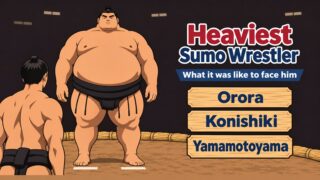
Nobody in the top division is over 200 kg (441 lb) this tournament, but the record books go a long way past that. The heaviest wrestler ever recorded in professional sumo is Orora, who weighed 292.6 kg (645 lb) at a health check in August 2018. His highest rank was makushita 43, in the top unsalaried division. Next on official profiles come the former ozeki Konishiki at 275.0 kg (606 lb) and Yamamotoyama at 266.0 kg (586 lb).
Source: Nihon Sumo Kyokai, profile of Orora (in Japanese)
I faced Orora in the ring myself. I tell that story, along with a longer table of the heaviest wrestlers in history, in my article on the heaviest sumo wrestler ever.
How sumo wrestlers gain weight
Back to the active wrestlers, and to how they reach those numbers. The 25 men in the 2013 measurement had all put on weight since the day they joined, and not a little.
20 to 70 kg heavier than the day they entered
Compared with their weight at entry, the 25 had gained anywhere from 20 kg (44 lb) to more than 70 kg (154 lb). The three highest-ranked wrestlers in the group, all from Mongolia, had entered at somewhere between 80 and 90 kg (176 and 198 lb), and 12 to 13 years later weighed somewhere from 130 to 159 kg (287 to 351 lb). Their lean body mass alone had grown by 35 to 45 kg (77 to 99 lb) in that time.
Practice, chanko, sleep
How do they put it on? Nothing about the method is secret. Morning practice on an empty stomach, then chanko, the stable’s own cooking, then a long nap, dinner in the evening, and the same again the next day. The weight comes from repeating that cycle for years.
How much food that cycle involves, and what a day of it looks like from the inside, is in my article on the sumo wrestler diet.

That chanko is cooked by the wrestlers themselves, and the Nihon Sumo Kyokai’s official channel filmed it being made at Isenoumi stable, which is Fujinokawa’s stable.
The video is in Japanese, but the size of the pot needs no translation.
There was a scale, but nobody told us to use it
You might picture a stable where every wrestler is weighed each morning. At my stable it was not like that. There was a scale, but nobody had set a rule for when to step on it, and you weighed yourself when you felt like checking and otherwise left it alone. What was watched closely was whether you ate, not what the scale said.
The official number is a different layer. Orora’s 292.6 kg (645 lb), for example, was measured at a health check run by the association in August 2018, which is why that figure carries a date.

How much we ate is in the diet article, so I’ll leave the amounts there.
From here it’s my own weight, and the years before it started to climb.
From 78 kg to 96 kg: my own weight as a wrestler
This last part is my own story, not a statistic. I entered at 174 cm (5 ft 8.5 in) and 78 kg (172 lb) and retired about seven years later at 96 kg (212 lb). That is 18 kg (40 lb) in seven years. Against the 20 to 70 kg (44 to 154 lb) of the 2013 group, it falls just short of the smallest gain, and whether 2 kg (4 lb) is a small gap depends on where you are standing.
One or two kilos change how the ring feels
From the outside, 18 kg (40 lb) and 20 kg (44 lb) look like the same thing. In the ring they are not, because a kilogram or two works in three directions at once.
- When the man in front of you is a little heavier, there are moments when you cannot finish the push, and every push costs more
- When you are the heavier one, you gain the strength to stay in at the edge. There is a pause, about the length of one breath, in which you can dig in and hold
- When you go too far, your own body turns heavy and your movement dulls
The balance between the second and the third is hard to find, and I believe the wrestlers who can tune their best weight by a kilogram or two are the ones who win.
Eating fast was the rule for new wrestlers
So why did my 18 kg (40 lb) take seven years? It started with the pace of meals. At my stable, clearing the table after a meal was basically the job of the first- and second-year wrestlers, depending a little on the situation. While you were still eating, the bowls and plates of the people who had finished kept piling up in front of you, and the pile told you to hurry. On top of that, new wrestlers were expected to eat a lot, and to eat it fast.
That was a bad match for me. I have always been slow to chew and slow to swallow, so eating a large amount was hard enough, and eating it in a short time was harder still. To get through it faster I washed the food down with water and soup, which probably did my stomach no favors either. In those days I did not like eating very much.
Sometimes I put my chopsticks down while I could still have eaten more, and went to do the washing up. In a house where we all lived together, that was the choice that caused no friction, and more than once it was the choice I made.
“Did you eat properly?”
One day the most senior wrestler in the stable happened to see me do exactly that.
I had put my chopsticks down with room still left and was getting up to clear the dishes. The most senior of my seniors had been watching.
“Did you eat properly?”
It came in a strong voice, and it frightened me. But it was not a remark thrown at me in anger. He was serious, and he was telling me something. I think what he was telling me was that eating came before clearing up. Frightening and kind, in the same breath.
That scolding is why a few of us smaller wrestlers were then put on a quota of five bowls of rice a meal. The quota itself, and how it went, is in the diet article.
The third year, when I finally had time to eat
The quota did not last long, but it did two things. It stretched the amount I could eat, and it taught me, through that senior, that eating mattered to a wrestler. What it could not give me was time.
Time came in my third year, from a change that had nothing to do with food. New recruits joined below me, and the clearing up passed to them. With no pile of dishes waiting, there was no reason to rush, and I could take my time over a meal. The seniors’ eyes, and the pressure that came with them, moved down to the new faces, and the weight on my mind eased with them. For the first time I was able to enjoy eating, and around then my weight began to climb.
Looking back
Looking back, I think I took eating too lightly. If I had been serious about rising in sumo, eating was something I needed to face head-on, and I should have put getting bigger ahead of what the other seniors might think of me for leaving the dishes.
Three things had to line up before my weight moved. A body that could take the food, which the quota began to build. Time to eat, which came only when the clearing up passed to someone else. And a reason to eat, which that senior gave me with one question. It took three years for all three to be in place.
When the washing up was waiting, I rushed. I couldn’t help it.
In my first year my hands were reaching for the dishes before I’d finished chewing.
FAQ: Sumo wrestler weight
Q1. What is the average weight of a sumo wrestler?
A. For the 42 wrestlers in makuuchi, the top division, on the November 2026 banzuke, the average is 158.8 kg (350 lb), taken from their official profiles. The figure moves a little every tournament as the division changes.
Q2. Who is the heaviest sumo wrestler ever?
A. Orora, whose official profile lists 292.6 kg (645 lb), measured at a health check in August 2018. His highest rank was makushita 43.
Q3. Who is the lightest wrestler in the top division right now?
A. Asasuiryu at 120 kg (265 lb), ranked maegashira 13 for the November 2026 tournament. Fourth lightest is Fujinokawa at 125 kg (276 lb), and he is a sekiwake.
Q4. Are there weight classes in sumo?
A. No. Sumo has no weight classes, so a 125 kg (276 lb) wrestler and a 198 kg (437 lb) wrestler can meet. Pairings are made by rank and by results during the tournament, with wrestlers from the same stable, and close relatives, kept apart except in a championship playoff. The ranks are explained in my guide below.
Q5. How much weight do sumo wrestlers gain after joining?
A. In a 2013 measurement of 25 top-division wrestlers, the gain since entry ranged from 20 kg (44 lb) to more than 70 kg (154 lb). That result covers those 25 only. My own gain was 18 kg (40 lb).
Q6. How tall is the average sumo wrestler?
A. The average height of the 42 top-division wrestlers in November 2026 is 184.6 cm (6 ft 1 in). The tallest is Toshinofuji at 195 cm (6 ft 5 in) and the shortest is Arashifuji at 172 cm (5 ft 8 in).
Q7. Do sumo wrestlers lose weight after they retire?
A. I can only answer for myself. I retired at 96 kg (212 lb). I kept eating the same amount while my exercise dropped off, and my weight rose to about 98 kg (216 lb). Then I went to a gym almost every day for a year and came down to 80 kg (176 lb). That is one person’s year, not a rule.
What else changed for me after I left sumo, and where other retired wrestlers go, I write about here.

Summary
After adding up all 42 wrestlers, the number I keep coming back to is not the 159 kg (350 lb) average. It is the 125 kg (276 lb) sekiwake standing on the same line of the banzuke as a 198 kg (437 lb) one, and the 108 kg (239 lb) of lean body mass measured in the 2013 group. Weight is a weapon in sumo. It is not a ranking.
My own line in that story is a short one. I came in at 78 kg (172 lb) and left at 96 kg (212 lb). Putting on those 18 kg (40 lb) took seven years, and taking most of them off again took one.
The next time a wrestler steps onto the dohyo, the ring, try to picture the years inside that body, the meals eaten in a hurry and the meals finally eaten slowly.

A heavy body is not the same as a strong one.
Build the body that can eat, then the body that can fight. The order matters.