Sumo Ranks in Order: All 10 Ranks and 6 Divisions, Explained by a Former Rikishi
When I was an active wrestler, the first thing I did on the day a new banzuke came out was look for my own name. If a stablemate who had joined after me sat only a rank or two below, my heart was pounding before I even found it.
I was his senior, and I wanted to stay above him, even by a little. To me the banzuke was my own place in the world, rewritten by every tournament’s results.
Hello, I’m Shinzaburo, a former sumo wrestler.
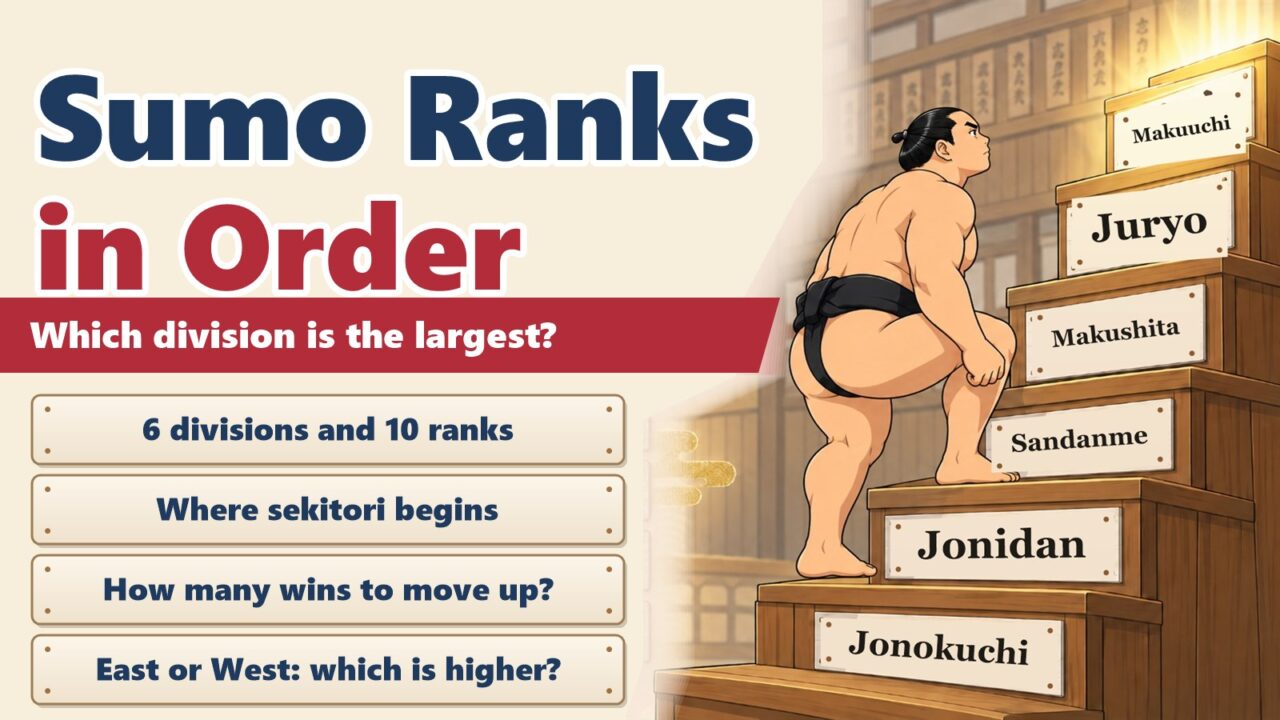
Sumo ranks are the positions on the banzuke (the official ranking list), which runs from yokozuna at the top down to jonokuchi at the bottom in six divisions and ten ranks. So how many wrestlers sit in each division, and where does the line between the sekitori (the salaried wrestlers) and everyone else actually fall?
In this article I’ll walk through how the sumo ranks are ordered, how many wrestlers each division holds, what changes at the line between juryo and makushita, and how many wins it takes to move up, along with what I saw myself on the way up to jonidan.

Back in the stable, the banzuke was just the sheet that told me where I stood.
How many wrestlers actually fill each division, though, I never stopped to think about. That’s the part I want to read.

Sumo ranks in order: the 6 divisions and 10 ranks
From the top, the six divisions are makuuchi, juryo, makushita, sandanme, jonidan, and jonokuchi. The top division, makuuchi, is itself split into five ranks: yokozuna, ozeki, sekiwake, komusubi, and maegashira.
That is why the same ladder can be counted two ways: six steps by division, ten by rank, since from juryo downward the division’s name is also the rank’s name.
The word for rank, 階級 (kaikyu), appears in article 49 of the articles of incorporation of the Nihon Sumo Kyokai (Japan Sumo Association), which leaves promotion and demotion of wrestlers ozeki and below to the banzuke compilation meeting.
Source: Nihon Sumo Kyokai, Articles of Incorporation, art. 49 (Japanese PDF)
How much that ranking sheet means to the wrestlers themselves shows best on the day it comes out, in the video below.
It was filmed on August 29, 2022, the morning the banzuke for that September’s tournament was released, as wrestlers from every stable came to the Kokugikan, Tokyo’s sumo arena, early to pick up their copies. The wrestlers and ranks in it are those of 2022, and some division sizes have changed since, so the current head counts are in the table further down.
When you watch, look for the part on sekitori privileges around 3:29, and the closing look at jonokuchi around 4:44. Those are the two ends of the ladder this article walks through.

Everyone lining up first thing in the morning just to pick up a sheet of paper!
The banzuke clearly matters to every wrestler on it, not only the ones at the very top.
The full list from yokozuna to jonokuchi
Laid out in order, with the sekitori line marked, the ten ranks look like this.
On a phone, swipe sideways to see the whole table
| Rank | Japanese | Division | Sekitori? |
|---|---|---|---|
| Yokozuna | 横綱 | Makuuchi | Sekitori |
| Ozeki | 大関 | Makuuchi | Sekitori |
| Sekiwake | 関脇 | Makuuchi | Sekitori |
| Komusubi | 小結 | Makuuchi | Sekitori |
| Maegashira | 前頭 | Makuuchi | Sekitori |
| Juryo | 十両 | Juryo | Sekitori |
| Makushita | 幕下 | Makushita | Trainee (not sekitori) |
| Sandanme | 三段目 | Sandanme | Trainee (not sekitori) |
| Jonidan | 序二段 | Jonidan | Trainee (not sekitori) |
| Jonokuchi | 序ノ口 | Jonokuchi | Trainee (not sekitori) |
Source: Zenbu Wakaru Ozumo Guide (Tanaka Akira, Seibido Shuppan, 2019), p.24-25
No weight classes: rank is decided by results
Unlike judo or boxing, sumo has no weight classes. Rank moves on tournament results, not on body weight, so a small man and a huge man meet whenever the banzuke puts them close together.
A newcomer normally starts in mae-zumo (pre-sumo, a few unranked bouts in his first tournament) and appears on the banzuke from his second. The exception is tsukedashi, which lets a wrestler with strong amateur results start at a ranked position, though even then the highest starting point is the bottom of makushita (as of February 2025).
Source: Nihon Sumo Kyokai, Sumo Quiz No. 1147 (Japanese)
The banzuke pyramid
Stacked up, the six divisions make a pyramid, shown below with the head count for each division that has a fixed size.
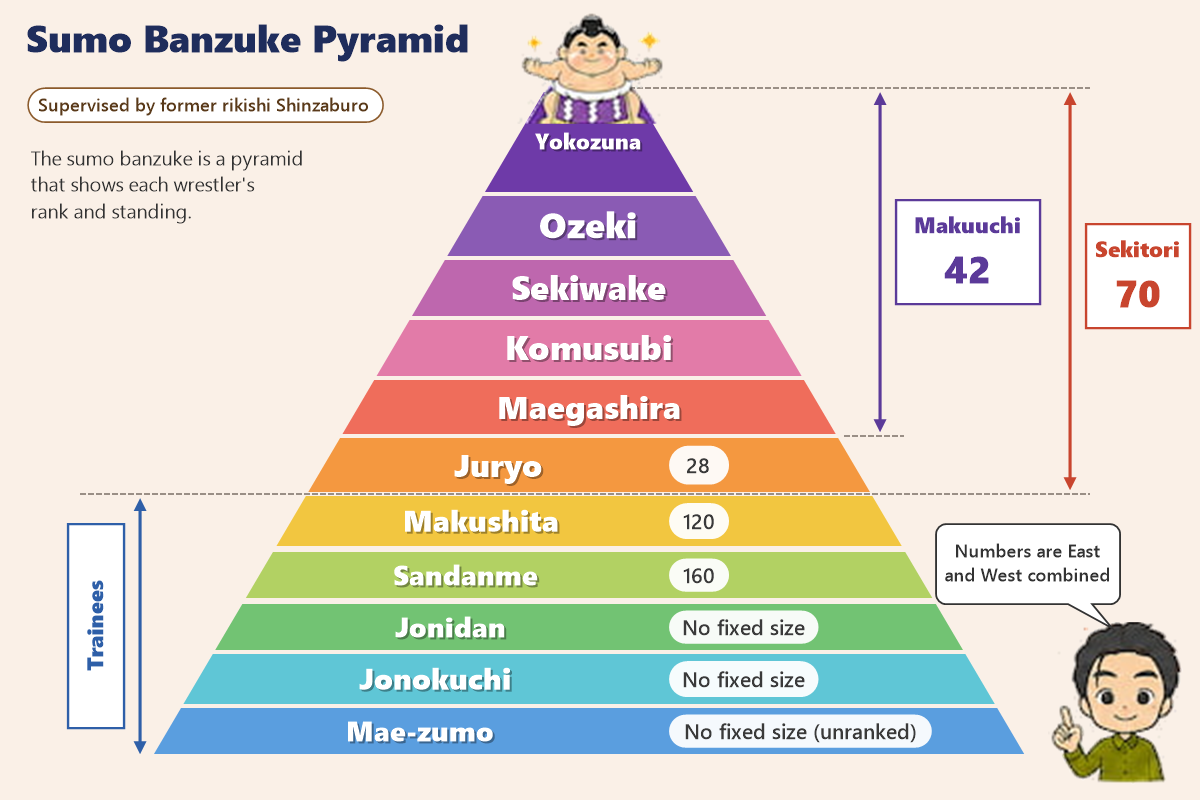
Three things about the figure are easy to misread.
- Mae-zumo: drawn at the base, but strictly off the banzuke. Those wrestlers have no name on the sheet yet
- Jonidan and jonokuchi: no fixed size, so the number of names changes with each tournament
- Fixed sizes: the caps can change when the Association revises its rules
Makuuchi: from yokozuna to maegashira
Makuuchi is the collective name for the wrestlers written on the top tier of the banzuke. It holds the five ranks from yokozuna to maegashira, and its size is capped at 42.
Source: Sumo Daijiten, 4th ed. (Kanazashi Motoi, Gendai Shokan), “Makuuchi”
Above the maegashira sit the sanyaku, the collective name for ozeki, sekiwake, and komusubi, and yokozuna stand apart and are not counted among the sanyaku.
There are tournaments with no yokozuna at all, while the three sanyaku ranks are placed one each on the East and West as a baseline. When there is only one ozeki on the banzuke, or none at all, a yokozuna may be listed as ozeki as well, under the title yokozuna-ozeki.
So the wrestlers I know from TV are all up in that top box, makuuchi, plus a few in juryo. I had no idea four whole divisions sat underneath them!
Next time I go to the Kokugikan I want to get in early and watch the lower divisions from the very first bout.
How many wrestlers are in each division
From makuuchi down to sandanme, each division has a fixed size, while jonidan and jonokuchi do not. So the number of names on the banzuke rises and falls with recruits and retirements, and the real head count is no neat triangle.
In the November 2026 tournament, jonidan was the largest division with 200 wrestlers. The list widens all the way down to jonidan, then shrinks sharply at jonokuchi.
Jonidan is the largest division
Here is the head count for the November 2026 tournament, division by division.
On a phone, swipe sideways to see the whole table
| Division | Wrestlers | Rank numbers |
|---|---|---|
| Makuuchi | 42 | Maegashira down to No. 17 |
| Juryo | 28 | No. 1 to 14, East and West |
| Makushita | 120 | No. 1 to 60, East and West |
| Sandanme | 160 | No. 1 to 80, East and West |
| Jonidan | 200 | No. 1 to 100, East and West |
| Jonokuchi | 43 | 22 on the East and 21 on the West |
| Total | 593 |
Source: Nihon Sumo Kyokai, Banzuke Information
That total of 593 is a long way below the record. The largest banzuke ever printed was for the May 1994 tournament, with 943 wrestlers, 350 more than in November 2026. The upper divisions have fixed sizes, so most of that difference shows in the lower tiers.
Source: Sumo Daijiten, 4th ed., “Banzuke history,” p.276
Divisions with a fixed size and divisions without
The caps themselves, division by division, are these.
- Makuuchi: 42 or fewer (Banzuke Compilation Rules, art. 9)
- Juryo: 28 or fewer (same article)
- Makushita: 120 (60 each on the East and West)
- Sandanme: 160 (80 each on the East and West in November 2026, where the 2019 guide gives 200)
- Jonidan and jonokuchi: no fixed size
Source: Sumo Daijiten, 4th ed., p.277 / Zenbu Wakaru Ozumo Guide, p.24 / Banzuke Information
The border to watch is the one between uncapped jonidan and sandanme, with its 80 slots a side. Getting into sandanme is spoken of as one of the first gates on the road to becoming a sekitori, and with only 160 places, a winning record in jonidan does not guarantee the step up.
More yokozuna and sanyaku means fewer maegashira
Inside the cap of 42, the number of yokozuna and sanyaku shifts from tournament to tournament. From the July 1992 tournament through the January 1993 tournament, for example, the banzuke had no yokozuna at all, between Hokutoumi’s retirement and Akebono’s promotion.
Ozeki, sekiwake, and komusubi are set at one each on the East and West as a baseline, but when several wrestlers post strong records the number of sekiwake or komusubi can grow. Makuuchi as a whole stays at 42 or fewer, so each extra yokozuna or sanyaku wrestler means one maegashira slot less.

When I was active, jonidan went down to about No. 200 and jonokuchi to about No. 70, as far as I remember. With one wrestler on the East and one on the West at each number, far more names sat in those lower tiers than today.
Climbing out of a crowd like that, one rank at a time, felt hard to me. Not that I’m making excuses for not getting further.
What changes at the juryo line: sekitori and everyone else
A wrestler’s standing changes sharply at one line on the banzuke, the one between juryo and makushita. From juryo upward he is a sekitori. From makushita downward he is a trainee, a rikishi yoseiin, and pay, clothing, attendants, and life inside the stable all change at that line.
Sekitori starts at juryo
Sekitori is both an honorific and a collective term for wrestlers ranked juryo and above. It is not written into the rules as a rank of its own, but it has been used that way for generations, and a wrestler is called sekitori from the tournament in which he reaches juryo.
From the mawashi to a private room: seven differences
Set side by side, the differences between juryo and above and makushita and below come to these seven.
On a phone, swipe sideways to see the whole table
| Item | Sekitori (juryo and above) | Trainee (makushita and below) |
|---|---|---|
| Bouts per tournament | 15 bouts in 15 days | 7 bouts in 15 days, as a rule |
| Pay | Monthly salary from the Association | No monthly salary. An allowance per tournament |
| Tournament mawashi (belt) | Silk shimekomi (the rules say navy or purple tones) | Cotton mawashi in navy or black |
| Practice mawashi | White cotton, separate from the tournament belt | Black cotton, the same one used in tournaments |
| Hairstyle in tournaments | Oicho-mage (the ginkgo-leaf topknot) | Plain chonmage (a simple topknot) |
| Attendants | Attended by lower-division wrestlers | May serve as a sekitori’s attendant |
| Sleeping quarters at the stable | A private room | A shared room with the other trainees |
Source: Zenbu Wakaru Ozumo Guide (2019), p.24-25
A monthly salary starts at juryo
Of the seven rows, the one that reshapes daily life from the ground up is pay. A sekitori’s monthly salary is fixed by rank, from 1,100,000 yen a month in juryo to 3,000,000 yen for a yokozuna until the November 2026 tournament, and every rank goes up from the January 2027 tournament. Below juryo there is no monthly salary, only an allowance paid for each tournament.
The full table by rank with the new amounts, the allowances below juryo, and the money that depends on winning are in my article on how much a sumo wrestler makes.

What I saw on the other side of the line
Everything above is the system on paper. The rest of this section is not about the rules but about me, and about the sekitori I lived alongside during my years in jonidan.
Same stable, same roof, and a summer that felt completely different depending on which room you slept in.
On hot summer days, in the shared room where the trainees slept, there would be a fight over the electric fan. On one of those days I was called to a sekitori’s private room. The air conditioning was blasting, and he was lounging there wrapped in a blanket.
“It feels good to chill the room until it’s cold and sleep under a blanket.”
That is what he told me, and I remember how envious I was. We lived in the same stable, but to me it looked like another world.
There were plenty of differences in how we were treated, but the one I kept noticing was the time after practice. The sekitori in my stable finished morning practice, bathed, ate chanko (the stable’s communal meal), and took a nap. After that, outside tournaments and regional tours, the hours were his own, and he had no curfew.
Money, and time he could spend as he liked. From where I stood in jonidan, that looked like a very comfortable life.
Of course, once you are a sekitori the public sees you as a sumo wrestler wherever you go, and you have to mind how you carry yourself. Even so, from where I was standing then, the gap between his life and ours below makushita looked enormous.
Fighting over the fan, yeah, I remember that. In summer the big shared room gets brutally hot, and you’re sweating before you’ve even moved.
A blanket in the middle of summer. That’s a kind of luxury I’d never even thought of.
How sumo ranks go up and down
The basic direction is simple: a winning record usually moves a wrestler up the banzuke, and a losing record usually moves him down. How many ranks he actually moves is not settled by his own score alone, because the results of the wrestlers ranked near him count too.
How many wins make a winning record
The threshold for kachi-koshi (a winning record) depends on how many bouts a wrestler fights. Juryo and above fight every day for 15 days, while makushita and below fight 7 bouts over the same 15 days.
- Juryo and above: 8 wins or more out of 15 is kachi-koshi
- Makushita and below: 4 wins or more out of 7 is kachi-koshi
Anything short of that is make-koshi (a losing record), which usually means a lower rank next time. A winning record usually means a higher one, and the top two ranks have their own rules, covered further down.
Below juryo you get seven bouts, so a single bout is all that separates a winning record from a losing one.
Lose once and there are that many fewer chances to take it back.
Banzuke luck: your rank depends on other wrestlers too
How far a winning record pushes you is the open part, because the scores of the wrestlers around you change how far you move, and this piece of luck has a name in Japanese, banzuke-un, “banzuke fortune.”
A wrestler at juryo No. 1 with a strong record, for example, may still be left out of makuuchi if too few makuuchi wrestlers are falling the other way. When many wrestlers above post losing records, the reverse happens.
Source: Sumo Daijiten, 4th ed., “Banzuke-un,” p.274
Next tournament’s ranks are settled at the banzuke compilation meeting, held within three days after the final day. That meeting is why I was hunting for my own name the moment the banzuke came out: even with a winning record, I did not know how many ranks I had climbed until I saw the sheet.
The opponents get stronger as you climb
The arithmetic of wins and losses does not explain every stalled climb. What follows is not a rule. It is my own story, from the last stretch of my time in jonidan.
My highest rank was in the upper part of jonidan, one step short of sandanme.
By the time I got there, I felt sandanme was within reach and had some confidence in my sumo. My neck, though, was in bad shape at the time.
As you climb, the opponents change. Their pressure at the tachi-ai (the initial charge), their size, their strength, and their technique all go up a notch. Facing men like that, a thought started to surface before each bout.
“If I charge in with everything at the tachi-ai, I’ll hurt my neck.”
Once that thought was there, I began holding back at the tachi-ai, waiting instead of committing, and the wins stopped coming.
At the time I believed I had the ability for sandanme. Looking back now, I think “ability” included the mental state to commit fully, not just the body. Mind, technique, and body, what sumo calls shin-gi-tai, have to line up for a wrestler to climb, and by that measure I may not yet have had what sandanme required.
Ozeki and yokozuna follow different rules
Promotion to ozeki goes through the board of directors before the banzuke compilation meeting settles it, and promotion to yokozuna also needs a recommendation from the Yokozuna Deliberation Council. The guideline often quoted for ozeki is 33 wins over the three latest tournaments in sanyaku, though it is not a written condition, and for yokozuna it is two consecutive championships as an ozeki or a record close to it, together with outstanding ability and character.
Source: Nihon Sumo Kyokai, Sumo Quiz No. 1081 (Japanese)
Coming down works differently as well. An ozeki who posts two losing records in a row is demoted to sekiwake. The tournament after a losing record is called kadoban, and a winning record there keeps the rank, while a demoted ozeki who wins 10 or more bouts in his first tournament back at sekiwake returns to ozeki.
Source: Sumo Daijiten, 4th ed., “Banzuke Compilation Rules,” art. 8, p.277
A yokozuna, on the other hand, is never demoted. When the results stop coming he is not dropped to ozeki or sekiwake. He retires.
I explain how a wrestler is promoted to yokozuna, who holds the rank now, and why a yokozuna retires instead of being demoted, in more detail here.

When the new banzuke comes out
A new banzuke is normally released 13 days before day one of the tournament. The January banzuke comes out earlier, because the printed sheets are mailed around the country over the year-end holidays.
Three kinds of promotion do not wait for that day. New yokozuna, new ozeki, and new juryo wrestlers are announced on the day of the banzuke compilation meeting itself, while every other change becomes public with the new banzuke. A wrestler reaching juryo becomes a sekitori, and he needs that extra time to prepare his kesho-mawashi (the ceremonial apron) and the rest of his outfit.
The November 2026 tournament, for example, started on Sunday, November 8, and its banzuke came out on Monday, October 26, 13 days earlier.
How to read a banzuke
Two rules will get you through a banzuke on your first try. Within the same rank, East is above West. And a smaller number is a higher rank.
East ranks above West
The banzuke is split into an East side and a West side. For the same rank and number, the East wrestler is the higher of the two, and the gap is called “half a rank,” because a full rank is one number on the sheet.
East and West make no difference to pay or treatment. Where that half rank does matter is when the next banzuke is drawn up: if the East and West juryo No. 1 both finish 8-7 and the makuuchi cap leaves room for only one of them, the East wrestler is given priority for that place. The West wrestler is said to have “wept over half a rank.”
Source: Sumo Daijiten, 4th ed., “Hanmai,” p.278
Numbers and hitto
Within a rank, the No. 1 position is called hitto, “the head.” Below it come No. 2, No. 3, and so on, the larger the number the lower the position, and in November 2026 the maegashira ran down to No. 17.
One more thing trips people up here. The six divisions and the tiers printed on the paper banzuke are different counts, because the paper sheet is laid out in five horizontal tiers.
- Top tier: makuuchi
- Second tier: juryo and makushita
- Third tier: sandanme
- Fourth tier: jonidan
- Bottom tier: jonokuchi
The higher the rank, the larger and bolder the brush strokes of the name. By the bottom tier the characters are hard to read with the naked eye, and the jonokuchi names are nicknamed mushi-megane, “magnifying glass,” for that reason.
Source: Zenbu Wakaru Ozumo Guide (2019), p.22
Where to see the current banzuke
If you want to try reading one yourself, here is where to find the current sheet and how to get a paper copy.
- Online: the Association posts the current banzuke on its English site. ⇒Nihon Sumo Kyokai, Banzuke Information
- On paper: printed sheets are sold by mail order through Banzukeya, the shop the Association’s shopping guide points to. ⇒Banzukeya (Japanese)
Ranks move only on the results of the six official tournaments, held in January, March, May, July, September, and November. Wins and losses on the regional tours in between do not touch the banzuke.
So there’s a fresh sheet to read every two months.
If I order a paper one, I want to see for myself how tiny the jonokuchi names are, with an actual magnifying glass!
Frequently asked questions about sumo ranks
Here are short answers to the questions that come up often about sumo ranks.
Q1. What is the highest rank in sumo?
A. Yokozuna. Below it, in order, come ozeki, sekiwake, komusubi, and maegashira, which together make up the top division, makuuchi.
Q2. Is juryo above or below makushita?
A. Juryo is above. Juryo and everything above it are sekitori, while makushita and below are trainees, which is why a monthly salary, a private room, and attendants all begin at juryo.
Q3. Are there weight classes in sumo?
A. No. Sumo ranks are decided by the banzuke, not by body weight, and the banzuke moves on tournament results. Wrestlers are not separated by size when bouts are arranged either.
Q4. How many wrestlers are in makuuchi?
A. The division is capped at 42, and in the November 2026 tournament it held exactly that many.
Q5. What is the lowest rank?
A. Among the ranks printed on the banzuke, jonokuchi is the lowest. Below it is mae-zumo, whose wrestlers have no name on the banzuke yet. A recruit who fights even one bout there moves up to jonokuchi the next tournament, win or lose.
Q6. How do you move up in rank?
A. By posting a winning record in an official tournament: 8 wins or more out of 15 for juryo and above, 4 or more out of 7 for makushita and below. A winning record usually lifts you, but how many ranks you gain depends on the wrestlers around you, and it does not guarantee a place in the next division up. The exact answer waits for the new banzuke.
Summary
Seen as a table, the ten ranks look like a tidy ladder. Read with the head counts beside them, the ladder bulges at jonidan and narrows hard at the top, and one of its rungs, the one between makushita and juryo, is where a wrestler’s daily life changes sharply.
My own climb stopped in upper jonidan, with sandanme in plain sight. I had the ability for it, or so I believed. What I did not have was a neck I could trust and a mind that would commit at the tachi-ai.
The next time a new banzuke comes out, find the wrestler you follow and count how many names sit above him. Then look at how many he has already passed.

A rank is not given. It is earned one bout at a time.
Look not only at the size of a name, but at the wins that carried it there.