Sumo Wrestler Diet: What and How Much Sumo Wrestlers Eat, from a Former Rikishi
I always liked to eat, but once I joined a sumo stable, the total amount I ate jumped. After practice came chanko, the stable’s own cooking, then bowl after bowl of rice, and then a little more. Living that way, I came to see that amount as normal.
The trouble is that the amount doesn’t go back down. I have tried to eat less many times since, and a smaller meal still leaves me feeling something is missing. In my case, the amount of food the stable made normal stayed with me long after I stopped wrestling.
Hello, I’m Shinzaburo, a former sumo wrestler.
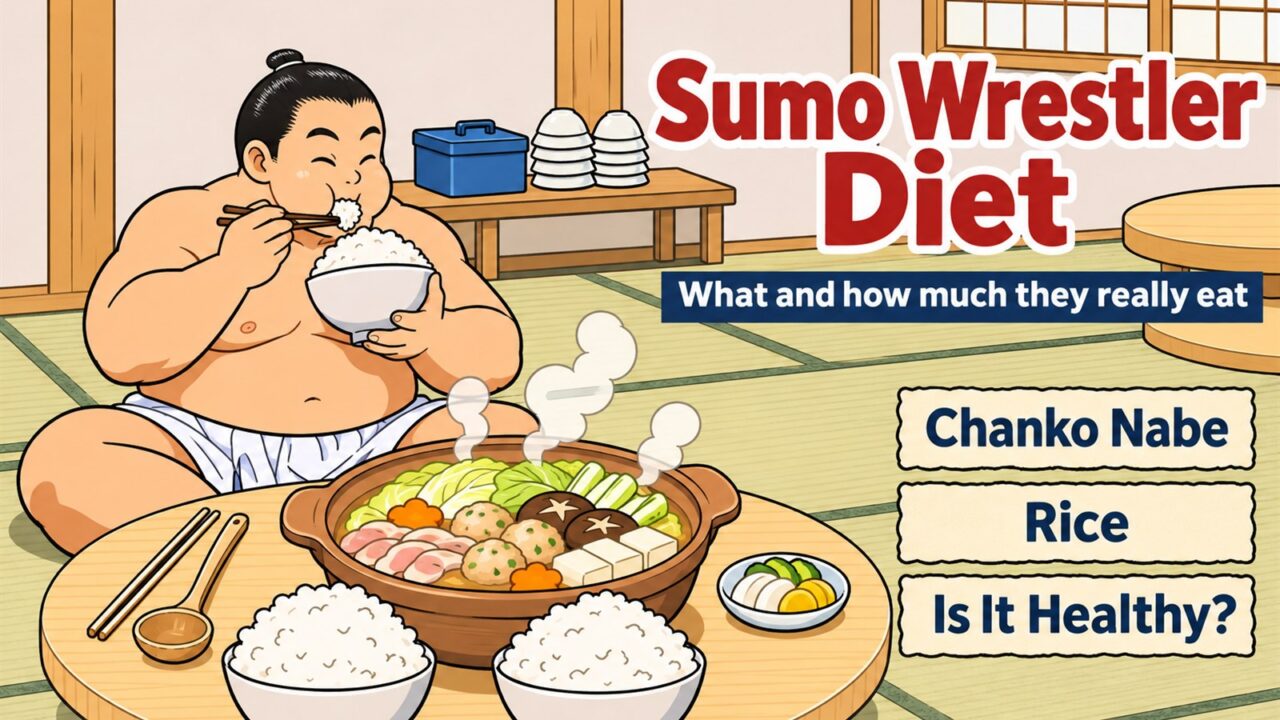
A sumo wrestler’s diet is built on two large meals a day, with no breakfast: chanko nabe and rice after morning practice, and home-style dishes in the evening. So how much food does that really add up to, and can eating like that be healthy?
In this article I’ll answer what sumo wrestlers actually eat in a day, how many calories it comes to, and whether eating like that is good for them, along with what I saw cooking and eating in my own stable.

I ate in a stable for years, but I never once counted how much went in.
Two meals a day sounds small. It really wasn’t, so I’m curious what the number comes to.

A sumo wrestler’s day of eating: two meals and no breakfast
In a sumo stable, the basic schedule is two meals a day, and anything beyond that is up to each wrestler. The first meal comes only after morning practice is over, and the second comes in the evening.
The video below shows how that order plays out inside a stable.
It was posted by nippon.com in August 2018 and follows a day at Takadagawa stable in Tokyo, from morning practice to the meal that comes after it.
This is a different stable from mine, so the details are not the same as what I lived. The order of the day is the same, though.

All that practice before eating a single thing!
I always grab something small before the gym, so I can’t imagine training that hard on nothing.
Practice on an empty stomach
In the sumo world, wrestlers do not eat breakfast, and there is a practical reason. Eating before hard practice leaves the body heavy and can even make you bring the food back up. Some wrestlers I knew had a banana or a protein drink first, but nobody at my stable sat down to a morning meal.
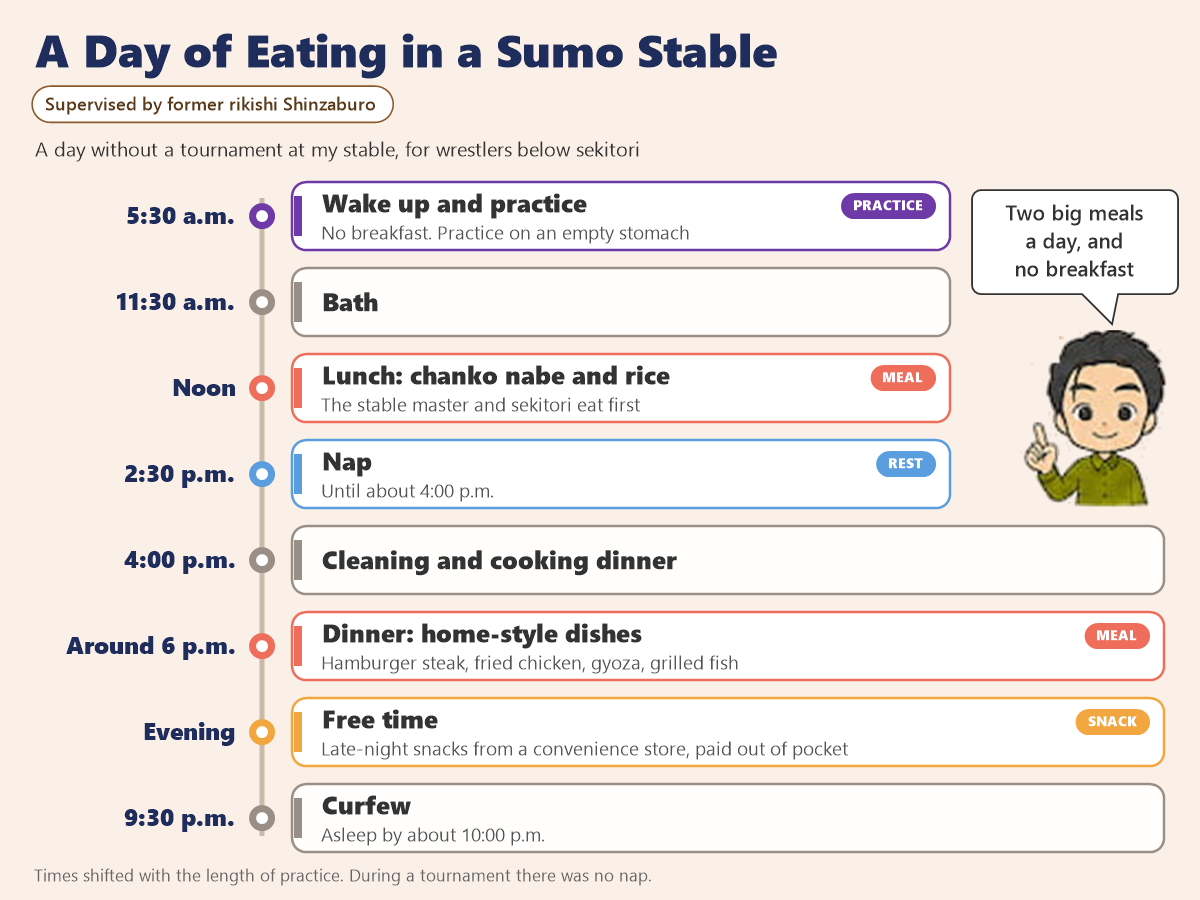
Once practice ends, the rest of the day is arranged around food and rest. At my stable, a day without a tournament ran like this.
A nap after lunch
After lunch comes the nap. Mine usually lasted from one hour to a little under two.
During a tournament, however, the juniors at my stable did not nap at all. The stable master and the sekitori, the salaried wrestlers in the top two divisions, were working at the tournament, and it was not a time for the juniors to be asleep. In months without a tournament it went the other way, and when practice finished early I sometimes slept more than three hours and woke up groggy.
Dinner in the evening
At my stable, dinner came around 6 p.m., after the cleaning and dinner prep that started at 4 p.m. It was still a big meal, but smaller than lunch, for three reasons.
- Everyone has already eaten a lot of chanko at lunch
- The afternoon is a nap and cleaning, far less work than morning practice
- A hot pot is eaten with its broth, so it goes down easily and lunch tends to become the bigger meal
How much do sumo wrestlers eat?
With only two main meals a day, each one is large, and how much that comes to has actually been measured.
What a 1974 study measured
In 1974, researchers recorded everything that nine wrestlers at one stable in Ryogoku, Tokyo, ate and drank, snacks included, over four days in summer and three in winter. The nine were divided into three groups by rank.
- Sekitori (juryo and above): about 4,500 kcal a day
- Makushita (the top unsalaried division): about 4,360 kcal a day
- Jonidan (the second-lowest division): about 4,000 kcal a day
The survey is more than 50 years old and covers a single stable. Still, the day it describes is the day I lived decades later: chanko nabe at noon after practice, a nap of some hours, an ordinary dinner, and something to eat in between.
My own rough count at my stable
My own count comes out higher. When I add up what I remember eating at my stable, using rough per-serving figures, I get the numbers below.
On a phone, swipe sideways to see the whole table
| Item | How I counted | Amount | Calories |
|---|---|---|---|
| Rice | At least 2 go a meal, 2 meals | 4 go a day | About 2,050 kcal |
| Chanko nabe at lunch | About 300 kcal a serving, counted as 7 servings | 7 servings | About 2,100 kcal |
| Dinner side dishes | 500 to 700 kcal a serving | 3 servings | 1,500 to 2,100 kcal |
| Total | Late-night snacks not included | About 5,650 to 6,250 kcal |
A go (合) is the Japanese unit for measuring rice, about 150 g uncooked, and one go of polished rice is about 513 kcal.
Source: MEXT, Standard Tables of Food Composition in Japan, polished rice
My count is built from remembered servings and general calorie figures, not from anything measured, so it cannot be set directly against the survey. Treat the survey as the firmer figure and my count as a rough picture of how it felt. Chanko came in a big shared pot and we refilled our bowls again and again, so nobody could say exactly how many servings they ate. To me it felt like seven or eight.
Cooking rice for 25 wrestlers
Rice was also where I felt the amount most directly, because for a while cooking it was my job.
At my stable, cooking the rice fell to the lowest-ranked member of the chanko crew. We had about 25 wrestlers, trainees included, and a 5-sho cooker like the ones in a school kitchen. A sho (升) is 10 go, and we usually cooked 30 to 40 go at a time.
Counting the cold rice left from the meal before and the extra batches, a single meal needed more than 5 sho. Getting that amount right was harder than it sounds. Cook too much, and the cold rice piled up until even the senior wrestlers had to help finish it, which left me feeling small in front of everyone. Cook too little, and I had to rush another batch in the middle of the meal.
The timing of that extra batch was its own problem. Too late and it wasn’t ready, too early and it turned out we hadn’t needed it, and the cold rice grew again. There were times the head cook, the chanko-cho, reminded me that I couldn’t get this wrong. Honestly, I never imagined cooking rice could wear on my nerves that much.
What made it worse was that every dish used up rice at a different speed. On meatball or fried chicken days, the rice disappeared much faster than usual.
On those days I kept glancing at what was left in the cooker, silently praying that nobody would ask for another bowl.
What do sumo wrestlers eat?
So much for the amount. What actually goes into those two meals starts with a word you will hear constantly in any stable.
Chanko means every meal in the stable
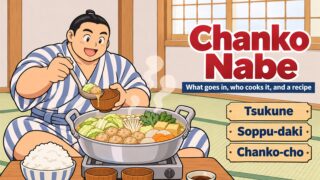
In a sumo stable, chanko is not only the name of a hot pot. Any food the wrestlers cook and eat in the stable is called chanko, so the fried chicken at dinner is chanko as well. The hot pot itself is chanko nabe, and that is what anchors lunch.
What goes into that pot, who cooks it, and a recipe for making one at home are in my guide to chanko nabe.
Lunch: chanko nabe and plenty of rice
Lunch comes straight after practice, when wrestlers take in the most food of the day. A hot pot suits that moment: meat, fish and vegetables all go in at once, and the broth helps a large amount go down in a short time.
- Chanko nabe with chicken, pork, seafood and plenty of vegetables
- White rice, 2 to 5 go
- Pickles
- Fruit or dessert
At my stable, the stable master and the sekitori ate first, and the rest of us ate after them.
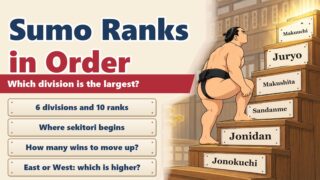
For where the line between the sekitori and the other wrestlers falls, and what else changes at that rank, see my guide to sumo ranks.
Dinner: home-style dishes
Dinner, by contrast, moves away from the pot. At my stable we often made hamburger steak, fried chicken and gyoza, the kind of food a Japanese family might have at home.
- White rice, 2 to 3 go
- Miso soup and pickles
- A fish or meat dish
- Tofu or a salad
- Fruit or dessert
Late-night snacks paid out of pocket
The day’s eating did not always end with dinner. Before lights-out, wrestlers at my stable went to a convenience store and bought rice balls, bento boxes, bread, snacks and sweets. The stable did not pay for any of it, so each wrestler bought his own.
For the younger wrestlers, those snacks were extra fuel for putting on size. Some of the wrestlers who were already big seemed to buy chips, pudding or ice cream simply because they liked them.
What I remember best is eating after lights-out, quietly, by flashlight. In that silent room, even an ordinary rice ball tasted special.
Snacks by flashlight, man, those were the best. I mostly went for sweet stuff like pudding and sweet buns.
But it all came out of my own money, so right before every tournament I was pretty much broke.
Eating as part of training
There is a saying in sumo that eating is part of practice. At my stable, nobody ever warned me that I was eating too much, and the cost of food never came up. What I heard was the opposite.
“Eat.”
Five bowls a meal: the quota I was given
I entered sumo at 174 cm and 78 kg, about 5 ft 8.5 in and 172 lb, which is small for a wrestler. A senior told me to get bigger, and several of us smaller wrestlers were given a quota of five bowls of rice at every meal.
Our bowls were the size of a donburi, the large bowl Japanese homes use for rice dishes, and each held about 0.8 go. Five of them at two meals came to 8 go a day.
I managed the first day. From the second day, however, my stomach could not keep up, and I felt full from one meal to the next. By the third day meals ran long, cleanup ran late and the rice ran short, so more had to be cooked. After that, the quota quietly faded away.
For a while I was afraid a senior would notice I had dropped it and scold me. Nobody ever said a word, and I remember how relieved I felt.
Not everyone struggled like I did. A junior who had wrestled in school once told us he used to eat about 1 sho of rice. The seniors made him prove it, and he ate ten bowls of white rice in about an hour, just that once. It was far beyond anything I could have done.
So you had quotas back then.
For me, the hard part was being made to finish whatever was left over from the meal before. That one I really hated.
An “eating practice” night out
Eating as practice did not only happen at the stable table. One evening I skipped dinner at the stable and went out with several seniors. The outing was called eating practice, a part of training to get bigger, and nobody told me where we were going or for how long.
At my stable, wrestlers below sekitori had a curfew, so all of the following happened in about three hours, from around 6 to 9 p.m.
- CoCo Ichibanya (curry): a 1,300 g rice challenge, free if finished in 20 minutes. With curry and toppings it came to over 2 kg. Everyone finished
- A tonkotsu (pork-bone broth) ramen shop: the seniors had about five extra servings of noodles. I stopped at three
- Yoshinoya (beef bowls): a senior ordered me three extra-large bowls. I finished two and a few bites of the third
- A convenience store: the seniors bought sweets. I bought nothing
At the curry shop, my toppings were fried chicken, sausage, sliced pork, spinach and cheese, and even I was amazed at how much I had piled on. Because the challenge made the meal free, paying nothing at all felt wrong, so each of us ordered a drink or a side dish on the way out.
By the beef bowl shop I was past full and fighting the urge to run to the toilet, while the seniors next to me finished theirs without any fuss. I swore I would never do that again. All the same, it has become one of the stories I laugh about.
It sounds painful, but working through it together with the seniors also looks a little fun.
I’d want to see their faces at the third shop.
Two stories from the stable table
Some of the food stories from my stable are less about volume than about who was eating. Two of the people I lived with stand out.
On days we grilled meat over a shichirin, a small charcoal grill, one senior announced that he could eat rice with nothing but green pepper. He dipped one piece, about half a pepper, in yakiniku sauce and finished a whole bowl of rice with it. In the end he had three pieces and three bowls, without touching anything else on the table.
The other was a junior, a different person, who kept a stock of microwave rice packs for late-night snacks and ate them with yakiniku sauce and nothing else. Night after night, in the dark, I could hear him muttering to himself.
“Yakiniku sauce, so good.”
Are sumo wrestlers healthy?
The short answer is that the research cannot settle it. The diet gives plenty of energy, but one survey found it short on some nutrients, and a separate study linked a higher BMI to a higher risk of death among top-division wrestlers. Neither tells us how healthy wrestlers are today.
What the 1974 survey found lacking
The same 1974 survey also checked what the wrestlers were not getting enough of. Rice, fish, meat and vegetables were plentiful, and protein was sufficient even for bodies that size.
- Low in the diet: green and yellow vegetables, and fruit
- Somewhat short: calcium, vitamin A (the largest gap) and vitamin B2, more so for the younger wrestlers
Since I go to the gym, I assumed the rice would be the worry.
Coming up short on green and yellow vegetables and calcium while eating 4,000 kcal a day surprised me more.
Higher BMI and death: what one study found
Body size is the other half of the health question. A 2009 study looked at the 430 wrestlers who reached makuuchi, the top division, between 1926 and 1989. Of those 430, 73 were listed as deceased in the 2006 wrestler directory the researchers used, and they were compared with 73 surviving wrestlers born in the same years.
A higher BMI, a measure of weight relative to height, was linked to a higher risk of death. It is a single small study, though, and it gives no figure for how many years shorter a wrestler’s life might be.
Source: Kanda et al., Journal of Sports Science and Medicine (2009)
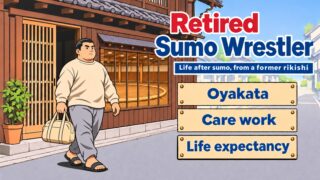
How long sumo wrestlers have lived, and what the research can and cannot tell us about it, I explain here.
The habit that stays after retirement
Then there is what happens after the career ends, and here I can only speak for myself.
I have tried to cut back for my health many times. A smaller meal simply doesn’t fill me, or I feel full but something still seems missing, and before I know it I’m snacking more. With age I do eat less than I used to, and these days eating too much upsets my stomach. Even so, I think I still eat more than most people.
FAQ: Sumo wrestler diet
Q1. Do sumo wrestlers eat breakfast?
A. No. In the sumo world, wrestlers practice on an empty stomach in the morning and eat their first meal after practice. Eating before practice leaves the body heavy and can even make you bring the food back up. Some wrestlers I knew had a banana or a protein drink, but not a meal.
Q2. How many calories does a sumo wrestler eat a day?
A. A 1974 survey at one stable measured about 4,000 to 4,500 kcal a day, snacks included, rising with rank. My own rough count at my stable came to about 5,650 to 6,250 kcal before late-night snacks.
Q3. Do sumo wrestlers eat chanko nabe every day?
A. In a stable, chanko means every meal the wrestlers cook and eat, not only the hot pot. The hot pot, chanko nabe, is the usual lunch after practice, while dinner is closer to home cooking.
Q4. How much rice does a sumo wrestler eat?
A. At my stable it was at least 2 go a meal, so 4 go a day, about 600 g of uncooked rice. When I was given a quota to put on weight, it went up to 8 go a day.
Q5. Why do sumo wrestlers nap after lunch?
A. To rest the body after the morning’s practice and the big lunch. At my stable the nap lasted one to two hours, and the juniors skipped it during tournaments.
Summary
Written down, a sumo diet looks like a list of calories and bowls. Having lived it, I remember it less as a menu and more as one more thing we worked at every day, alongside practice.
What stays with me most is not the number of bowls but those glances into the rice cooker in the middle of a meal, checking whether I had got the amount right that day.
The next time you watch a wrestler step onto the dohyo, the ring, picture the two meals and the nap behind that body, and somewhere in his stable, someone keeping an eye on the rice.
Eating is practice too. A rikishi’s body is built one bowl at a time.