Retired Sumo Wrestler: Life After Sumo, Jobs, and Life Expectancy, from a Former Rikishi
About a year after I left sumo, I started on an assembly line putting mobile phones together. This was the age of flip phones.
I clocked in at 8 a.m., and overtime ran about four hours a day on average. For months my life was work, then home, then sleep.
“Is this what ordinary working life is like? Is it going to be like this forever?”
I honestly believed it would, and I fell into despair.
Hello, I’m Shinzaburo, a former sumo wrestler.
When a sumo wrestler retires, his life changes all at once: where he lives, how he earns, and even the people around him. Only 70 of the 593 wrestlers on the November 2026 banzuke, the ranking list, are sekitori, the ranks that draw a monthly salary. A wrestler who leaves from below them, as I did, can find himself starting work in his twenties with no job experience and only a middle school education. So what happens to a sumo wrestler after he retires?
Some retired wrestlers stay in sumo as elders or Association staff, while others build new careers in restaurants, care work and other fields. What they receive on retiring depends on their rank and how long they wrestled. Studies of earlier generations point to higher death rates in middle age, but they cannot tell us how long today’s wrestlers will live.
This article explains where retired wrestlers go, the jobs they take, what happens to the topknot and the money, and what research says about how long sumo wrestlers live, along with what happened to me after I left.
When a wrestler I liked retired, I saw his name in the news once, and then never again.
I’ve always wondered what came next for him.

What happens to sumo wrestlers when they retire
A retired wrestler has three broad paths. He can stay in the Nihon Sumo Kyokai, the sumo association, he can stay on at his stable, or he can leave the sumo world altogether. Staying in the Association comes with conditions and a limited number of places.
Staying in the Association as an oyakata
The best-known way to stay is to become an oyakata, a sumo elder. The Association’s own term is toshiyori. An elder is a retired wrestler who has taken over one of the elder names, and he has a duty to train young wrestlers.
The number of elder names is fixed at 105, so a new elder can take one only when one falls vacant. Some wrestlers are said to time their retirement around an opening.
To qualify, a wrestler needs Japanese citizenship and, among the main conditions, 20 tournaments in makuuchi, the top division, 30 tournaments as a sekitori, or at least one tournament in sanyaku, the ranks just below yokozuna. All of these conditions require time in the salaried ranks, so a wrestler who never reached juryo, like me, cannot become an elder.
Elders work until the day before their 65th birthday, and since November 2014 they can be rehired up to the age of 70.
Source: Sumo Daijiten, 4th ed. (Kanazashi Motoi, Gendai Shokan), entries Toshiyori and Toshiyori Myoseki, pp.235 to 236, and Teinensei
Wakaimono-gashira and sewanin, the jobs beyond oyakata
The Association has other places for former wrestlers too. A wrestler who does not meet the conditions for an elder name, or who finds none vacant, may be hired as a wakaimono-gashira or a sewanin. Both belong to a stable.
- Wakaimono-gashira guide the young wrestlers in the lower divisions, keep records of bouts, and run mae-zumo, the entry-level bouts that come before the banzuke
- Sewanin carry and look after the equipment used in competition
These jobs are not only for former sekitori. As of November 2026, the Association lists six wakaimono-gashira and nine sewanin. Two of the six, and eight of the nine, never wrestled above makushita, the division just below the salaried ranks.
Source: 裏まで楽しむ!大相撲 (Ura made Tanoshimu! Ozumo, KADOKAWA, 2017), and Nihon Sumo Kyokai, lists of wakaimono-gashira and sewanin (in Japanese)
Staying on at the stable
There is also a way to stay that has nothing to do with the Association. At my stable, one of my seniors never became a sekitori, yet he stayed on as the stable’s manager and kept it running.
Even after he stepped down from the ring, there was work for him inside the stable. Leaving the ring does not always mean leaving the sumo world.
I thought that once a name dropped off the banzuke, that person was gone from sumo for good.
So the wakaimono-gashira and sewanin I see around the ring on tournament days are former wrestlers too.
What changed for me when I left sumo
From here on, this is what happened to me after I stepped down from the ring. I did not start working right away.
■From retirement to care work, about two and a half years
- The first six months I spent doing nothing in particular
- The next six months I worked a part-time job and got my driving license
- The next year and a half I worked through a staffing agency on a phone assembly line
- After that I went into care work
The assembly line was where real working life began for me. Three things changed at once, and in each of them the gap between the stable and the world outside hit me hard.
On a phone, swipe sideways to see the whole table
| In the stable | After I left | |
|---|---|---|
| Time | Practice was hard, but afterward I could relax with my stablemates. There was a curfew, though, and never a whole day to myself | Eight-hour shifts, with about four hours of overtime on average |
| Freedom and money | A curfew, seniors watching, the public watching. Many limits, but food and a bed were always provided | Free of those limits, and earning more, but with no time or energy left to spend it |
| The people around me | A world in the spotlight | An ordinary life, and coworkers I struggled to fit in with |
Time
The first thing that changed was my sense of time.
Practice in a sumo stable is hard. Once it was over, though, I spent the rest of the day fairly relaxed with my stablemates. The hard hours and the easy hours were clearly divided.
On the assembly line that divide disappeared. Being tied to one spot for eight hours straight felt very long, and it was painful.
This is not to say practice was easier. The load came in a different shape. Practice packs its strain into a short time, while what wore me down at work was less the strain itself than the way it never let up.
On top of that, overtime went on and on. I clocked in at 8 a.m. and worked about four extra hours on average. Those were the months of work, home and sleep that I described at the top.
Freedom and money
Next came freedom and money.
As a wrestler, I never had a day when I could do whatever I liked. Except when I went home to my family, something was always holding me in.
- A curfew, meaning back at the stable by a set time every day
- Seniors’ eyes, because inside the stable someone was always watching
- The public’s eyes, because a sumo wrestler seen doing the wrong thing is big news
- The weight I carried, as someone who stood for Japan’s national sport and its history
I lived with the feeling of being watched all the time, and I was always holding myself back.
Retiring freed me from all of that. As for money, a wrestler has a place to eat and a place to sleep, so in an extreme case he could live without a single yen. Once I started working, my income went up.
In other words, I had gained both freedom and income. The trouble was that I had no time to spend the money, because nearly every day ended with work.
Nor could I spend all of it. Rent, utilities and food were now mine to pay, so I had to keep some back and manage it.
On my days off I was tired. I was supposedly free, yet I had no energy left to go out and enjoy myself.
Looking back, though, I notice something. My days off in the stable felt so precious because of the limits. The half day I could go out when there was no practice was something I truly looked forward to.
I have not felt that kind of joy in a day off since.
The people around me
The third change was the distance between me and the people around me.
A wrestler lives in a world in the spotlight. Moving from there into an ordinary life left me feeling that something was missing, whatever I was doing.
I struggled to fit in with my coworkers, too. The people I worked with had nothing to do with sumo, so every time I faced them I was reminded that I had quit.
This is not something you can see from outside, the way you can see income or schooling. Because the people around me had changed, I was confirming every day that I was no longer a wrestler.
The jobs retired sumo wrestlers take
The path I see most often, both around me and in sumo guides, is the restaurant business. Other wrestlers go into work that values strength and size, or into work that cares for the body, like care work or bone-setting clinics.
What these jobs share is that something learned in the stable carries straight over.
On a phone, swipe sideways to see the whole table
| Path | What carries over from sumo |
|---|---|
| Restaurants and chanko shops | Years of cooking for the stable. Some work in a bar or small restaurant first, then open their own place |
| Care work | Physical strength. Some care jobs take applicants with no qualifications or experience, though requirements vary by job |
| Jobs found through the stablemaster or supporters | Strength, and years in a strict hierarchy. Offers sometimes come from trucking companies or steelworks |
| Other paths | Size or a known name, in combat sports, sumo commentary or a bone-setting clinic |
Restaurants and chanko shops
There is a reason so many open restaurants. Wrestlers are in the kitchen almost every day of their careers.
Kitchen duty in a stable rotates, but each meal has to fill a lot of very large appetites. Measured in hours with a knife in hand, cooking comes second only to practice.
So it is natural for a wrestler who quits to think, “Cooking, at least, I know how to do.”
Some of those who go into restaurants aim to open a chanko shop, a restaurant serving chanko nabe, the sumo hot pot. Among the people I knew, some first worked at a bar or a small restaurant. As far as I could tell, the point was to learn up close how a place is run and to save money to open one.
A senior I was close to opened his chanko shop once he had saved 3 million yen (about $19,000 at the November 2026 rate). I went a few times. It was busy, and the pot was good.
Dollar figures are rounded, at about 158 yen to the dollar (rate for November 10, 2026).
What goes into a stable’s chanko nabe, and who cooks it, I explain here.
Care work, which is what I did
This one is my own story.
I chose care work because my choices were limited. My schooling ended with compulsory education, and I had no qualifications of any kind.
Care work was one job I could apply for without either, and its pay did not look worse than the other jobs open to me.
I also had my reasons for believing it suited me. People often told me I was kind, and I had heard that care work takes physical strength.
“Kind and strong. That’s me.”
That is what I thought, and so I went into care.
It did not take long to learn that kindness alone does not get the job done. Even so, I stayed in care work for 21 years in total, and along the way I earned the national qualification of certified care worker. As of 2026, I do a different kind of work.
In truth, I thought I was choosing a job by what suited me, when I was really choosing from what was open to me. That I lasted 21 years suggests my belief was at least partly right.
Jobs found through the stablemaster or supporters
Sometimes a stablemaster or a stable’s supporters find a wrestler a job, at a trucking company or a steelworks, for example. My sense is that physical work values a former wrestler, who is strong and used to living inside a strict hierarchy.
This way in has a trap, though.
When you take a job through an introduction, the thought that you must not embarrass your stablemaster or supporters comes first. Then, even if the job does not suit you, you cannot bring yourself to say you want to quit.
The longer you hold out, the narrower your next choices become. Starting somewhere without those ties can mean lasting longer in the end.
Other paths
Former wrestlers have gone in many other directions as well. Some found work where their size and strength still counted, while others made a name in fields far from sumo.
- Combat sports, as with Tenryu, who reached the top division, and the former yokozuna Wajima, both of whom became professional wrestlers
- Sumo commentary, for wrestlers who were well known, outside the Association
- Bone-setting clinics, which require a license to treat patients
- Further afield, manga artists, novelists, pilots and comedians
Source: 裏まで楽しむ!大相撲 (Ura made Tanoshimu! Ozumo, KADOKAWA, 2017)

I get why the kitchen is the first thing that comes to mind after you quit.
Opening a shop is another matter. Cooking for the stable and running a business are two different jobs.
What nobody tells you in your first year out
Right after stepping down from the ring, rebuilding a daily life comes before sorting out your feelings. A place to live, insurance, proof of identity, and work all arrived at once, things I never had to think about as a wrestler.
Most of them only became clear to me after I left the sumo world, and I had no one to walk me through them.
Stable rules don’t work outside
In the sumo world, you learn a job by watching, and chores are the youngest wrestlers’ work. When we went out to eat, handing out chopsticks and towels and passing orders to the staff were all a newcomer’s job.
The problem comes when you expect the same of others after you start working.
In my experience, senior coworkers tend to like you in the first year. You take on every chore without complaint, so it is not surprising.
The turning point comes once you have juniors of your own. Ask the same of them, and they may find you frightening, call it workplace bullying, and take it to a boss or a coworker. Then you end up isolated at work.
The sumo world’s rules stop working the moment you carry them outside. Whether you can switch them off is the first test.
Paperwork, a license, and school
In the stable, money never stood between me and food or a bed. I have no memory of ever sorting out my own health insurance or pension while I was a wrestler.
So right after I retired, it did not even occur to me that there was paperwork to do. Putting it off only makes it worse, so it pays to move early.
A driving license matters for more than driving, too. In Japan it works as proof of identity, with your address, name and photo, which helps when you open a bank account or apply for a credit card.
I got mine in the second half of my first year out, the six months I mentioned above. I went to a driving school for about six months, and because I was working a part-time job at the same time, fitting the lessons around my shifts was a struggle.
On schooling, I have since passed the national exam that certifies a high school level of education, though I did not go on to further study.
I never thought of it that way, but the stable takes care of everything from meals to a bed.
Leaving must be like moving out of your parents’ home for the first time, with a new job on top.
It was not a dead end
All of this may sound bleak, but there is more to it.
I left sumo without becoming a sekitori, and what stayed with me was the thought that I had failed to rise. Having failed in sumo, I could not shake the feeling that I was no good.
In my case, left alone, that thought hardened into a verdict: I didn’t rise, so I lack ability, so I am a worthless person.
I should say it plainly. As of 2026 that feeling is still with me. This is not a story of getting over it. I feel it is something that changes shape as long as you live.
Even so, there were two moments when the way I took it began to move.
The first was care work. I had gone in with no schooling past the minimum and no qualifications, and I came out with the national qualification I mentioned above.
“I can do this too.”
Being able to think that felt as if it changed my life.
The second was reading. Reading changed my life, and that much I can say for certain.
Looking back, I lacked resolve, both in sumo and after I left it. I always ran from whatever was unpleasant or troublesome, and I was passive in everything. So whatever I did felt hard, and I went at it unwillingly.
That is no way to rise up the ranks, and no way to grow.
What changed that thinking was The 7 Habits of Highly Effective People by Stephen R. Covey, which I read in Japanese. It gave me the resolve to keep growing and keep learning for as long as I live.
I cannot rewrite the fact that I failed to rise. What moved was the meaning I give that fact, and how I face what comes next.
The topknot and the money
A retiring wrestler’s topknot is cut off at the danpatsushiki, the hair-cutting ceremony. A wrestler who spent at least one tournament in juryo may hold it on the dohyo, the ring, at the Kokugikan in Tokyo. Others cut theirs elsewhere, and at my stable a wrestler retiring from the lower divisions had his cut in the stable itself, dressed and treated like a sekitori for the day.
How the ceremony works, and how the topknot is tied, I explain in the hair article.
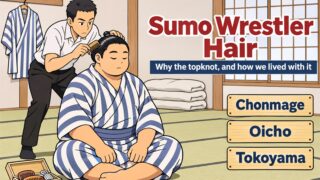
I still remember one of those days at my stable.
The senior retiring that day was someone I was very close to. He sat there in a crested kimono, with his hair tied in an oicho, the formal topknot of the sekitori. Seeing him like that, a man who had always been close at hand suddenly felt very far away.
At the same time, loneliness welled up. There would be no more practice together, no more chanko together, no more fooling around and talking after lights out.
I couldn’t sort out what I was feeling. It was as if someone different from the usual him was sitting there, and I couldn’t act the way I normally did with him.
It was the end of his life in sumo. Was this a moment to congratulate him? To be sad? To thank him for his hard work?
As his junior, I never found the right words to say to him.
That left me with some regret about that day. Now, I could tell him thank you. As a teenager, I couldn’t.
Money is decided by rank as well. A wrestler who reached juryo receives a lump sum called rikishi yorokin when he retires, and the lower-division wrestlers have a farewell payment with its own rule. Calling the yorokin a “retirement allowance” is not quite right, because in sumo a wrestler is not said to leave a job. He is said to retire from the ring.
The amounts and the conditions are in the salary article.
Sumo wrestler life expectancy: do sumo wrestlers die young?
The research says that sumo wrestlers have died younger than other Japanese men, particularly at ages 35 to 74, and that the risk has been higher for wrestlers with the highest BMIs. What the research I found does not give is a figure for how long today’s wrestlers will live.
What the 1995 study found
The fullest study I found was published in 1995 by Hoshi and Inaba. It followed all 664 wrestlers who reached makuuchi, the top division, between 1898 and 1991, retired wrestlers included, with deaths checked through the end of 1992.
Compared with Japanese men of the same ages and the same years, they died at 1.66 times the expected rate. By age, the gap looked like this.
On a phone, swipe sideways to see the whole table
| Age | Death rate compared with Japanese men of the same age (1.00 means the same) |
|---|---|
| 34 or younger | 0.87 |
| 35 to 44 | 1.75 (significantly higher) |
| 45 to 54 | 2.24 (significantly higher) |
| 55 to 64 | 1.98 (significantly higher) |
| 65 to 74 | 1.72 (significantly higher) |
| 75 or older | 1.06 |
The 328 wrestlers who had died did so at an average age of 56.0. That average rose steadily over the century.
- Died 1898 to 1947, average age at death 46.0
- Died 1948 to 1962, average age at death 57.5
- Died 1963 to 1977, average age at death 60.6
- Died 1978 to 1992, average age at death 65.2
The authors estimated the average age at death of Japanese men over 20 at 69.1 in 1985, so the wrestlers’ figure was still lower, though the gap had narrowed. They suggest that health care for wrestlers, including checkups twice a year by then, may be part of the reason.
Two of the factors they examined were statistically significant. Wrestlers with a BMI of 42 or more had 3.66 times the risk of death of those at 32.9 or less. For a wrestler 180 cm (5 ft 11 in) tall, that is roughly 136 kg (300 lb) against 107 kg (235 lb). Wrestlers who reached makuuchi in 1954 or earlier also had a higher death rate than those who reached it from 1955 on. Rank, holding an elder name, age on reaching makuuchi, and length of career were not statistically significant factors in this analysis.
Among the deaths from 1978 to 1992 with a known cause, heart disease came first, at 28.3 percent, against 17.9 percent for Japanese men in the same years. The authors add that the numbers were too small for a firm conclusion.
A 2009 case-control study drew on the records of 430 top-division wrestlers and compared 73 who had died with 73 survivors born in the same years. It also linked a higher BMI to death, as I explain in the diet article.
Source: Hoshi and Inaba, “Risk Factors for Mortality and Mortality Rate of Sumo Wrestlers,” Japanese Journal of Hygiene 50(3), 1995 (in Japanese with an English abstract) / Kanda et al., Journal of Sports Science and Medicine (2009)
Where the “around 65” figure comes from
Online you will often read that sumo wrestlers live to about 60 or 65. One place the figure appears is a 2025 conference abstract in the Journal of the Endocrine Society, which puts their life expectancy at around 65, at least ten years shorter than controls.
The abstract is a summary of earlier literature, though, and it does not say which data the figure comes from. It is close to the 65.2 above, but I cannot tell whether that is where it came from.
Keep in mind, too, that 65.2 was the average age at death of the wrestlers who died in one particular period. It was not a calculated life expectancy for sumo wrestlers as a whole.
What these studies cannot tell us
The 1995 study and the 2009 case-control study both looked only at wrestlers who had reached makuuchi, and the 2025 abstract reviewed earlier literature rather than following a new group of wrestlers. None of these sources covers the wrestlers who retire from the lower divisions, the much larger group that I belong to, and I could not find a study that does.
The underlying data are also old. In the 1995 study, only 20 of the 254 wrestlers who reached makuuchi from 1955 onward had died by the end of 1992, so even its most recent averages mostly reflect earlier generations. The authors themselves noted that wrestlers had been getting bigger over the years, and that the effect of the larger bodies might only show later.
So the honest answer is that sumo wrestlers have died younger than other men in the past, especially those with the highest BMIs, but the research I found does not establish a life expectancy for the wrestlers on today’s banzuke.
My own body after sumo
I can only speak for myself here, and this is not advice.
After I retired, I kept eating the same amount while my exercise dropped off sharply, and for a while my weight went up from 96 kg (212 lb) to about 98 kg (216 lb). That was part of why I started going to a gym almost every day, and after a year of it I was down to 80 kg (176 lb).
As of November 2026 my weight stays fairly steady, and I eat a lot less than I used to. I still eat more than most people.
My weight from entry to retirement, and how much wrestlers weigh, are in this article.
FAQ: Retired sumo wrestlers
Q1. When do sumo wrestlers retire?
A. There is no fixed age for a wrestler. Among the 664 top-division wrestlers in the 1995 study, the average age at retirement was 31.6. The age of 65 you may see is the mandatory retirement age for elders and other Association staff, which is a separate rule.
Q2. What is the life expectancy of a sumo wrestler?
A. The research I found does not establish one for today’s wrestlers. In the 1995 study of 664 top-division wrestlers, those who had died did so at an average age of 56.0, or 65.2 for deaths from 1978 to 1992, and they died at 1.66 times the rate of Japanese men of the same ages.
Q3. Do retired sumo wrestlers lose weight?
A. I can only answer for myself. After retiring I went up to about 98 kg (216 lb) for a while, then went to a gym almost every day for a year and came down to 80 kg (176 lb). That is one person’s experience, not a rule.
Q4. Do lower-ranked wrestlers get any money when they retire?
A. Yes. The Association’s rules include a farewell payment for wrestlers in makushita and below, and a wrestler in sandanme or below qualifies only after 15 tournaments or more. The details are in the salary article.
Q5. Can any retired wrestler become an oyakata?
A. No. He needs Japanese citizenship and a record in the salaried ranks, such as 20 tournaments in makuuchi, 30 as a sekitori, or at least one in sanyaku. One of the 105 elder names also has to be vacant.
Q6. What is the difference between “intai” and “haigyo”?
A. Both describe a wrestler leaving the ring. Until November 1996, a wrestler who stayed in the Association as an elder was said to retire, intai, while one who left without an elder name was said to quit, haigyo. Since then every wrestler is said to retire, and haigyo is no longer used.
Summary
What happens to a retired sumo wrestler depends on how far he rose and who he knows. Some stay on as elders or staff, while others, like me, start work with no job experience at all. One senior of mine opened a chanko shop, and I spent 21 years in care work.
Life after sumo can be hard, and I still carry the feeling that I failed to rise. Even so, I think whether it is a tragedy or a comedy depends on how the person takes it.
Next time you watch a bout, spare a thought for the wrestler who lost, as well as the one who won.
The banzuke records a single tournament, nothing more.
The years that never reached it do not vanish. Walking on without an answer is not weakness.