Sumo Tickets: How to Buy in English, Seat Prices, and Which Seat to Pick, from a Former Rikishi
I have sat in a box seat at the Ryogoku Kokugikan as a spectator only once. It was not a grand tournament but a retirement sumo event for someone I knew, and I went with a former wrestler who had been my junior, and with my son, who had not yet started school.
My junior and I are both big men, so our shoulders were touching from the moment we sat down, and I could not stretch my legs out. Even so, I had watched sumo on television more times than I could count, and the heat coming off the crowd around me was nothing like it.
Hello, I’m Shinzaburo, a former sumo wrestler.
Sumo tickets for the grand tournaments can be bought in English, on the official ticket site. General sale opens at 10:00 a.m. Japan time, about one month before the first day for Tokyo and Osaka and about two months before for Nagoya and Fukuoka. With seats from ringside to the back row at very different prices, though, which one should you actually buy?
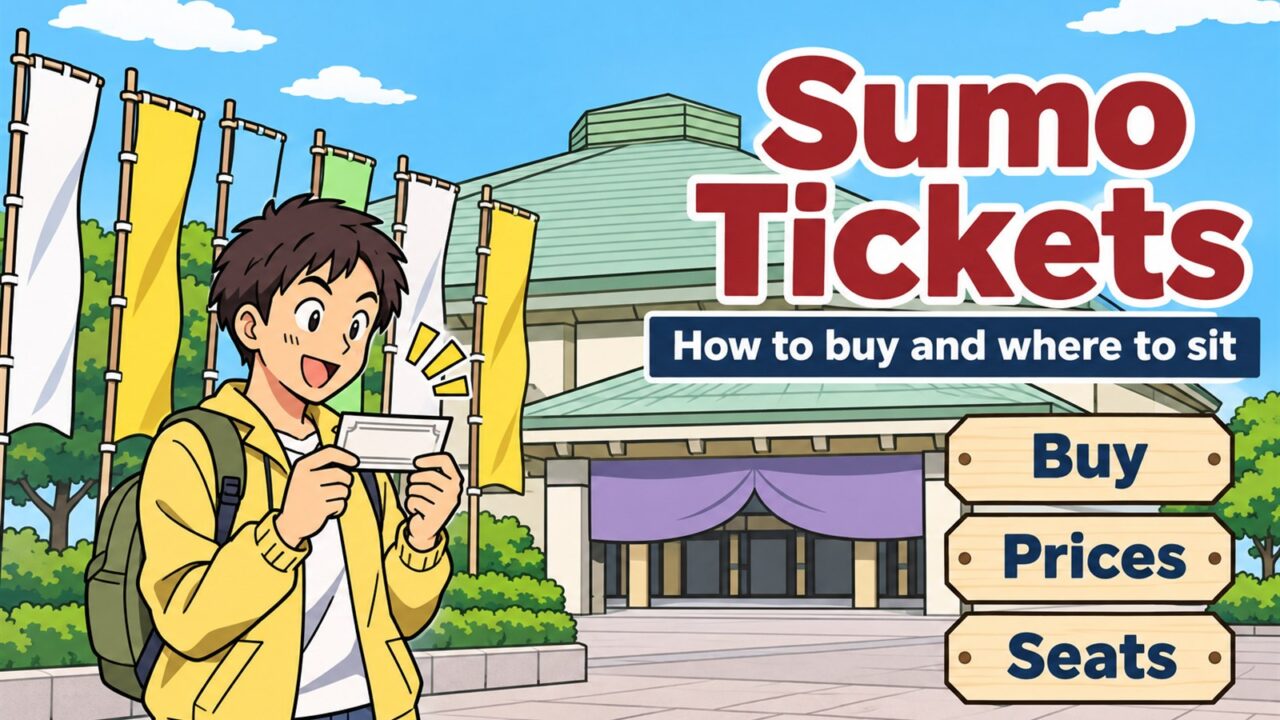
This article explains how to buy sumo tickets on the official English site, what each seat costs, which seat I would pick as a former rikishi, and what you can still do if the tickets sell out.

Can you really buy them in English? I’d pictured a lot of forms I couldn’t read.
And box, chair, ringside. I can’t even tell which one I’d want.

Where to buy sumo tickets: the official English site
The official place to buy sumo tickets in English is Ticket Oosumo English, at sumo.pia.jp/en/. The Nihon Sumo Kyokai, the sumo association, sends buyers there from the How to Buy page of its own English site.
For the January 2027 tournament at Ryogoku Kokugikan, which runs from January 10 to 24, sales open on December 5, 2026, at 10:00 a.m. Japan time. Before you buy, these are the terms to know.
On a phone, swipe sideways to see the whole table
| Item | What to know |
|---|---|
| Payment | Credit card only |
| Fee | ¥2,000 per ticket |
| Pickup | Printed at a 7-Eleven store in Japan. Your seat number is shown when the ticket is printed |
| Changes | No changes or refunds for any reason. A lost ticket means no entry |
| Seats sold in English | Box A, Box B, Box C (4 people), Chair S, Chair A, Chair B, Chair C |
Source: Ticket Oosumo English, January Grand Tournament
Two of those rows are worth reading twice. Because the ticket comes only out of a 7-Eleven in Japan, you collect it after you arrive, and once you have paid, the date and the seat are fixed. It makes sense to settle your travel dates first and buy after that.
How to buy sumo tickets in English, step by step
Buying from abroad, or from inside Japan, comes down to five steps.
- Check the general sale date for your tournament. Sales open at 10:00 a.m. Japan time
- On Ticket Oosumo English, choose the day and the seat
- Pay by credit card. The fee is ¥2,000 per ticket
- Keep the purchase completion screen and the email. They explain how to pick up your ticket
- After you arrive in Japan, print the ticket at a 7-Eleven, and bring it with you on the day
What the English site does not sell
The English site keeps to the four-person boxes and the four main chair grades. Ringside seats, called tamari-seki, and Box S, the highest-priced four-person box, are sold only on the Japanese site, Ticket Oosumo. The same goes for the boxes for one, two, three, five or six people and for Chair D in the back row.
If one of those is the seat you have in mind, you will be buying it on the Japanese pages.
Advance lotteries
Before general sale opens, some seats go out by lottery. For the November 2026 tournament, the English site held a lottery of its own, the International Advance Lottery, and every ticket bought through it carried a special sales fee of ¥550 on top of the usual fee.
Source: Ticket Oosumo English, November Grand Tournament
That does not mean every tournament gets one. As of November 8, 2026, no English lottery has been announced for the January 2027 tournament.
The general sale dates for all six tournaments of 2027, along with when the January lotteries begin, are in my guide to the sumo schedule.
Not every ticket comes through a website. How my own family got tickets, I know only secondhand. While I was wrestling, they came to watch me without telling me, and I had no idea they were there. I understand the tickets were arranged through the stable’s supporters’ association.
Sumo ticket prices: from ringside to the back row
What a seat costs depends on where it is and on the day. These are the figures for the January 2027 tournament at Ryogoku Kokugikan. Prices include tax, and buying on the English site adds the ¥2,000 fee per ticket on top.
On a phone, swipe sideways to see the whole table
| Seat | Weekday | Weekend and holidays | Day 14, final day | For |
|---|---|---|---|---|
| Ringside (tamari) | ¥25,000 | ¥27,500 | ¥30,000 | 1 person, 16 and over |
| Box S (4 people) | ¥72,000 | ¥80,000 | ¥88,000 | 4 people |
| Box A (4 people) | ¥60,000 | ¥66,000 | ¥72,000 | 4 people |
| Box B (4 people) | ¥44,000 | ¥50,000 | ¥56,000 | 4 people |
| Box C (4 people) | ¥38,000 | ¥42,000 | ¥46,000 | 4 people |
| Chair S | ¥11,000 | ¥12,000 | ¥13,000 | 1 person |
| Chair A | ¥10,000 | ¥11,000 | ¥12,000 | 1 person |
| Chair B | ¥6,000 | ¥7,000 | ¥8,000 | 1 person |
| Chair C | ¥5,000 | ¥6,000 | ¥7,000 | 1 person |
| Chair D (adult) | ¥3,000 | ¥3,000 | ¥3,000 | 1 person |
| Chair D (child, 4 to 15) | ¥500 | ¥1,000 | ¥1,000 | 1 person |
Source: Nihon Sumo Kyokai, January 2027 ticket prices (in Japanese)
From the January 2027 tournament, ticket prices were revised in Tokyo and Osaka, while Nagoya and Kyushu stayed as they were. A Tokyo price you remember from an earlier visit may no longer match.
Source: Nihon Sumo Kyokai, notice on the ticket price revision (in Japanese)
A box price is for the whole box, so the numbers look bigger than they are. Split a weekday Box B, ¥44,000, four ways and each person pays ¥11,000, the same as a weekday Chair S. From ringside to Chair C, every seat costs more at weekends and on holidays, and more again on Day 14 and the final day.
As for the chair seats, all of them are on the second floor. Chair S covers rows 1 to 3, A rows 4 to 6, B rows 7 to 11, C rows 12 to 13 and D the last row, row 14. Chair D is the only seat with a children’s price.
Box seats
A box seat is a masu-seki in Japanese. At the Kokugikan each box is a square about 1.3 meters on a side, and four people sit in it on cushions laid over the wooden floor, with their shoes off. The boxes rise in steps as they move back from the ring, so a box near the back still looks over the ones in front.
Boxes are sold only as whole boxes, and one person in a four-person box pays the four-person price. Along the aisles there are also odd-shaped boxes for one, two, three, five or six people. If four does not suit your group, the Association’s price list linked under the table shows those sizes and their prices, though it is in Japanese.
Ringside seats
The ringside seats are the tamari-seki, the rows right below the ring, also nicknamed sunakaburi, literally “covered in sand.” Each one is for a single person, and only people aged 16 and over can sit there. Eating, drinking and smoking are not allowed in those rows.
The Association also warns that, being right beside the ring, these seats carry a high risk of a wrestler or a gyoji, the referee, falling into them. Photography without permission and the use of mobile phones are banned there as well.
Source: Sumo Daijiten, 4th ed. (Kanazashi Motoi, Gendai Shokan), entry “Masuseki”, entry “Tamariseki” / Nihon Sumo Kyokai, rules for spectators (in Japanese)
¥44,000 looked like a lot until I split it four ways.
If I go on my own, though, I’d be paying for three empty cushions.
Which seat should you choose? A former rikishi’s pick
If it is your first time and you are going anyway, my pick is a box seat. You can sit on a chair at any other sport or at the theater, but taking off your shoes and sitting cross-legged to watch is something only sumo gives you. To me that is a piece of Japanese culture, and the real pleasure of watching sumo.
If sitting on a cushion for hours would be hard on your knees or back, the chair seats are there for exactly that.
My own time in a box comes down to one day, and it was not even a grand tournament.
It was a long time ago, and parts of it are hazy. My son was about five at the time.
Three of us in a box for four, and honestly, it was still tight. That was down to us, not the box. My junior and I both had a wrestler’s build, and our shoulders touched. I could not stretch my legs out either, which was partly the shape of the box.
Once we had settled in and the bouts began, though, the squeeze stopped bothering me.
“This is our place.”
That is what I felt. The square was ours to use, and that felt different from a chair seat, where everyone has a seat of their own.
My son watched quietly. He may not have understood what was going on, but he was as curious about the people around us as about the ring, and I think he enjoyed himself.
That same day, from the same box, I saw a yokozuna’s ring-entering ceremony live for the first time. I still have not found the right word for what the power of his shiko, the leg-stamping, did to me. What I can say is that the cheering and clapping, with the whole crowd as one, was something television had never given me.

I’m not exactly small myself, so I know how that goes.
A box for four doesn’t mean any four people will be comfortable. Think about who you’re going with, not just how many.
Choose by the size of your group
Start from the number of people, then pick the seat.
- Four people, a four-person box. The English site sells Box A, Box B and Box C
- Three people, a four-person box, paid at the four-person price
- One person, a chair seat, or a one-person box along the aisle, which is sold on the Japanese site
- Anyone under 16 in the group, a box or a chair, because ringside is for 16 and over
Can the wrestlers see you from the ring?
From a box you can make out the wrestlers’ faces, so it is natural to wonder whether they can see yours.
Speaking only for myself, during a bout I never took in the crowd. Nerves narrowed my vision until all I was looking at was the gyoji and my opponent.
The moment a bout was decided was another matter. When a big, bold technique settled it, the cheering came with loud applause, and I felt a lift I still cannot put into words. The feeling of that roar has never left me.
Faces I did see, once, at that retirement event. I stepped up onto the ring to make my cut at the danpatsushiki, the hair-cutting ceremony, and with no bout to fight, I could see the expressions of the people sitting right below.
If sumo tickets are sold out
Sumo tickets can sell out before a tournament even begins. If they sell out in advance, no tickets are sold on the day, so turning up at the venue to queue will not get you in. For the November 2026 tournament in Fukuoka, the top page of the English site said every day was sold out, with no same-day tickets, as of November 8, 2026.
There are still a few things to look at, though some carry more risk than others.
The official resale
Ticket Oosumo runs an official fixed-price resale, the teika resale. People who can no longer go put their tickets up, and you buy them at face value, plus the fees the seller paid when buying.
- Trading opens on the first Monday after general sale, or the next business day if that Monday is a public holiday
- A QR ticket can be listed until three days before the day it is for
- A ticket not yet printed can be listed until the day before
- Payment is by credit card only
Source: Ticket Oosumo, fixed-price resale (in Japanese)
So new seats can appear almost until the day itself. Keep in mind that the resale runs on the Japanese site, not the English one, so treat it as something to check rather than something to plan a trip around.
Tickets from resale sites and tours
Other sites resell sumo tickets as well. Resale or transfer without the organizer’s permission is prohibited, however, and a ticket obtained for that kind of resale may be refused at the entrance. Passing a ticket to family or friends without making any profit is the exception.
Some travel companies also sell tours with sumo tickets included. The same rule covers them, so before you book one, check that the company has the organizer’s permission.
Sumo outside the grand tournaments
If no ticket turns up, there is still sumo between the tournaments. The jungyo, the regional tours, take wrestlers around Japan, and hanazumo, exhibition sumo, includes events like the retirement sumo where I sat in my box. The months of the tours are in the schedule guide mentioned above.
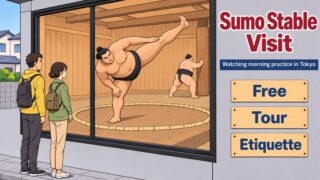
Between tournaments you can also watch a stable at morning practice. In Tokyo, Arashio Beya lets visitors watch for free, through a window. How to go, and the manners that matter, are in my guide to sumo stable visits.
Sold out sounds like the end of it.
But the closer a tournament gets, the more people find work or a cold keeping them away. I’d keep checking right up to the last few days.
On the day: what your sumo ticket gets you
Once you have a ticket, the whole day is yours. The bouts climb through the divisions from the morning until the end, around 6 p.m., and a few details are worth knowing before you go.
- One ticket covers the day, from the first bout in the morning to the last one
- Re-entry depends on the tournament. At the January tournament in Tokyo you may go out and come back once, by 5 p.m. At the November tournament in Fukuoka you may come and go as often as you like until 5 p.m. Check the ticket page for your tournament
- Doors for January 2027 open at 8:45 a.m., except 10:30 a.m. on January 22 and 23 and 10:00 a.m. on January 24
- Children aged four and over need their own ticket, and the English site lists no children’s discount
The full timetable of a tournament day, from the first bouts to the bow-twirling ceremony at the end, is in the schedule guide.
Going in the morning
Arrive in the morning and the wrestlers on the ring will be from the bottom divisions, jonokuchi and jonidan, where my own bouts were.
In those years, honestly, you could count the people watching. Even so, the ring was lit brighter than everything around it, and standing in that space made me oddly nervous.
The ring is not all there is to the Kokugikan, either. The Association’s English channel spent a day at the building, from the entrance to the food.
It runs a little over nine minutes and was filmed on Day 12 of the January 2023 tournament. Entering the Kokugikan comes at 0:25, former yokozuna Onokuni’s sweets shop at 1:15, the capsule-toy machines at 2:10, Kokugikan food at 3:05, lunch in the banquet hall at 4:23 and the bouts of juryo, the second division, at 5:10.
A former yokozuna’s sweets shop, and capsule toys too. I had no idea.
I think I’d go early just to wander around before the top division comes on.
FAQ: Sumo tickets
Q1. Can I buy sumo tickets in English?
A. Yes, including from outside Japan, on Ticket Oosumo English, the official ticket site. You pay by credit card when you buy, then print the tickets at a 7-Eleven after you arrive in Japan. Ringside seats and Box S are sold only on the Japanese site.
Q2. How much are sumo tickets?
A. For the January 2027 tournament in Tokyo, the English site starts at ¥5,000 for a weekday Chair C seat, plus a ¥2,000 fee per ticket. On the Japanese site, Chair D is ¥3,000 for adults. At the top end, a Box S is ¥88,000 on Day 14 or the final day, and a ringside seat is ¥25,000 to ¥30,000 per person.
Q3. Can I buy sumo tickets on the day?
A. Not if the tournament has sold out in advance. In that case no tickets are sold on the day.
Q4. Do children need a sumo ticket?
A. Yes, from the age of four, and a child under four needs one too if they will have a seat of their own. The English site lists no discount for children, and ringside seats are for ages 16 and over.
Q5. Is it safe to buy sumo tickets from resale sites?
A. A ticket resold without the organizer’s permission may be refused at the entrance, and that includes tickets inside unapproved tours or packages. The official fixed-price resale runs on the Japanese site.
Q6. Which seat is best for a first visit?
A. A box seat, if you ask me. Watching with your shoes off, sitting cross-legged on a cushion, is something you can only do at sumo.
Final thoughts
A sumo ticket buys you a cushion or a chair for one day. From either one, the two men on the ring can look a long way off, and it is easy to feel that you are only watching.
The sound carries, though. During a bout I never saw the people watching, but when a bout was decided their voices and their clapping reached me, and that roar is still with me.
So wherever you end up, in a box with your shoes off, in the back row of the chairs or among a handful of people in the morning, clap when a bout is decided. The wrestler may not see your face. Speaking from my own time up there, he will hear you.

A good seat is not the one nearest the ring.
It is the one you watch from with your whole heart.