Sumo Schedule 2027: Every Tournament Date, Venue and Start Time, from a Former Rikishi
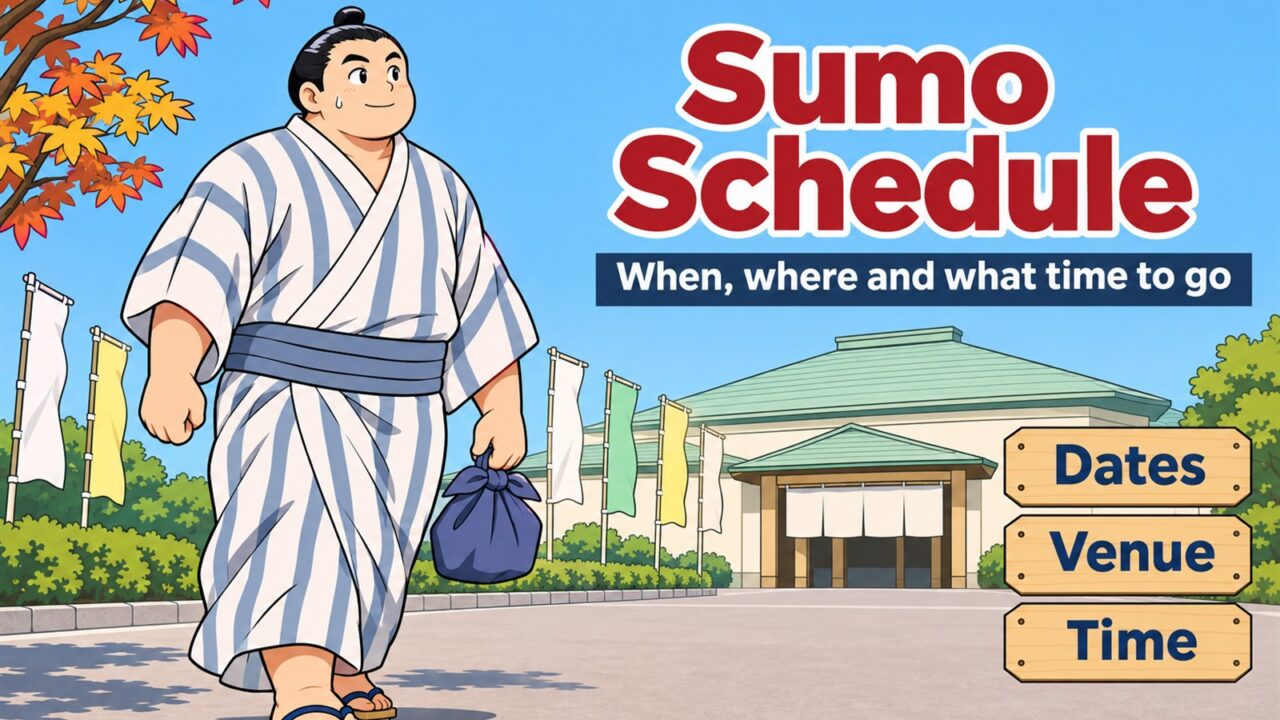
As a wrestler, I could go home to my family only during the one week off after a tournament, and even that took my stablemaster’s permission.
My family home was in the Kanto area around Tokyo, so I could have gone three times a year. In practice it was once a year, if that. There was no clear rule about it, but at my stable the normal thing was to go home with a winning record.
For me the sumo calendar was less a list of dates than a question of whether I would get to go home.
Hello, I’m Shinzaburo, a former sumo wrestler.
Grand sumo holds six official tournaments a year, one in every odd-numbered month. In 2027 they run January 10 to 24, March 14 to 28, May 9 to 23, July 11 to 25, September 12 to 26 and November 14 to 28, in Tokyo, Osaka, Nagoya and Fukuoka. So when do the rankings and tickets come out, and what time should you actually be in your seat?
This article explains when and where each of the six tournaments takes place, when the rankings and tickets come out, what time the top bouts start in Japan and where you live, and how that calendar felt from inside a stable.
Dates are the easy part. What I never know is what time to turn up.
Do I need to be there in the morning, or can I walk in after lunch?
- Grand sumo schedule 2027: all six tournaments
- How the sumo calendar works
- Where the tournaments are held
- What time does sumo start? A tournament day hour by hour
- How to watch sumo outside Japan
- Between tournaments: regional tours and quieter months
- What the schedule felt like from inside
- FAQ: Sumo schedule
- Final thoughts
Grand sumo schedule 2027: all six tournaments
Each basho, the Japanese word for a tournament, comes with more than a first and a final day. The table below also gives the day general ticket sales open and the day the banzuke, the ranking sheet, is released, for all six tournaments of 2027.
On a phone, swipe sideways to see the whole table
| Tournament | Venue | General sale starts | Banzuke released | First day | Final day |
|---|---|---|---|---|---|
| January | Ryogoku Kokugikan, Tokyo | Dec 5, 2026 | Dec 21, 2026 | Jan 10 | Jan 24 |
| March | EDION Arena Osaka | Feb 6 | Mar 1 | Mar 14 | Mar 28 |
| May | Ryogoku Kokugikan, Tokyo | Apr 10 | Apr 26 | May 9 | May 23 |
| July | IG Arena, Nagoya | May 15 | Jun 28 | Jul 11 | Jul 25 |
| September | Ryogoku Kokugikan, Tokyo | Aug 7 | Aug 30 | Sep 12 | Sep 26 |
| November | Fukuoka Kokusai Center | Sep 18 | Nov 1 | Nov 14 | Nov 28 |
Source: Nihon Sumo Kyokai, Grand Tournament Schedule
Read a row from left to right and you have the order things happen in, general sale first, then the banzuke, then the 15 days. For the January tournament, the first two of those dates fall in December 2026.
The final tournament of 2026 runs from November 8 to 22 at Fukuoka Kokusai Center, and its banzuke came out on October 26.
The 2028 schedule
The dates are set further ahead than that. As of November 2026, these are the first and final days for 2028.
On a phone, swipe sideways to see the whole table
| Tournament | First day | Final day |
|---|---|---|
| January | Jan 9 | Jan 23 |
| March | Mar 12 | Mar 26 |
| May | May 14 | May 28 |
| July | Jul 9 | Jul 23 |
| September | Sep 10 | Sep 24 |
| November | Nov 12 | Nov 26 |
The months stay the same as in 2027, and only the days move.
How the sumo calendar works
Those dates follow a pattern, and once you know it you can get close to most of them without looking anything up.
Six tournaments, 15 days, always a Sunday start
Grand sumo has six tournaments a year, in January, March, May, July, September and November. Each one lasts 15 days, and both the first day and the final day fall on a Sunday. Across 2026, 2027 and 2028, all 18 tournaments begin on the second Sunday of the month.
The six-tournament year goes back to 1958. A Kyushu tournament, the one held in Fukuoka, was added in 1957 and a Nagoya tournament in 1958, which brought the total to six.
Source: Sumo Daijiten, 4th ed. (Kanazashi Motoi, Gendai Shokan), sumo history chronology
When the banzuke comes out
The banzuke usually comes out on a Monday, 13 days before the first day. Five of the six tournaments in 2027 follow that timing. January does not, and it is not the only date that has moved.
- January 2027, released December 21, 2026, 20 days before the first day
- January 2028, released December 24, 2027, 16 days before
- May 2028, released April 24, 20 days before
- March 2026, released February 24, a Tuesday
So the 13-day count will get you close, but if a date matters to you, take it from the table and do not count back.
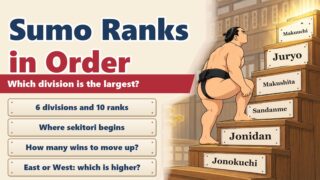
As for what the sheet itself shows, from the yokozuna at the top to the smallest print at the bottom, I have laid that out in my guide to sumo ranks.
When tickets go on sale
Tickets come first. Every tournament in the 2027 table goes on general sale before its banzuke is released. For Tokyo and Osaka that means about one month before the first day, and for Nagoya and Fukuoka about two months before. General sale opens at 10:00 a.m. Japan time.
The dates in the table are for that general sale, and advance lotteries come before it. For January 2027, the first lottery, for official fan club members, opens on November 14, 2026. Seats that sell out in the lotteries are not offered in the general sale.
Source: Ticket Oosumo, January tournament ticket page (in Japanese)
The two early sale dates are easy to miss. General sale for the July tournament opens on May 15, while the May tournament is under way, and for the November tournament on September 18, in the middle of the September tournament.
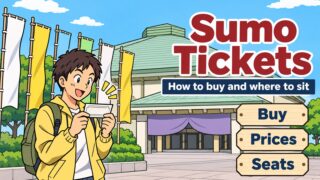
How to buy them on the official English site, what each seat costs and which seat I would pick are in my guide to sumo tickets.
The names you will see
One tournament can go by two names. The Nihon Sumo Kyokai, the sumo association, writes them in English as The January Tournament, The March Tournament and so on, and you will also run into the Japanese names.
On a phone, swipe sideways to see the whole table
| Month | English name | Japanese name |
|---|---|---|
| January | The January Tournament | Hatsu Basho |
| March | The March Tournament | Haru Basho (Osaka) |
| May | The May Tournament | Natsu Basho |
| July | The July Tournament | Nagoya Basho |
| September | The September Tournament | Aki Basho |
| November | The November Tournament | Kyushu Basho |
Hatsu, Haru, Natsu and Aki mean first, spring, summer and autumn, while the other two are place names, Kyushu being the island where Fukuoka sits.
So the first tournament of the year really gets going in December.
I’d better open my December calendar when I plan a January trip.
Where the tournaments are held
The six tournaments share four venues in four cities.
On a phone, swipe sideways to see the whole table
| Venue | City | Tournaments |
|---|---|---|
| Ryogoku Kokugikan | Tokyo | January, May, September |
| EDION Arena Osaka (Osaka Prefectural Gymnasium) | Osaka | March |
| IG Arena | Nagoya | July (since 2025) |
| Fukuoka Kokusai Center | Fukuoka | November |
Tokyo is the one city with more than one tournament, so the Tokyo sumo schedule is January, May and September, all three at the Kokugikan. Traveling in March, July or November means Osaka, Nagoya or Fukuoka.
My own first tournament was in Osaka, and although the unfamiliar surroundings made me ill at times, there was even more to enjoy, above all the takoyaki I ate there, soft and runny in the middle and unforgettable. A tournament away from Tokyo also meant getting our things packed and sent, so it was never restful, and just as I had settled in, it was time to go back to the stable in Tokyo.
Back in Tokyo, the Association’s English channel has a tour of the Kokugikan.
It runs a little over eight minutes and dates from October 2022. The suspended roof comes at 1:11, the championship portraits at 1:45, the Sumo Museum at 3:05 and the dressing room at 5:22.

The tournaments away from Tokyo were good too, but the stable in Tokyo was home, and that’s where I felt most at ease.
The buzz out in the regions and the calm of home. I needed both.
What time does sumo start? A tournament day hour by hour
Sumo starts in the morning and ends in the early evening, climbing through the divisions as it goes. The times below are for an ordinary day at the November 2026 tournament. Treat them as rough guides, because they shift a little from one tournament to another.
On a phone, swipe sideways to see the whole table
| Time (Japan time) | What happens |
|---|---|
| 8:45 a.m. | Doors open |
| Around 9:20 a.m. | Bouts from jonokuchi, the lowest division, up through makushita (maezumo, the new recruits’ bouts, from Day 3) |
| Around 2:15 p.m. | Juryo ring-entering ceremony |
| Around 2:35 p.m. | Juryo bouts |
| Around 3:40 p.m. | Makuuchi ring-entering ceremony |
| Around 3:55 p.m. | Yokozuna ring-entering ceremony |
| Around 4:10 p.m. | Makuuchi bouts (komusubi, sekiwake and ozeki after 5 p.m.) |
| Around 5:55 p.m. | Yumitori-shiki, the bow-twirling ceremony |
Source: Nihon Sumo Kyokai, November 2026 tournament viewing guide (in Japanese)
Read down the table and the day splits in two. The lower divisions fill close to five hours, and the sekitori, the wrestlers of the top two divisions, juryo and makuuchi, have the rest. The day ends around 6 p.m.
How the first and last days differ
Three parts of a tournament run to a different clock from that table.
On a phone, swipe sideways to see the whole table
| Day (Japan time) | Bouts begin | Juryo ring-entering | Makuuchi ring-entering |
|---|---|---|---|
| First day | 9:10 a.m. | 2:05 p.m. | 3:30 p.m. |
| Day 13 and Day 14 | 10:55 a.m. | 2:15 p.m. | 3:40 p.m. |
| Final day | 10:20 a.m. | 1:45 p.m. | 3:15 p.m. |
The final day also has the sanyaku-soroibumi, the ceremony of the top-ranked wrestlers, and the award ceremony.
The doors change with the bouts. In January 2027 they open at 8:45 a.m. as usual, but at 10:30 a.m. on January 22 and 23 and at 10:00 a.m. on January 24.
Source: Ticket Oosumo, January Grand Tournament
What time is that where you live?
From abroad, the stretch to look for is the makuuchi bouts, from around 4:10 p.m. to around 5:55 p.m. Japan time. Two columns are needed here because the clocks in these cities change during the year.
On a phone, swipe sideways to see the whole table
| City | January, November | May, July, September |
|---|---|---|
| Japan | 4:10 p.m. to 5:55 p.m. | 4:10 p.m. to 5:55 p.m. |
| London | 7:10 a.m. to 8:55 a.m. | 8:10 a.m. to 9:55 a.m. |
| New York | 2:10 a.m. to 3:55 a.m. | 3:10 a.m. to 4:55 a.m. |
| Los Angeles | 11:10 p.m. to 12:55 a.m. (the night before) | 12:10 a.m. to 1:55 a.m. |
| Sydney | 6:10 p.m. to 7:55 p.m. | 5:10 p.m. to 6:55 p.m. |
London gets the top bouts around breakfast, Sydney in the early evening and New York in the middle of the night.
March is left out of the table because the clocks change during it. In March 2027, New York follows the May column for all 15 days and Sydney follows the January column. London follows the January column until British Summer Time begins on the final day, March 28, and Los Angeles follows the May column from Day 2.
When to be in your seat
If the top division is what you came for, be in your seat 10 to 15 minutes before the makuuchi ring-entering ceremony. On an ordinary day that means around 3:30 p.m. On the first day and the final day the ceremony comes earlier, so count back from the times above.
Finding that seat in an arena you have never been inside is a small job of its own, and the Association has made a short guide to it in English.
It runs a little over six minutes and dates from November 2024. How to enter is at 0:33, how to find your seat at 1:30, and the notices during the matches at 4:28.
So I really can walk in after lunch. The first bouts are at 9:20 a.m., and the top division doesn’t appear for more than six hours after that.
I’d pictured sumo as a late-afternoon thing, but there are bouts going all day.
How to watch sumo outside Japan
If you are not in Japan, start with NHK WORLD-JAPAN. Its program GRAND SUMO Highlights carries daily highlights of a tournament, with background information and play-by-play commentary in English.
Source: NHK WORLD-JAPAN, GRAND SUMO Highlights
Highlights also get around the problem in the table above. If the top bouts fall at 3 a.m. where you live, you do not have to be awake for them.
Some days are shown live as well, under the name GRAND SUMO LIVE. In November 2026 that included Day 1, November 8, from 5:10 p.m. Japan time. Which days are live changes from one tournament to another, so for the NHK grand sumo schedule on any given day, check the NHK WORLD-JAPAN page linked above.
For results, the Association’s English site has the banzuke and a Matches & Results page, so a bout that finished while you were asleep is there to look up.
Between tournaments: regional tours and quieter months
A tournament takes up only 15 days out of every two months, which leaves a lot of room in the sumo year. Some of that room goes to the jungyo, the regional tours. The table shows how the 12 months fit together, using 2026 as the pattern, because as of November 2026 the Association has not published its 2027 tour dates.
On a phone, swipe sideways to see the whole table
| Month | Grand tournament | Regional tour or other sumo |
|---|---|---|
| January | January Tournament | No tour |
| February | None | No tour, two hanazumo events at the Kokugikan |
| March | March Tournament | Spring tour, from the end of the month |
| April | None | Spring tour |
| May | May Tournament | No tour |
| June | None | No tour, practice at the stables and training camps |
| July | July Tournament | No tour |
| August | None | Summer tour |
| September | September Tournament | No tour |
| October | None | Autumn tour |
| November | November Tournament | Winter tour, from the end of the month |
| December | None | Winter tour |
In the middle column the tournaments take every other month. The right-hand column fills most of the gaps, and February and June are the only two months with neither a tournament nor a tour.
The four regional tours
A jungyo takes sumo out to other parts of Japan between tournaments, and there are four a year, one each in spring, summer, autumn and winter. The destinations change from year to year, so treat the 2026 dates below as an example.
- Spring tour, March 29 to April 26
- Summer tour, August 2 to August 30
- Autumn tour, October 6 to October 25
- Winter tour, November 29 to December 20
Source: Nihon Sumo Kyokai, Tour Schedule
February and June
February belongs to hanazumo, exhibition sumo held while no grand tournament is running. The two events in the table are the NHK charity sumo and a knockout tournament, and their results have no effect on the banzuke.
Source: Sumo Daijiten, 4th ed. (Kanazashi Motoi, Gendai Shokan), entry “Hanazumo”
In June the stables keep up their practice, and some go off to training camps.
As for the tours, I only know them from the side that stayed behind, because I never went on one. While the sekitori were away, the work of looking after them stopped, and I will admit I was glad of the extra time to myself.
What the schedule felt like from inside
Everything so far has been the calendar anyone can read. From here on, this is about my own stable, in the years I was wrestling, and other stables will have done things their own way.
Before the tournament: building the ring
Before a tournament, we built the stable’s dohyo, the ring we practiced in, helping the yobidashi, the ring attendants who do this work. My part was mainly breaking up the old ring, and after that working the tako, the tool for ramming the earth down, four of us to a team, calling out together as we went.
Then came the tataki, the beating that firms up the surface. That took real skill and it was hard, and I could never do it. A few of my seniors could.
We kept at it until the day before the banzuke came out. At my stable, then, the date in the Banzuke released column also meant the ring was finished.
Banzuke day
At my stable, the job of collecting the printed banzuke went to a lower-division wrestler who had done especially well at the previous tournament. My stablemaster named him, for luck.
I did it once. It was an early start, and that alone was hard, and the sheets came in lots of 1,000, which turned out to be heavier than I expected. I carried them very carefully. If I dropped them, the good luck the job was supposed to bring would be gone, and if one tore or got dirty, I thought I would be scolded.
Then the sheets had to go out to the supporters of my stablemaster and the sekitori. We stamped each one with the right name, rolled them, wrapped them in large sheets of paper and took them to the post office. There were hundreds of sheets, and it took all the lower-ranked wrestlers together more than half a day. Only after that did I send my own to my family.
But the date I remember the calendar by is not in any of the tables above. It is the day after the final day.
At my stable, the week off began the day after the final day, and that week was the only time I could go home to my family. Even then, I needed my stablemaster’s permission.
Because my family home was in the Kanto area around Tokyo, I could have gone after each of the three Tokyo tournaments, three times a year. That was never really how it went, though. I went home once a year, if that.
New Year was no exception. We held a party at the stable on New Year’s Day, and the butsukari-geiko, the charging drill, was a little tougher than usual the next morning.
There was no clear rule, but the normal thing at my stable was to go home after kachi-koshi, a winning record.
The wrestlers from far away had one chance a year. Holding out for a winning record could keep one of them from home for years, so some went home after a losing tournament anyway. Others decided they would not go home on a losing record, and there were men who had not been home in about three or four years.
Three or four years without going home. That’s a long time.
You can’t see any of that on a banzuke.
FAQ: Sumo schedule
Q1. When is the next sumo tournament?
A. The tournaments fall in January, March, May, July, September and November. The first of 2027 runs from January 10 to 24 at Ryogoku Kokugikan in Tokyo, and the rest are in the table at the top of this article.
Q2. How many sumo tournaments are there in a year?
A. Six, one in every odd-numbered month. Three are in Tokyo, and Osaka, Nagoya and Fukuoka have one each.
Q3. How long does a sumo tournament last?
A. 15 days, from a Sunday to the Sunday two weeks later. The 2027 January tournament, for example, runs from January 10 to January 24.
Q4. When do sumo tickets go on sale?
A. General sale opens about one month before the first day for Tokyo and Osaka, and about two months before for Nagoya and Kyushu, at 10:00 a.m. Japan time. For the January 2027 tournament, the date is December 5, 2026, and the advance lotteries for it begin on November 14, 2026.
Q5. What time do the top wrestlers fight?
A. The makuuchi bouts begin around 4:10 p.m. Japan time, komusubi, sekiwake and ozeki come on after 5 p.m., and the yumitori-shiki follows around 5:55 p.m. Those are rough guides from the November 2026 tournament, and they shift a little from one tournament to another.
Q6. Is there any sumo in February or June?
A. Going by the 2026 calendar, neither month has a grand tournament or a regional tour. February has two hanazumo events at the Kokugikan, the NHK charity sumo and a knockout tournament. June has practice at the stables and training camps.
Q7. When is sumo in Tokyo?
A. In January, May and September, at Ryogoku Kokugikan. In 2027 that means January 10 to 24, May 9 to 23 and September 12 to 26.
Final thoughts
A schedule tells you where to be and when. It cannot tell you what a final day means to the men on the banzuke.
At my stable, the day after the final day was when the week off began, and the record from those 15 days had a say in whether I went home.
When the final-day results reach you, whichever month it is, think of a wrestler at a stable like mine, waking up the next morning with a week in front of him and a record that may or may not take him home.

Fifteen days on the dohyo rest on the days between tournaments.
A wrestler lives those days too.