Sumo Wrestler Salary: How Much Sumo Wrestlers Make, and Why Most Are Paid No Salary, from a Former Rikishi
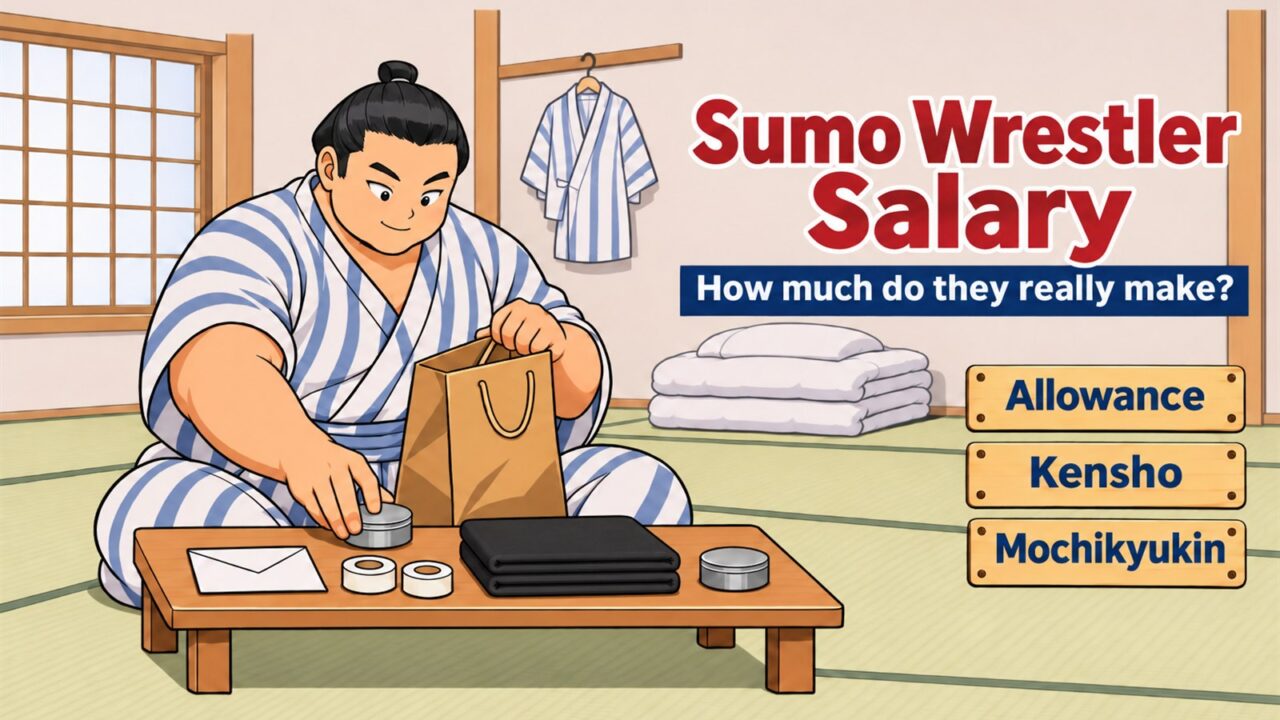
When I was in jonokuchi, the lowest division, the allowance I received after a tournament was a little over 70,000 yen, if I remember right. The next one would not come for two months, so I got by on about 30,000 yen a month.
The reason that worked without a monthly salary is that the stable gave me a place to live and fed me. The allowance paid for everything I needed beyond a roof over my head and the meals the stable cooked.
Hello, I’m Shinzaburo, a former sumo wrestler.
A sumo wrestler’s pay is set by rank. A yokozuna is paid 3,000,000 yen a month, about $19,000, while the wrestlers in the four lowest divisions are paid no monthly salary at all. So how does a wrestler outside the top two divisions live, and what does a winning tournament add on top?
In this article I’ll lay out the monthly salary at each rank and the raise coming in January 2027, the allowance and win money paid below juryo, the prize money and kensho envelopes that come on top, and what I spent my own jonokuchi allowance on.

$19,000 a month for a yokozuna. I had no idea the top of sumo paid like that.
What I really want to know is the other end, though. No monthly salary at all sounds hard to live on.

- How much does a sumo wrestler make? Monthly salary by rank
- Below juryo there is no salary: the allowance per tournament
- Prize money, kensho envelopes and the mochikyukin bonus
- What a sumo wrestler pays for and what the stable covers
- Money that does not come from the Association
- FAQ: Sumo wrestler salary
- Q1. How much do sumo wrestlers make a month?
- Q2. How much does a yokozuna make a year?
- Q3. Do all sumo wrestlers get paid?
- Q4. How much does a sumo wrestler make per match?
- Q5. How much is in a kensho envelope?
- Q6. Do sumo wrestlers pay for food and housing?
- Q7. What happens to pay when a wrestler drops from juryo to makushita?
- Q8. Is there a payment when a wrestler retires?
- Final thoughts
How much does a sumo wrestler make? Monthly salary by rank
A sumo wrestler’s monthly salary comes from the Nihon Sumo Kyokai, the sumo association, and the amount is fixed by his rank on the banzuke, the ranking sheet. Only the top two divisions, makuuchi and juryo, are on that payroll.
So promotion into juryo is the line where a salary begins, and the Association films the press conference that marks it. The video below is from its official channel.
The two wrestlers are Hyugamaru 日向丸 and Fujiryoga 藤凌駕, whose promotion to juryo was announced on October 1, 2025, three days after the September tournament ended. The conference is in Japanese. Fujiryoga has since climbed to maegashira 1, the top of the rank-and-file, for the November 2026 tournament.
Yokozuna to juryo: pay before and after January 2027
On July 30, 2026, the Association’s board approved a raise in pay for the salaried wrestlers, the first since 2019, to take effect from the January 2027 tournament. Here is the monthly salary at each rank on both sides of that date. The figures are the amounts the Association pays, before tax, not take-home pay.
On a phone, swipe sideways to see the whole table
| Rank | Until the November 2026 tournament | From the January 2027 tournament |
|---|---|---|
| Yokozuna | 3,000,000 yen (about $19,000) | 3,300,000 yen (about $20,900) |
| Ozeki | 2,500,000 yen (about $15,800) | 2,750,000 yen (about $17,400) |
| Sekiwake and komusubi | 1,800,000 yen (about $11,400) | 2,000,000 yen (about $12,650) |
| Maegashira | 1,400,000 yen (about $8,850) | 1,550,000 yen (about $9,800) |
| Juryo | 1,100,000 yen (about $6,950) | 1,200,000 yen (about $7,600) |
Source: Nikkan Sports, “Yokozuna monthly pay up 300,000 yen” (July 30, 2026, in Japanese), and Jiji Press via Adnkronos (July 30, 2026)
Dollar figures are rounded, at about 158 yen to the dollar (rate for November 3, 2026).
Reading down the table, each row is a rank or a group of ranks, and the pay drops with each row. Yokozuna, ozeki, sekiwake and komusubi are the four titled ranks at the top of makuuchi, maegashira is the rest of that division, and juryo is the division below it.
A salary starts at juryo
The table covers a small group. Of the 593 wrestlers on the November 2026 banzuke, 70 are paid a monthly salary. Those 70 are the 42 in makuuchi and the 28 in juryo, and together they are the sekitori, the salaried wrestlers.
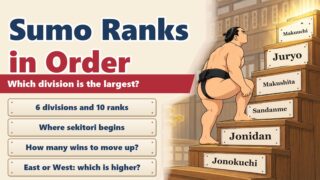
The salary is not the only thing that changes at that line. A sekitori also gets a private room at the stable, a lower-ranked wrestler as his attendant, a silk belt for tournaments and a different topknot, and I have put all of those differences side by side in my guide to sumo ranks.
What a yokozuna makes in a year
On the salary alone, a yokozuna is paid 36,000,000 yen a year, about $227,000, until the end of 2026, and 39,600,000 yen, about $250,000, from the January 2027 tournament. That is twelve months of the figure in the table.
On top of the salary, sekitori are paid a bonus twice a year, each one equal to a month’s salary, which brings a yokozuna’s salary and bonus for 2026 to 42,000,000 yen, about $265,000. There is also a special tournament allowance of up to 200,000 yen per tournament for a yokozuna, with the amount depending on how many days he competes, and the mochikyukin bonus, a performance bonus paid every tournament.
Source: Money Post WEB (Shogakukan), February 1, 2025, in Japanese, and the same site, October 2, 2026
The published figures are the ones the Association sets. What a wrestler actually takes in over a year, with prize money, kensho and the rest added, is a different number, and the tables in this article do not give it.
I was ready to be surprised by the yokozuna’s pay, but the number that stopped me was 70 out of 593.
So the other 523 wrestlers are on that same banzuke without a salary.
Below juryo there is no salary: the allowance per tournament
A wrestler in makushita, sandanme, jonidan or jonokuchi, the four divisions below juryo, is paid nothing month to month. Instead, he is paid after each of the six tournaments a year, and the amount depends on his division and on how many bouts he won.
Spread over the two months between tournaments, the jonokuchi allowance of 77,000 yen comes to about 38,500 yen a month, and the 82,000 yen paid from January 2027 to about 41,000 yen. Those are monthly equivalents, not a monthly salary. No allowance arrives in the month in between.
Trainees are paid six times a year
The Association’s official term for these wrestlers is rikishi yoseiin, which is usually rendered in English as trainee.
Source: Sumo Daijiten, 4th ed. (Kanazashi Motoi, Gendai Shokan), entry “Rikishi yoseiin”
A trainee’s pay comes in three parts, and each part is counted in a different unit.
- Tournament allowance, a fixed amount for the division, paid once per tournament
- Win money, one payment for every bout won
- Kachi-koshi money, one payment for every point of a winning record
A trainee fights seven bouts in a fifteen-day tournament, as a rule, so each of those seven bouts moves the second and third parts.
Allowance by division
The tournament allowance is the largest of the three, and it was raised in the same July 2026 revision as the sekitori salaries. Here it is by division.
On a phone, swipe sideways to see the whole table
| Division | Allowance per tournament, until Nov 2026 | From Jan 2027 |
|---|---|---|
| Makushita | 165,000 yen (about $1,040) | 180,000 yen (about $1,140) |
| Sandanme | 110,000 yen (about $695) | 120,000 yen (about $760) |
| Jonidan | 88,000 yen (about $555) | 95,000 yen (about $600) |
| Jonokuchi | 77,000 yen (about $485) | 82,000 yen (about $520) |
Source: Daily Sports, “Wrestler pay and allowances also rise” (July 30, 2026, in Japanese)
The source lists the last row as “jonokuchi and below.”
The amount is set by division, not by position inside it. In my day too, the allowance was the same whether you were at the top of jonokuchi or the bottom, and it changed only when your division changed.
Win money and kachi-koshi money
The other two parts ride on results. Win money is paid for each bout won, whatever the final record, and kachi-koshi money is paid for each point of a winning record. A point is wins minus losses, so 4-3 is one point, 6-1 is five points and 7-0 is seven. In a losing tournament there are no points, so no kachi-koshi money, but the win money for the bouts won is still paid.
On a phone, swipe sideways to see the whole table
| Division | Per win, until Nov 2026 → from Jan 2027 | Per kachi-koshi point, until Nov 2026 → from Jan 2027 |
|---|---|---|
| Makushita | 3,500 → 4,000 yen | 8,000 → 10,000 yen |
| Sandanme | 3,000 → 3,500 yen | 6,500 → 8,500 yen |
| Jonidan | 2,500 → 3,000 yen | 5,500 → 7,500 yen |
| Jonokuchi | 2,500 → 3,000 yen | 5,500 → 7,500 yen |
These figures come from the same July 2026 revision as the allowance table. Set beside the allowance, the amounts look small, but with only seven bouts in a tournament, each win shows up clearly in what a trainee is paid for the tournament.
Two worked examples
Put the three parts together and a tournament’s pay below juryo looks like this. The first example is a makushita wrestler who goes 6-1, the second a jonidan wrestler who goes 4-3.
- Makushita, 6-1 (5 kachi-koshi points)
Until Nov 2026, 165,000 + 3,500 × 6 + 8,000 × 5 = 226,000 yen (about $1,430)
From Jan 2027, 180,000 + 4,000 × 6 + 10,000 × 5 = 254,000 yen (about $1,600) - Jonidan, 4-3 (1 kachi-koshi point)
Until Nov 2026, 88,000 + 2,500 × 4 + 5,500 = 103,500 yen (about $655)
From Jan 2027, 95,000 + 3,000 × 4 + 7,500 = 114,500 yen (about $725)
Over a year, a wrestler who stays in the same division collects the allowance six times. On the allowance alone that is 990,000 yen (about $6,250) in makushita and 462,000 yen (about $2,900) in jonokuchi until the November 2026 tournament, rising to 1,080,000 yen and 492,000 yen from January 2027, with the win money and kachi-koshi money on top.

The seventh bout at 3-3 is the one. Win it and you get the win money and the kachi-koshi money both, lose it and the kachi-koshi money is zero.
That’s the one bout where my body always went stiff.
Prize money, kensho envelopes and the mochikyukin bonus
The salary and the allowance are the base. On top of them sits the money that depends on winning: championship prize money and the three special prizes, kensho, and mochikyukin. The same July 2026 board meeting raised the prize money and the special prizes.
Championship prize money by division
Each of the six divisions has its own championship, and each champion receives prize money from the Association. The makuuchi prize doubles from January 2027, its first revision in 33 years.
On a phone, swipe sideways to see the whole table
| Division | Until Nov 2026 | From Jan 2027 |
|---|---|---|
| Makuuchi | 10,000,000 yen (about $63,000) | 20,000,000 yen (about $126,000) |
| Juryo | 2,000,000 yen | 3,000,000 yen |
| Makushita | 500,000 yen | 700,000 yen |
| Sandanme | 300,000 yen | 500,000 yen |
| Jonidan | 200,000 yen | 300,000 yen |
| Jonokuchi | 100,000 yen | 200,000 yen |
Source: Nikkan Sports, “Championship prize doubled, first revision in 33 years” (July 30, 2026, in Japanese)
From January 2027, one makuuchi championship is worth about six months of a yokozuna’s new salary.
The three special prizes
Alongside the championship, three special prizes can go at the end of each tournament to makuuchi wrestlers below the rank of ozeki, for Outstanding Performance, Fighting Spirit and Technique. Each prize is worth 2,000,000 yen until the November 2026 tournament and 3,000,000 yen from January 2027.
Kensho: the envelopes handed over on the dohyo
Then there is the money that changes hands in front of the crowd. Kensho is sponsor prize money placed on a single bout. A sponsor pays 70,000 yen (about $440) per banner, the banners are paraded around the dohyo, the ring, before the bout, and the winner receives a stack of envelopes from the referee. Kensho is placed only on makuuchi bouts.
- 70,000 yen per banner, of which 10,000 yen is the Association’s fee and 60,000 yen (about $380) goes to the winning wrestler’s side (since the September 2019 tournament)
- Of that 60,000 yen, 10,000 yen is in the envelope handed over on the dohyo (since the May 2025 tournament, down from 30,000 yen), 20,000 yen is paid by bank transfer, and 30,000 yen is set aside against the wrestler’s tax
- The loser receives nothing, and neither does a wrestler who wins by default when his opponent is absent
Source: Nihon Sumo Kyokai, “About kensho” (in Japanese), and Nikkan Sports, “Cash portion of kensho cut from 30,000 to 10,000 yen” (May 9, 2025, in Japanese)
So the thick stack a popular wrestler carries off the dohyo is a stack of 10,000-yen envelopes, one per banner, and the larger part of each banner’s money reaches him later by other routes.
Mochikyukin: a running total that never goes down
The last of them is the quietest, because nothing is handed over in public. Mochikyukin is a performance bonus built on a running total kept in yen.
A wrestler starts at 3 yen when his name first appears on the banzuke. Every point of a winning record adds 50 sen (half a yen), a kinboshi, a win by a maegashira over a yokozuna, adds 10 yen, a makuuchi championship adds 30 yen, and a championship with a perfect 15-0 record adds 50 yen. Nothing is ever subtracted, so a bad tournament leaves the total where it was.
The total itself is tiny. What is paid is 4,000 times the total, at every tournament, six times a year, and only to sekitori. Trainees build their totals from the moment they are on the banzuke, but the payment starts at juryo. Each sekitori rank also carries a guaranteed minimum, 40 yen for juryo, 60 yen for makuuchi, 100 yen for ozeki and 150 yen for yokozuna, and a wrestler whose own total is below it is paid as if he stood at the minimum. A yokozuna is therefore paid at least 600,000 yen (about $3,800) per tournament on this bonus. The total never falls, but the payment can. When a wrestler drops to a lower sekitori rank, he is paid on whichever is higher, his own total or the new rank’s minimum, and the payment stops altogether if he falls out of juryo, until he is back. One kinboshi, at 10 yen, is worth 40,000 yen every tournament for as long as the wrestler stays a sekitori. At the September 2026 tournament, yokozuna Onosato 大の里 stood at 260 yen, which came to 1,040,000 yen for that tournament.
So a kinboshi keeps paying long after the upset itself.
I’d always cheered a kinboshi for the upset. Now I’ll be cheering for the wrestler’s bank account too.
What a sumo wrestler pays for and what the stable covers
Everything so far is the system as the Association runs it. From here on, this is about my own stable, in the years I was wrestling, and I can only speak for how things were there.
Room and board are covered
A wrestler lives in the stable, and the meals are cooked by the wrestlers on kitchen duty. So I paid no rent and nothing for food. A place to sleep and something to eat were guaranteed, and to put it at its most extreme, I could have lived without a single yen.
The one meal the stable did not pay for was the late-night snack. The convenience-store bento after dinner came out of my own pocket, and what we bought and when we ate it is in my article on the sumo wrestler diet.

What I paid for out of my allowance
Beyond a bed and the meals, the rest was mine to pay for. These are the things my allowance went on, at the prices of the time.
- Everyday supplies, laundry detergent and shampoo, and bandages and disinfectant for cuts
- Practice gear, a black mawashi (the belt) at 800 yen per meter from the Ryogoku Kokugikan, tape (1 cm wide) at 100 yen a roll from the sumo clinic inside the Kokugikan, bandages torn from sarashi cotton cloth, towels and protein powder
- Yukata, the cotton summer kimono, tailored by someone who lived near the stable for 5,000 yen each
- Hair-oil money, 5,000 yen per tournament to the stable’s tokoyama, the hairdresser who ties the topknots
- Late-night snacks from the convenience store
The hair-oil money and the yukata on that list each have a story behind the price, and the kimono is missing from it for a reason.
Hair oil cost more before I could tie a topknot
The hair-oil money, called aburasen, is what a wrestler gives the tokoyama for the oil used on his hair. The comb and the paper cord that binds the topknot are supplied to the tokoyama by the Association, so what the wrestler covers is the sukiabura, the pomade itself.
Source: Sumo Daijiten, 4th ed. (Kanazashi Motoi, Gendai Shokan), entry “Aburasen”
My stable had its own tokoyama, so I handed over the 5,000 yen once per tournament. When I needed another stable’s tokoyama to tie my hair during a tournament, I brought the oil with me and asked him to do it.
The expensive stretch came before any of that. A new wrestler’s hair is not yet long enough to tie, and that in-between period is called zanbara. A topknot could not be tied yet, but the hair still had to be slicked straight back with sukiabura, and I bought that myself at a shop in Ryogoku. At the time it was 1,200 yen a tin, and over the two months between tournaments I went through five or six, though I think that varies from person to person.
Once the topknot could be tied, 5,000 yen a tournament to the tokoyama worked out cheaper than buying the oil, so I wanted to be able to tie mine as soon as I could.
Kimono were hand-me-downs
The kimono was the opposite case. I never bought one. I was given one when I entered, and after that it was up to each wrestler to provide his own, but I knew how much they cost and never even considered it.
Instead, a senior with a build close to mine looked after me, and now and then he passed a kimono down. For some reason he owned a good many of them. He was strong and popular, so perhaps he had a tanimachi, a patron who supports a wrestler personally. At the stable, the wrestlers all wore kimono that looked much alike, and stepping out in a different one took some nerve. Once I had it on, though, I did feel a little superior.
The yukata cloth came the same way. The bolts were given to me by my stablemaster or by a sekitori, and I think stablemasters and sekitori give them to one another, so there are bolts left over, and some of those came to us. What I paid for was the tailoring.
Getting by on about 30,000 yen a month
So in my case, the money I actually lived on came to about 30,000 yen a month, about $190, and I managed inside that. In the tournaments where it went well, a little was left when the next allowance came, and that went into savings or into something I enjoyed.
The trouble was the end of a tournament. Once the fifteen days were over and the tension let go, I wanted to go out, and there were tournaments where I spent past the budget. I did not manage to save much.
The last day of a tournament, when the tension finally lets go. My body remembers that feeling before my head does.
And the money went with it. By the time the next allowance came around, I’d be wondering where it had all gone.
Money that does not come from the Association
Not everything a trainee lives on comes through the Association’s books. Some of it is handed to him by people around the sumo world, and the first time it happened to me, I did not handle it well.
Goshugi: the first time I made kachi-koshi
A goshugi is a cash gift of congratulation. This is my own story, from the stable I belonged to, on the day I first made kachi-koshi, a winning record, in jonokuchi.
At the party on the final day of that tournament, three people or so each gave me a goshugi, and as I remember it, each one was 10,000 yen. I did not know their faces or their names, and I was very grateful.
At my stable, any goshugi you received was to be reported to the stablemaster’s wife, so that the stable could thank the giver properly later. A goshugi was not finished when you received it. Telling the stable who it came from was part of the same act.
My stablemaster had told me this himself, well before that day.
“You’ll need to thank them later, so find out who they are.”
But I was shy, and saying thank you on the spot was as much as I could manage. I never asked who they were.
That was the rule at my stable. How other stables handle a goshugi I do not know, and I think there are stables where you simply accept it and nobody reports anything.
Tsukebito: paid by the sekitori, not the Association
A tsukebito is a sekitori’s attendant, drawn from the trainees in his stable. The Association pays nothing for that work. If an attendant is given anything for it, it comes from the sekitori himself. When I was a sekitori’s tsukebito, he gave me about 30,000 yen at the end of each tournament. The amount seems to vary a great deal with the sekitori’s character and with how well the attendant does the job.
Mochi-pounding and tanimachi
There was also work outside the stable. Around the New Year, companies and organizations ask a stable to send wrestlers to pound mochi, the rice cake, at their events. I went once, and I remember receiving about 30,000 yen for it, passed on through my stablemaster.
A tanimachi is a patron who backs a wrestler or a stable out of his own pocket. The guests at a final-day party include the stable’s supporters. Nothing a tanimachi gives passes through the Association, so none of it appears in the tables above.
FAQ: Sumo wrestler salary
Q1. How much do sumo wrestlers make a month?
A. It depends on rank. Until the November 2026 tournament, a yokozuna is paid 3,000,000 yen a month (about $19,000) and a juryo wrestler 1,100,000 yen (about $6,950), with ozeki, sekiwake, komusubi and maegashira in between. From the January 2027 tournament, the range is 3,300,000 yen to 1,200,000 yen. The four divisions below juryo are paid no monthly salary, only an allowance per tournament.
Q2. How much does a yokozuna make a year?
A. On the salary alone, 36,000,000 yen (about $227,000) until the end of 2026, and 39,600,000 yen (about $250,000) from the January 2027 tournament. Sekitori are also paid a bonus twice a year, each one equal to a month’s salary. A special tournament allowance, the mochikyukin bonus, championship prize money and kensho come on top, so the salary is the floor, not the total.
Q3. Do all sumo wrestlers get paid?
A. A monthly salary goes to the 70 wrestlers in makuuchi and juryo, out of 593 on the November 2026 banzuke. The rest are paid after each of the six tournaments a year, with a tournament allowance for their division plus win money for each bout won and kachi-koshi money for each point of a winning record.
Q4. How much does a sumo wrestler make per match?
A. There is no fixed fee per bout. Below juryo, each win brings win money of 2,500 to 3,500 yen until the November 2026 tournament, and 3,000 to 4,000 yen from January 2027, depending on the division. In makuuchi, each kensho banner on a bout sends 60,000 yen (about $380) to the winner’s side.
Q5. How much is in a kensho envelope?
A. 10,000 yen per banner, since the May 2025 tournament. Of the 60,000 yen a winning wrestler’s side receives per banner, 20,000 yen is paid by bank transfer and 30,000 yen is set aside against tax.
Q6. Do sumo wrestlers pay for food and housing?
A. Not while they live in the stable, and every trainee does. The stable provides the room and the meals. A sekitori who has moved out of the stable, as a married sekitori may, pays for his own home. What a trainee pays for himself is the rest, from late-night snacks to the mawashi for practice, and at my stable that came to about 30,000 yen a month in my case.
Q7. What happens to pay when a wrestler drops from juryo to makushita?
A. The monthly salary stops with the first tournament he is ranked in makushita, and he is paid the makushita allowance instead, 165,000 yen (about $1,040) per tournament until the November 2026 tournament and 180,000 yen (about $1,140) from January 2027. The other things that change at that line, from the mawashi to the private room, are in my guide to sumo ranks.
Q8. Is there a payment when a wrestler retires?
A. For a wrestler who reached juryo, yes. On retirement he receives a lump sum called rikishi yorokin, set by the rank he reached, together with an addition for the number of tournaments served at each rank, and a yokozuna or ozeki may also receive a special merit payment on top. For trainees there is a farewell payment with its own rule, and a wrestler in sandanme or below qualifies only after 15 tournaments or more. The July 2026 decision doubles that farewell payment from the January 2027 tournament, and the reports of the decision gave no new figure.
Source: 裏まで楽しむ!大相撲 (Ura made Tanoshimu! Ozumo, KADOKAWA, 2017), and Tokyo Sports, “Makuuchi prize doubled, sekitori pay raised” (July 30, 2026, in Japanese)
What else a wrestler faces when he retires, from finding work to whether he can stay in sumo, I write about here.

Final thoughts
The names printed small near the bottom of the banzuke have an allowance behind them too, paid once every two months, and there are wrestlers running a whole life inside it. Some of what carried me through arrived from outside that allowance, a bolt of yukata cloth, a kimono passed down from a senior.
What I still carry from my first kachi-koshi is not the money. It is the three people whose names I never asked, and the thank-you that was all I could get out.
The next time you watch a bout from the lower divisions, give a thought to the people standing outside the ring for that wrestler, the ones his pay never shows.

One bout moves more than the allowance. The rank, and the next two months of a life, are settled on the same dohyo.
Seven bouts, and every one of them heavy.