Sumo Wrestler Hair: The Chonmage Topknot, the Oicho, and What Living With One Was Really Like, from a Former Rikishi
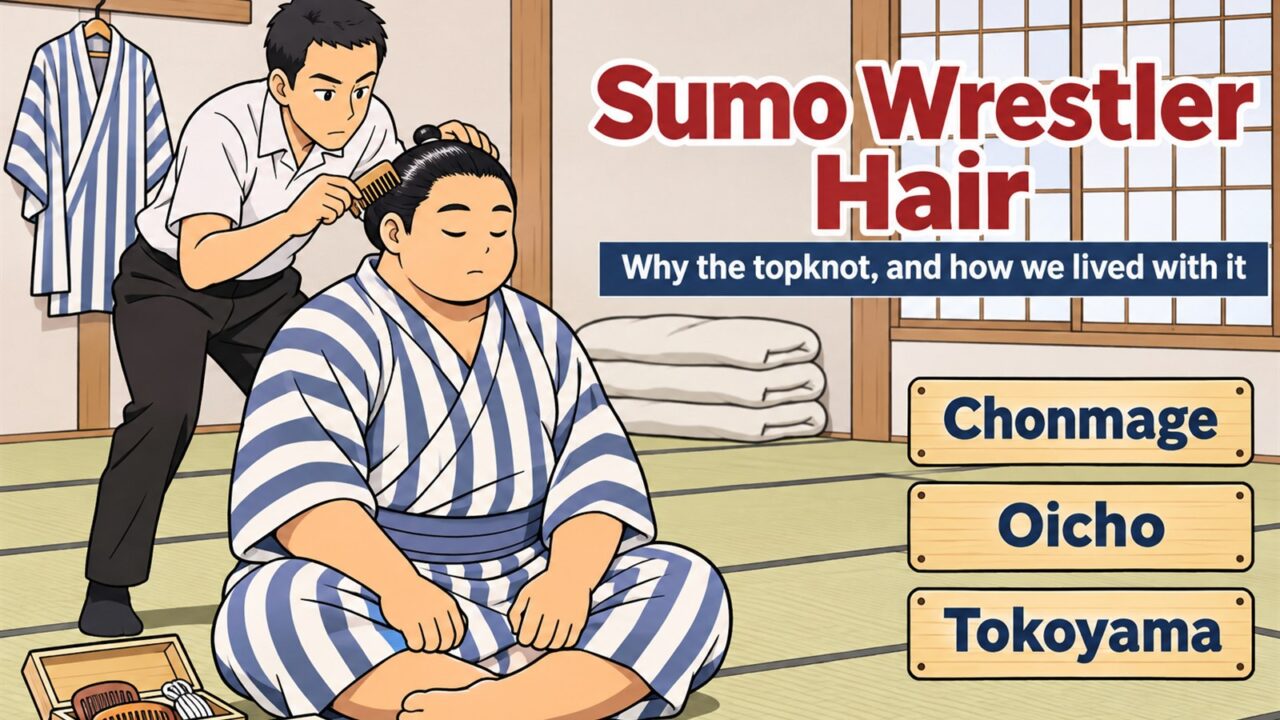
When I was in the lower divisions, the oicho was the hairstyle every one of us was dreaming of. I never made it to sekitori, so I never once had one tied on my own head.
Years after I left sumo, the broadcasts still do it to me. A sekitori appears with that fan of hair at the back of his head, and I think, that looks so good. The oicho is the one hairstyle I never got to wear, and I still feel that every time I see one on television. Just once would have been enough. It is a small thing, but it has stayed with me.
Hello, I’m Shinzaburo, a former sumo wrestler.
Once their hair is long enough, professional sumo wrestlers wear it in a topknot. The everyday one is called the chonmage, and the sekitori, the wrestlers in the top two divisions, have a larger one called the oicho tied for tournaments. If you have heard a wrestler’s hair called a bun, that is this topknot. So why does sumo keep a hairstyle the rest of Japan gave up in the 19th century, and what is it like to wash, sleep and train with one?
In this article I’ll explain where the chonmage comes from and what the rules actually say, how the oicho differs from the everyday knot, who ties them, and what living with a topknot was really like at my stable, from washing it to losing hair under it.
I had no idea the oicho and the everyday topknot were two different things. I thought every wrestler had the one.
And is it true they can’t wash their hair every day? I’ve heard that, and I never knew whether to believe it.
- Why do sumo wrestlers have a topknot? The chonmage
- Chonmage and oicho: the two sumo hairstyles
- Not every wrestler can tie an oicho
- Tokoyama: the hairdressers who tie it
- Living with a topknot: how I washed, slept and trained with it
- Do sumo wrestlers go bald?
- When a wrestler retires, the topknot comes off
- FAQ: Sumo wrestler hair
- Q1. Why do sumo wrestlers have top knots?
- Q2. What is the difference between chonmage and oicho?
- Q3. Do sumo wrestlers wash their hair?
- Q4. How long does it take to grow hair for a topknot?
- Q5. What is the oil in a sumo wrestler’s hair?
- Q6. Can a sumo wrestler go bald, and does he have to retire?
- Q7. Who ties a sumo wrestler’s hair?
- Q8. What happens to the topknot when a sumo wrestler retires?
- Final thoughts
Why do sumo wrestlers have a topknot? The chonmage
The topknot a sumo wrestler wears is a chonmage, and it was once the ordinary hairstyle of men in Japan.
What that looks like today, from the shaving of the crown to the finished knot, is in the English program below, made by the Nihon Sumo Kyokai, the sumo association.
It runs about 15 minutes and is in English. If you only have a moment, the shaving begins at 0:52 and the shaping of the knot at 6:13.
A hairstyle from the Edo period that sumo kept
Chonmage is the Japanese word for the topknot men wore in the Edo period, with the front of the head shaved and the gathered hair folded forward onto the crown. In 1871 the Meiji government issued an ordinance that left men free to cut their hair and go without the topknot. Short hair spread from there, and today almost the only people who still tie a chonmage are sumo wrestlers.
Source: National Archives of Japan, “Ano hi no kobunsho” on the 1871 hair-cutting ordinance (in Japanese) / Kokugakuin University, “Why did samurai warriors adopt such a unique hairstyle?” (Prof. Shigeo Negishi, 2015)
A wrestler’s chonmage is not quite the samurai one, though. The front of the head stays unshaven. When a tokoyama, the hairdresser employed by the Association, does shave anything, it is a patch on the crown, and that is done to thin the hair.
What the rule actually says
The wrestlers’ regulations, in force since 1955, run to eight articles in the version printed in the Sumo Daijiten. Article 3 says that wrestlers ranked juryo, the second division, and above must tie their hair in an oicho when they appear. That is the only one of the eight that mentions hair at all.
Source: Sumo Daijiten, 4th ed. (Kanazashi Motoi, Gendai Shokan), entry “Rikishi Kitei” (the wrestlers’ regulations), Article 3
So the rulebook covers the sekitori’s oicho and stops there. There is no article about the hairstyle of the four divisions below juryo. The chonmage that everyone below juryo wears, and that the sekitori themselves wear on ordinary days, rests on custom. Every wrestler I lived with wore one once his hair was long enough, tied by the stable’s tokoyama.

Nobody ever wrote down what our hair was supposed to look like, then. It sure felt like a rule when I was in it.
Every one of us had the same chonmage, and I never once asked why.
Chonmage and oicho: the two sumo hairstyles
Both hairstyles start from the same long hair, oiled and bound at the back of the head. What the tokoyama does with the end of it decides which one it is.
The everyday chonmage
The chonmage is the small one. The bound hair is folded forward and laid flat on the crown in a compact knot. Wrestlers in the four divisions below juryo wear it on all but a few days, and a sekitori wears it too on any day he is not on the dohyo, the ring, or in front of a crowd.
Look closely at the tip and you will see that most wrestlers have it bent a little to the right. The story goes that Tsunenohana 常ノ花, the 31st yokozuna, wore his that way, it looked so good that the others copied him, and the habit stayed.
Source: Sumo Daijiten, 4th ed. (Kanazashi Motoi, Gendai Shokan), entry “Chonmage”
The oicho, the ginkgo-leaf topknot
For the oicho the tokoyama takes the tip of the knot and spreads it out into a fan. The fan resembles a ginkgo leaf, icho in Japanese, and that is where the name comes from. A sekitori has it tied for his bouts at a tournament, for the ring-entering ceremony, and for hanazumo, the exhibition events such as the regional tours where wrestlers appear before the public. A skilled tokoyama takes 20 to 30 minutes to tie one, and learning to tie it takes him more than ten years.
Source: Sumo Daijiten, 4th ed. (Kanazashi Motoi, Gendai Shokan), entry “Oicho”
Set side by side, the two look like this.
On a phone, swipe sideways to see the whole table
| Hairstyle | Who wears it | When | Shape |
|---|---|---|---|
| Chonmage | Every wrestler once his hair is long enough. Below juryo on all but a few days, sekitori on ordinary days | Practice, daily life, bouts in the lower divisions | Bound hair folded forward and laid on the crown in a small knot |
| Oicho | Sekitori, and a wrestler below juryo on a few occasions | Tournament bouts, the ring-entering ceremony, hanazumo, and the occasions listed below | The tip of the knot spread into a fan like a ginkgo leaf |
Read across, the two rows share the hair and the hands that tie it. What changes between them is the rank of the man wearing it and the day.
When a lower-ranked wrestler ties an oicho
A wrestler below juryo is not shut out of the oicho entirely. There are days when he ties one too.
- A bout against a juryo wrestler at a tournament
- The yumitori-shiki, the bow-twirling ceremony at the end of the day’s bouts
- Shokkiri on the regional tour, a comic demonstration of sumo
- His own danpatsushiki, the retirement hair-cutting ceremony
- Serving as the practice head at a tokoyama training session
Source: Shireba Shiru Hodo: Gyoji, Yobidashi, Tokoyama (“Sumo” editorial dept., Baseball Magazine Sha, 2019), p.108
The retirement ceremony is the one I saw at my stable. When a wrestler retired from the lower divisions there, he had an oicho tied for the cutting, and for that one day he was treated like a sekitori.
The hairstyle is one of several things that change at juryo. A private room at the stable, an attendant, a silk mawashi, the belt, for tournaments and a monthly salary all arrive at the same line, and I have set them side by side in my guide to sumo ranks.
Five occasions when a wrestler below juryo gets an oicho. I’d assumed it was sekitori only, full stop.
What I’m wondering now is the wrestler whose hair hasn’t grown out yet. Does he just go without?
Not every wrestler can tie an oicho
Rank decides who may tie an oicho. Hair decides who can.
Promoted before the hair grew: Onosato, Takerufuji and Kusano
Onosato 大の里 won his first championship at the May 2024 tournament as a new komusubi, the fourth-highest rank. His hair was not yet long enough for an oicho, and he received the Emperor’s Cup wearing a chonmage. As of the November 2026 tournament he is a yokozuna.
Source: San-in Chuo Shimpo, editorial on Onosato’s record-fast championship (May 30, 2024, in Japanese)
Two months earlier, Takerufuji 尊富士 had taken the March 2024 championship in his first tournament in makuuchi, the top division, likewise before his hair could take an oicho. The last wrestler to win in his makuuchi debut had done so in 1914, 110 years earlier, and Takerufuji had needed only 10 tournaments from his debut. At that tournament Takerufuji wore a chonmage, while Onosato, in his sixth tournament since his own debut, still had his hair loose, too short even for that.
Source: Sankei Shimbun, editorial on Takerufuji’s first championship (March 25, 2024, in Japanese)
Kusano 草野, who as of November 2026 wrestles as Yoshinofuji, was promoted to juryo for the March 2025 tournament, his sixth since a debut in May 2024 that placed him straight into makushita, the third division. Through the sixth day he was the only unbeaten wrestler in the division, and he fought with his hair still loose and flying.
Source: Nikkan Sports, on new juryo Kusano’s unbeaten start (March 14, 2025, in Japanese)
Too much hair: the nakazori shave
The opposite problem exists as well. When a wrestler has too much hair, the knot comes out thick and is hard to tie, so the tokoyama shaves a circle on the crown to reduce the amount. That shaved circle is the nakazori, and it is done for the chonmage as well as the oicho. In the video above, the shaving starts at 0:52.
A razor is the proper tool. A wrestler who is afraid of the razor, or who has an unusual amount of hair, gets clippers instead. As retirement draws near, most wrestlers stop having it shaved, so that the hair has grown back in time for the hair-cutting ceremony.
Source: Sumo Daijiten, 4th ed. (Kanazashi Motoi, Gendai Shokan), entry “Nakazori”
Curly hair
The amount is not the only thing that can get in the way. At my stable there was a wrestler whose hair had a strong curl to it, and even the chonmage, never mind an oicho, was a struggle to tie on him. The tokoyama wet his hair with a damp towel again and again before the shape would hold. His hair seemed to dry out quickly, too, which made a clean shape hard to keep, and the tokoyama took more time over his head than over anyone else’s, finishing it carefully.
Thinning hair
When there is too little hair, the knot loses its shape more easily. The tokoyama gathers what hair there is and ties it, and a wrestler whose front has thinned keeps his chonmage.
The nakazori, honestly, I was a little jealous of. That shaved patch was the one part of the head you could wash every day, and it got some air.
The rest of my scalp sat under oil the whole time.
Tokoyama: the hairdressers who tie it
The tokoyama is employed by the Nihon Sumo Kyokai, the sumo association, and he is assigned to a stable the way a wrestler belongs to one. My stable had one, and he lived in, under the same roof as the rest of us. Not every stable does, and a stable without a tokoyama has one come over from another stable to cover it.
Source: Shireba Shiru Hodo: Gyoji, Yobidashi, Tokoyama (“Sumo” editorial dept., Baseball Magazine Sha, 2019), chapter 3, Tokoyama
He starts young. The Association takes on men up to the age of 19 who have finished compulsory education, and no barber’s license is needed, since the work is nothing like a barber’s. The first three years are an apprenticeship, spent commuting to an experienced tokoyama at another stable, and from there he climbs six grades, from fifth class to special class, by years of service. The quota for the whole of sumo is 50, and a tokoyama retires at 65.
Source: Sumo Daijiten, 4th ed. (Kanazashi Motoi, Gendai Shokan), entry “Tokoyama”
His everyday work is the chonmage, one head after another. The oicho is the longer job, 20 to 30 minutes for one head. On the regional tours a tokoyama ties one in front of the crowd as a demonstration, and the Association filmed one of them.
The wrestler is Wakamotoharu 若元春 and the tokoyama is Tokomitsu, at a hair-tying demonstration on the spring tour. It is a short video, so it shows only the finish, the stage where the tip of the knot is spread into its fan and the shape is set.
The name Tokomitsu is typical. A tokoyama’s working name begins with Toko 床, and the one character after it usually comes from his real name, his stable or his master. There is no inherited name to pass down, as there is for a wrestler or a gyoji, the referee.
Source: Shireba Shiru Hodo: Gyoji, Yobidashi, Tokoyama (“Sumo” editorial dept., Baseball Magazine Sha, 2019), p.106
Then there is the oil. It is sukiabura, also called bintsuke-abura, a solid pomade. The one wrestlers use is Omi sukiabura, made by Shimada Shoten in Edogawa, Tokyo, from Japan wax, rapeseed oil, castor oil and fragrances including vanilla. It comes as a 70 gram bar in a paper box now, and in my day it came in a tin. The maker delivers it to the stables every two months, in step with the tournament calendar, and during a Tokyo tournament it is also sold at some of the shops inside the Kokugikan, the sumo arena, and at shops in Ryogoku, the neighborhood around it.
Source: Waraku Web (Shogakukan), “The secret of Omi sukiabura” (May 8, 2025, in Japanese)
Sukiabura is not new. It has been in use since the Edo period, and the oil of those days is said to have smelled of plum blossom.
Source: Sumo Daijiten, 4th ed. (Kanazashi Motoi, Gendai Shokan), entry “Sukiabura”
The oil is paid for by the wrestlers. The comb and the motoyui, the paper cord that binds the knot, are supplied to the tokoyama by the Association, but the sukiabura is not, and the wrestlers cover it as aburasen, hair-oil money.
Source: Sumo Daijiten, 4th ed. (Kanazashi Motoi, Gendai Shokan), entry “Aburasen” (hair-oil money)
At my stable we handed it to our tokoyama once per tournament, in one payment. What it came to, and why the oil cost me more before I had a topknot than after, is in my article on sumo wrestler salary.
The tokoyama lived at the stable with you. I’d pictured someone who comes in on tournament days and goes home at night.
So does everyone line up and get their hair done every morning, like a barbershop opening? I’m trying to picture the line.
Living with a topknot: how I washed, slept and trained with it
From here on, this is about my own stable, in the years I was wrestling, and the hair in question is mine. The tokoyama tied our hair after morning practice and the bath, and the nap came after that.
Before the topknot: slicked straight back
A new wrestler has nothing to tie. His hair can go into a topknot once it has grown to about his shoulders, and in my case that took about ten months. Until then he oils it himself and combs it straight back, and that stretch, with hair not yet long enough to tie, is called zanbara.
I bought that oil myself, at a shop in Ryogoku. It was not cheap for a new wrestler, and wasting it was out of the question.
Zanbara had its good side. With no knot to protect, I could shampoo every day, and I did not have to stand in line in front of the tokoyama. What I could not do was nap. The seniors were still waiting to have their hair tied, and a new wrestler does not lie down while the men above him are up.
The oil also gave me a failure from those days that I still feel.
To make the oil last, I cut the amount. Where I normally took a good scoop on my fingertips, I took about half, and I thinned it with water to spread it over my hair.
It was a bad mistake. In practice that day a senior lent me his chest for butsukari-geiko, the drill where you charge into a partner’s chest again and again, and my hair ground against his skin, hard. By the end a faint trace of blood had come through.
He scolded me on the spot, of course. What has stayed with me is not the scolding. It is how sorry I felt toward the senior who had lent me his chest, and I feel it still.
Honestly, I sometimes wonder about student sumo. The college wrestlers all have short hair and do the same drill. Does this never happen to them? Watching them, I can’t quite picture it.
Hot water, not shampoo
Once my hair was tied, washing changed. Practice leaves sweat and sand in the hair, and that cannot stay, so after practice I rinsed it out with hot water. Shampoo was another matter. We did not use it every day.
The reason is the oil. If shampoo strips the pomade completely, the tokoyama has to work a great deal of fresh oil back in to tie the knot, and the job takes longer.
A head with the oil washed out took him 15 minutes or more, as I remember it, and a head with the oil still in took a little under 10. With 10 or 20 wrestlers waiting, that difference adds up to a great deal of time. The nap I describe in my article on the sumo wrestler diet began only after the tokoyama had finished with everyone.

How often we shampooed
How often, then? I shampooed about once every four days. Around me, I had the impression that the seniors and the wrestlers higher on the banzuke, the ranking sheet, shampooed every two or three days, while those lower down managed it only once or twice a week.
Part of that was time. The lower-ranked wrestlers had the clearing up and the other chores, so the bath and the meal had to be got through quickly, and washing a head full of oil, sand and sweat is slow work.
We did not use a hair dryer either. Dried hair is hard to get a comb through when the knot is tied, so after the bath we only patted the hair with a towel. With the oil always in it and the hair never blow-dried, my scalp was often damp and hot under the knot. More of my hair was coming out, too. When it was my turn to clean the bath, there was a great deal of hair on the floor, and seeing it made me a little sad at times.
Hair down in the bath
To wash, the knot has to come down. Hair that long cannot be left loose, though, so before leaving the bath it goes back up in a rough version of the knot. I rinsed my hair with a comb in my hand, then gathered it and wrung the water out as I bundled it, which is the trick to it, and twisted it into a simple knot. Then another wrestler bound it for me with a cord we made from sarashi, plain cotton cloth.
The week after a tournament, we tied each other’s hair
On a day without practice the tokoyama was off too, so as a rule the knot was not retied. A single day off was nothing. The week off after a tournament was different. By the end of it the scalp itched and the whole head felt unclean.
The tokoyama would have tied it if I had asked, I think. But at my stable he was my senior, he had joined before I did, and tying our hair was his job, so I found it hard to ask him on his day off. At another stable the tokoyama may well tie on the days off. I don’t know.
So we tied each other’s hair. The reason wrestlers can do it at all is the tournaments. During a tournament the tokoyama is busy with the oicho of the sekitori and cannot always get to everyone, and when he can’t, the wrestlers retie one another, so you learn out of necessity. I am nowhere near a tokoyama. Still, I can do a fairly good chonmage myself.
Falling head first into the ring
A tournament brings one more occasion for washing. If you go head first into the dohyo during your bout, the knot comes up full of sand, and it cannot be retied until the sand is washed out. On a day like that we washed our hair at the venue, in the bath of the dressing room. The east and west dressing rooms each have one.
The tokoyama in the dressing room is not necessarily the one from your own stable, so the hair-oil money you pay at your own stable does not cover him. You bring your own oil and ask him to tie your hair.
After I retired, washing my head every single day, without a thought for anyone else, was one thing I was really glad about.
Nothing fancy about it. Hot water and shampoo, whenever I liked.
Do sumo wrestlers go bald?
The hair on the bath floor leads to the question in the heading, and I can answer it only from my own stable and my own head.
Why I think the topknot is hard on the scalp
What I can offer is how it felt. Four things about living with a topknot struck me as hard on the scalp.
The oil keeps the hair in shape and protects it, but I never felt it was kind to my scalp. Under the knot, as I said, my scalp was often hot and damp. When the knot is tied, the comb sometimes pulls the hair hard. Once tied, the hair stays pulled for the rest of the day. Then there is the dohyo. A wrestler who goes in head first at the charge grinds his hairline into his opponent, and a small wrestler tends to go in head first while a tall one tends to meet his opponent chest first. I can imagine what that does to the front of the head over the years.
At my stable
At my stable nobody was bald. We were young. Even so, quite a few wrestlers had a thinning front, with the scalp showing through, and that was the pattern I saw most.
Did anyone worry about it? Nobody said so, and nobody did anything about it. No tonics, no treatments. It may be that some of them minded and kept quiet, because that is exactly what I did. I minded, and I never said a word, and the reason was the answer I was sure I would get.
“Are you here to get strong or not?”
Nobody ever said that to me. It is what I imagined I would hear if I brought up my hair.
Since retiring I have met some of the former wrestlers I still keep up with. Men whose hair I never gave a thought to while they wore a topknot look noticeably thinner with it cut off, and I have often found myself thinking that all of us have lost some hair. I was no exception. While I was wrestling, the amount coming out worried me, and even now the front of my hairline is something I notice.
There is no rule that a bald wrestler must retire
The question that follows is whether a wrestler whose hair is going has to retire, since the regulations require a sekitori to tie an oicho. They do not say so. Hair appears in them in that one place, the article on the sekitori’s oicho, and nothing in them says what happens when the hair will not make the shape.
What happens is what I described above. The tokoyama gathers the hair that is there and works a knot out of it.
A house full of young men who see each other every single day, and not one word about anyone’s hairline. That’s the part that stayed with me.
I say something the minute I find a gray hair.
When a wrestler retires, the topknot comes off
A wrestler’s topknot is cut off at a ceremony called the danpatsushiki, held after he has retired. The ceremony can come months later, and he keeps his topknot until then. Since a decision of the Association’s board in September 1999, a wrestler who has spent at least one tournament ranked in juryo may hold his on the dohyo at the Kokugikan. He sits on a chair in the center of the ring in a formal crested kimono and hakama, the pleated trousers worn over it, with his hair tied in an oicho, and his supporters, the wrestlers who entered sumo alongside him, wrestlers from other stables and his family step up one after another to make a cut.
The last cut belongs to his stablemaster, and that is the one that takes the knot off. The first danpatsushiki on the Kokugikan dohyo was Futabayama’s, in November 1946. Before that a wrestler cut his hair at his own stable.
Source: Sumo Daijiten, 4th ed. (Kanazashi Motoi, Gendai Shokan), entry “Danpatsushiki”
At my stable, a wrestler who retired from the lower divisions had his hair cut at the stable instead, in the agari-zashiki, the raised wooden floor beside the practice ring. He wore the crested kimono and hakama and had his hair tied in an oicho, and everyone in the stable made a cut, from the stablemaster down to the newest recruit, and his family came and made theirs too. I think other stables do much the same, though I can only speak for mine.
I have made a cut myself, once, at the retirement ceremony of a sekitori whose attendant I had been. Standing in that line I felt I had no business being there, and I was so nervous I hardly took anything in. I cut only a little, because the people behind me still had to have their turn.
What one of those days at my stable felt like, and what life after sumo looked like for me, I write about here.
FAQ: Sumo wrestler hair
Q1. Why do sumo wrestlers have top knots?
A. The chonmage was the ordinary hairstyle of men in the Edo period. In 1871 the Meiji government left men free to cut their hair, short hair spread, and sumo went on tying the topknot, so that today wrestlers are almost the only people who wear one. For sekitori, the oicho at tournaments has been required by the wrestlers’ regulations since 1955.
Q2. What is the difference between chonmage and oicho?
A. The chonmage is the everyday knot, the bound hair folded forward and laid on the crown. Every wrestler wears it once his hair is long enough, and below juryo it is the usual one. The oicho is the chonmage with the tip spread into a fan shaped like a ginkgo leaf, and sekitori have it tied for tournament bouts, the ring-entering ceremony and hanazumo.
Q3. Do sumo wrestlers wash their hair?
A. Yes. At my stable we rinsed the sweat and sand out with hot water after every practice. Shampoo was not every day, because it strips the oil and the tokoyama then needs far longer to retie each head.
Q4. How long does it take to grow hair for a topknot?
A. Until the hair reaches about the shoulders, which in my case took about ten months. Until then a new wrestler oils his hair himself and combs it straight back, the stage called zanbara.
Q5. What is the oil in a sumo wrestler’s hair?
A. Sukiabura, also called bintsuke-abura, a solid pomade. The one wrestlers use is Omi sukiabura, made in Edogawa, Tokyo, from Japan wax, rapeseed oil, castor oil and fragrances including vanilla. The sweet smell you may notice around Ryogoku is this oil.
Q6. Can a sumo wrestler go bald, and does he have to retire?
A. Hair thins, and at my stable a thinning front was common among us. No rule says such a wrestler must retire. The regulations mention hair once, in the article that requires a sekitori to tie an oicho, and the tokoyama ties what the hair allows.
Q7. Who ties a sumo wrestler’s hair?
A. The tokoyama, a hairdresser employed by the Nihon Sumo Kyokai and assigned to a stable. Ours lived at the stable with us. A stable without one has a tokoyama come over from another stable. A chonmage is quick work, and an oicho takes a skilled tokoyama 20 to 30 minutes.
Q8. What happens to the topknot when a sumo wrestler retires?
A. It is cut off at the danpatsushiki. A wrestler who spent at least one tournament in juryo may hold it on the dohyo at the Kokugikan, where supporters, fellow wrestlers and family each make a cut and the stablemaster makes the last. At my stable, a wrestler retiring from the lower divisions had the same done beside the practice ring.
Final thoughts
Step off the train at Ryogoku, by the Kokugikan, and you may catch a sweet smell in the air. That is the pomade, and for a time it was the smell of every one of my days. When I had just entered the stable, the building was full of it, and I remember thinking how good it smelled.
Then it went. Not the oil, my nose. After enough time the smell faded until I only noticed it if I put the oil right up to my face on purpose.
I still want to smell it again, the way it reached me in those first weeks. It is a sweet scent, and I like it. The next time you are near a wrestler, or walking through Ryogoku, breathe in. You are getting something I lost the ability to notice.
A topknot does not stay tied by itself. Hands put it back every day, for as long as a man stays in sumo.
Tradition lasts the same way, because someone does it again tomorrow.