Yokozuna Sumo: What the Top Rank Means, Who Holds It Now, and Why a Yokozuna Is Never Demoted, from a Former Rikishi
When I joined a sumo stable, I had my heart set on becoming a yokozuna.
That lasted until the day I first put on a mawashi, the sumo belt. A senior wrestler in my stable offered me his chest for butsukari-geiko, the drill where you charge into a partner over and over, and I drove into him with everything I had.
He did not move.
He was far stronger than anything I had imagined, and honestly, only one thought was left in my head.
“Is this really all the strength I have?”
From the bottom of the ranking sheet, a yokozuna was not so much a goal as a distant view.
Hello, I’m Shinzaburo, a former sumo wrestler.
A yokozuna is the highest rank in sumo, often translated as “grand champion”. The Association counts 75 yokozuna in the whole history of the rank, and as of the November 2026 tournament there are two. So what does it take to reach that rank, and why does a yokozuna who stops winning retire instead of dropping down?
This article explains what the word yokozuna means, who the current yokozuna are, how a wrestler is promoted, why a yokozuna is never demoted, and what the rope and the ring-entering ceremony are, from where I stood near the bottom of the banzuke, the official ranking list.

The yokozuna I looked up to was Takanohana.
That was the Waka-Taka boom, when he and his older brother Wakanohana were the talk of sumo. What a time that was.

- What yokozuna means: the top rank in sumo, named after a rope
- The current yokozuna, as of the November 2026 tournament
- How to become a yokozuna
- Can a yokozuna be demoted? No, he retires
- The yokozuna rope and the ring-entering ceremony
- A yokozuna, seen from the bottom of the banzuke
- FAQ: Yokozuna
- Final thoughts
What yokozuna means: the top rank in sumo, named after a rope
In sumo, yokozuna (横綱) is the highest rank a wrestler can hold, and his name is written at the very top of the banzuke. An ozeki, the rank just below, is recommended for promotion when he has won two tournaments in a row, or posted a record close to that, and is judged outstanding in both ability and character. Under the Japan Sumo Association’s articles of incorporation, the Yokozuna Deliberation Council recommends him, the board of directors approves, and the banzuke compilation meeting makes the decision.
Source: Sumo Daijiten, 4th ed. (Kanazashi Motoi, Gendai Shokan), entry Yokozuna, p.332 / Japan Sumo Association, Articles of Incorporation, Article 49 (PDF, in Japanese)
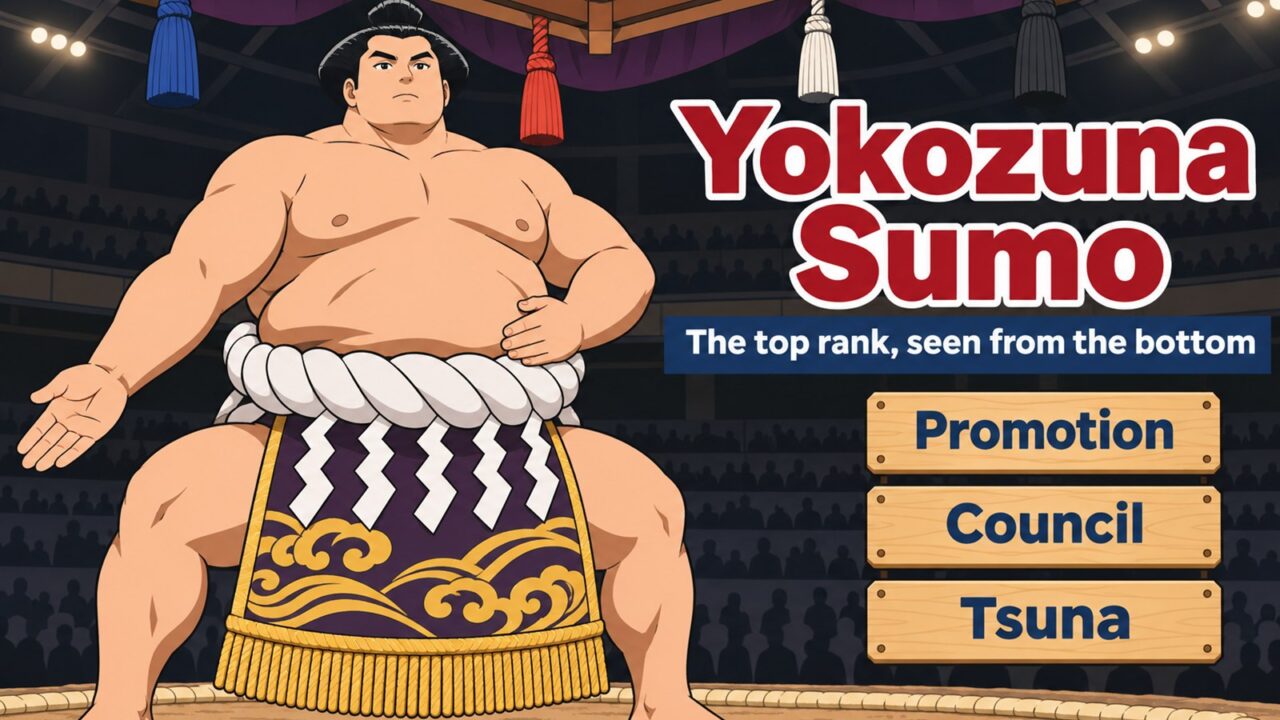
The word itself points at a rope. A yokozuna is named after the tsuna, the heavy white rope he wears around his waist for his ring-entering ceremony, the dohyo-iri. That rope is a familiar religious symbol in Japan. The same kind of rope hangs in Shinto shrines, and in homes it hangs over the kamidana, the household altar.
Source: Japan Sumo Association, Sumo Introduction (PDF)
From a license for the ceremony to the top rank
The rope came first, and the rank came much later. Until the early 1900s, a yokozuna was an ozeki who had been granted a license by the Yoshida Tsukasa family to wear the rope and perform the ring-entering ceremony. The word named a man who performed a ritual, not a position on the banzuke.
The steps from there to the top rank took more than a century.
On a phone, swipe sideways to see the whole table
| When | What changed |
|---|---|
| November 1789 | The earliest yokozuna ring-entering ceremony that the historical record can confirm, performed by Tanikaze and Onogawa |
| May 1890 | The word yokozuna is printed on the banzuke for the first time, beside the name of Nishinoumi. It is still only a title, so the highest rank remains ozeki |
| 1909 | A revision of the Tokyo sumo association’s rules states for the first time that yokozuna is the highest rank |
| January 1951 | The license from the Yoshida Tsukasa family is replaced, so the Association begins deciding its yokozuna itself |
Source: Sumo Daijiten, 4th ed. (Kanazashi Motoi, Gendai Shokan), entry Yokozuna, p.333 / Japan Sumo Association, Sumo Quiz No. 1149 (in Japanese)
On the banzuke, then, the yokozuna are listed first, ahead of the ozeki. The three ranks below them, ozeki, sekiwake and komusubi, are grouped together as the sanyaku, and a yokozuna is not counted among them. He stands apart.
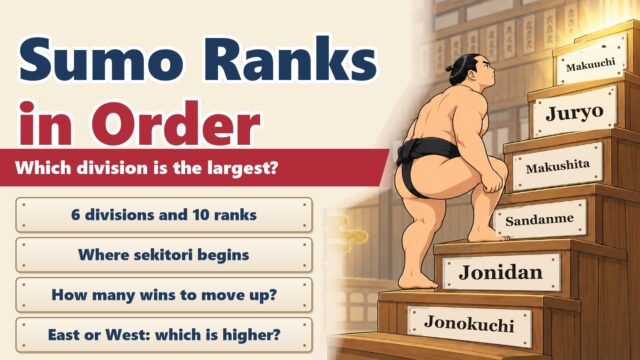
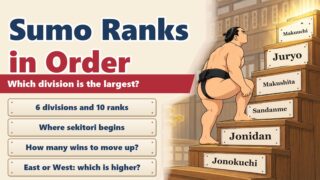
When I spread out a banzuke as a young wrestler, even the sanyaku, whose names sat on the same tier as the yokozuna, looked to me like people living above the clouds. I explain the full ladder of ranks, from yokozuna down to jonokuchi, in more detail here.
The current yokozuna, as of the November 2026 tournament
How many yokozuna are there? The Association’s official line of yokozuna has 75 names. As of the November 2026 tournament, two of them are active, Onosato as the East yokozuna and Hoshoryu as the West yokozuna.
Set side by side, the two look like this.
On a phone, swipe sideways to see the whole table
| Onosato | Hoshoryu | |
|---|---|---|
| Number in the line of yokozuna | 75th | 74th |
| Side of the banzuke (November 2026) | East | West |
| Stable | Nishonoseki Beya | Tatsunami Beya |
| Born in | Tsubata, Ishikawa, Japan | Ulaanbaatar, Mongolia |
| Promotion decided | May 28, 2025, after the May 2025 tournament | January 29, 2025, after the January 2025 tournament |
| The two tournaments before promotion | March 2025, won the title in a playoff. May 2025, won the title at 14-1 | November 2024, 13-2 as runner-up. January 2025, won the title at 12-3 in a three-way playoff |
| Top-division titles | 6 (the sixth in September 2026, at 12-3) | 2 |
As of the November 2026 tournament. The banzuke changes every tournament.
Source: Japan Sumo Association, rikishi profile of Onosato / Japan Sumo Association, rikishi profile of Hoshoryu / Japan Sumo Association, “The 75th Yokozuna, Onosato” (May 28, 2025)
The row for the two tournaments before promotion is where the two men differ, and that difference decided which route each promotion took, as the next section shows.
Recent yokozuna, from the 65th to the 75th
The two active yokozuna are the 74th and 75th in a line that the Association keeps on a Japanese page. Here are the eleven most recent. The column Promoted after gives the tournament whose results earned the promotion, and Last tournament gives the last one in which the man appeared on the banzuke.
On a phone, swipe sideways to see the whole table
| No. | Shikona | From | Promoted after | Last tournament |
|---|---|---|---|---|
| 65 | Takanohana | Nakano, Tokyo | November 1994 | January 2003 |
| 66 | Wakanohana (the third) | Nakano, Tokyo | May 1998 | March 2000 |
| 67 | Musashimaru | Oahu, Hawaii, USA | May 1999 | November 2003 |
| 68 | Asashoryu | Ulaanbaatar, Mongolia | January 2003 | January 2010 |
| 69 | Hakuho | Ulaanbaatar, Mongolia | May 2007 | September 2021 |
| 70 | Harumafuji | Gobi-Altai, Mongolia | September 2012 | November 2017 |
| 71 | Kakuryu | Sukhbaatar, Mongolia | March 2014 | March 2021 |
| 72 | Kisenosato | Ushiku, Ibaraki | January 2017 | January 2019 |
| 73 | Terunofuji | Ulaanbaatar, Mongolia | July 2021 | January 2025 |
| 74 | Hoshoryu | Ulaanbaatar, Mongolia | January 2025 | Active |
| 75 | Onosato | Tsubata, Ishikawa | May 2025 | Active |
Source: Japan Sumo Association, list of successive yokozuna (in Japanese)
Of these eleven, seven were born outside Japan, Musashimaru in Hawaii and six in Mongolia. The full list of all 75, reaching back to the Edo period, exists only on that Japanese page. As of November 2026 the Association has no English version of it.
How to become a yokozuna
The requirements for promotion to yokozuna are not written into the Association’s own regulations. They are the internal guidelines of the Yokozuna Deliberation Council, a body of people from outside the sumo world that advises the Association on yokozuna matters. Those guidelines say four things.
- A wrestler recommended for yokozuna must be outstanding in character and ability
- As a rule, the council recommends an ozeki who has won two tournaments in a row
- To recommend an ozeki whose record is close to that, two thirds or more of the members present must vote in favor
- Character is examined on the basis of what the Association has confirmed
Source: Jiji Press, “Two straight titles” column (June 25, 2009, in Japanese)
The process that applies those guidelines is easiest to follow through real cases, so here are the steps, mostly with the dates of Onosato’s promotion in May 2025.
On a phone, swipe sideways to see the whole table
| Step | What happens |
|---|---|
| 1 | After the final day, the judging department asks the chairman to call an extraordinary board meeting to consider the promotion. That is how Hoshoryu’s promotion began in January 2025 |
| 2 | The chairman puts the question to the Yokozuna Deliberation Council. Onosato was recommended unanimously on May 26, 2025 |
| 3 | Following the council’s recommendation, the board of directors approves the promotion and the banzuke compilation meeting decides it. For Onosato, both met on May 28, 2025, at the Ryogoku Kokugikan, and the decision was unanimous |
| 4 | The same day, messengers from the Association visit the stable, and the new yokozuna gives a short formal speech. For Onosato, that was at Nishonoseki Beya in Ami, Ibaraki |
| 5 | The rope is made at the stable, then the yokozuna receives his certificate and performs his first ring-entering ceremony at Meiji Shrine in Tokyo. For Onosato, the rope-making was on May 29, then Meiji Shrine on May 30 |
Source: Tokyo Sports, “Hoshoryu’s promotion to be considered” (January 27, 2025, in Japanese) / Kobe Shimbun, editorial on Onosato (May 27, 2025, in Japanese) / Japan Sumo Association, “The 75th Yokozuna, Onosato” (May 28, 2025)
At the ceremony in his stable, Onosato’s reply to the messengers included these words, translated here from the Japanese.
“I humbly accept. I will devote myself to training so as not to disgrace the rank of yokozuna, and aim to be a yokozuna like no other.”
Source: Daily Sports, “Onosato promoted to 75th yokozuna” (May 29, 2025, in Japanese)
Meiji Shrine has been the setting for that final step since June 1951, when Chiyonoyama became the first yokozuna to receive his certificate there.
Source: Sumo Daijiten, 4th ed. (Kanazashi Motoi, Gendai Shokan), entry Yokozuna Suikyojo Juyoshiki, p.336
Two straight titles, or a record “close to it”
Onosato fits the rule as written. He won the March 2025 tournament in a playoff, then won again in May at 14-1, two titles in a row as an ozeki.
Hoshoryu, four months earlier, took the other route. In November 2024 he finished 13-2, runner-up to the champion, then in January 2025 he won the title at 12-3 after a three-way playoff. That is not two straight titles, so his recommendation went through the two-thirds rule for a record close to it.
Source: Daily Sports, “Onosato wins the March title in a playoff” (March 23, 2025, in Japanese) / Daily Sports, “Hoshoryu’s promotion to be decided” (January 27, 2025, in Japanese)
When the council said no: Takanohana in 1994
The record close to it is where the council has said no. In September 1994, the ozeki Takanohana, the future 65th yokozuna, won the tournament with a perfect 15-0. On September 26 the council declined to recommend him, because in July he had won only 11. He answered in November with another 15-0, two perfect championships in a row, and was promoted after that tournament. By then he had won seven top-division titles, the most any wrestler had won before reaching the rank.
At the time he wrote his ring name with a different middle character, 貴ノ花, but in English both spellings read Takanohana.
The rule as written is another matter. Since Chiyonoyama, no ozeki who won two tournaments in a row has been passed over for yokozuna.
Source: Kyodo News, “Takanohana’s promotion passed over, 30 years ago on September 26” (September 26, 2024, in Japanese) / Japan Sumo Association, Sumo Quiz No. 1140 (in Japanese)
The Yokozuna Deliberation Council
The council itself was born out of a crisis. In the January 1950 tournament, all three yokozuna withdrew within the first five days, and from the fifth day on there was no yokozuna ring-entering ceremony at all. The Association went so far as to decide, during the tournament, that a yokozuna could be dropped to ozeki on his results. It reversed that decision after the tournament, and in May 1950 set up the council instead, to deliberate on recommending new yokozuna and on advising a yokozuna to retire.
The council answers the questions the Association puts to it, and it can also offer advice on its own initiative. The Association, for its part, respects the council’s decisions.
Source: Sumo Daijiten, 4th ed. (Kanazashi Motoi, Gendai Shokan), entry Yokozuna Shingi Iinkai, p.334-335
Its work does not end at promotion, either. By a vote of two thirds or more of the members present, the council can pass a resolution of encouragement, a warning, or a recommendation to retire. In November 2018 it passed a resolution of encouragement for Kisenosato, who was yokozuna at the time. After the November 2020 tournament it issued its first-ever warning, the second most serious of the three, to Hakuho and Kakuryu, both yokozuna then and both since retired.
Source: Tokyo Sports, “What the council can resolve” (November 27, 2023, in Japanese) / Daily Sports, “Council holds off on recommending retirement” (March 30, 2021, in Japanese)
I thought the council’s job ended once a yokozuna was promoted.
So what happens to one who keeps losing after that? Does he drop back to ozeki?
Can a yokozuna be demoted? No, he retires
I was a child when the yokozuna Chiyonofuji announced his retirement, and I remember his press conference. It was May 14, 1991. He had lost on the third day of the May tournament, to Takatoriki, and he stepped down the same day, saying he had reached the limit of his physical strength. A man that strong was leaving, and as a child I simply thought that was a shame.
Source: Kyoto Shimbun, “Today in history, May 14” (May 14, 2025, in Japanese) / Japan Sumo Association, Sumo Quiz No. 976 (in Japanese)
Looking back, that is how a yokozuna’s career ends, because the rank has no step down. A yokozuna who posts a losing record keeps his rank. If he can no longer carry the responsibility that comes with it, the only way out is retirement.
Source: Sumo Daijiten, 4th ed. (Kanazashi Motoi, Gendai Shokan), entry Yokozuna, p.332
With no way down, the pressure to keep winning must be enormous.
I hadn’t thought of the rank that way before.
Demotion came close only once, in 1950. The demotion decided on during that January tournament was withdrawn out of respect for the tradition and authority of the rank, and the council was created instead, with the power to advise a yokozuna to retire. Since then, the answer to a yokozuna who cannot win has been retirement, not a lower rank.
Hoshoryu’s 2026 shows how far that goes. He left the May 2026 tournament at 0-2 with 13 absences, finished July at 7-7 with one absence, and missed September entirely. He entered the November 2026 tournament still a yokozuna, and at its meeting after the September tournament the council did not take up a resolution such as encouragement.
Source: Japan Sumo Association, rikishi profile of Hoshoryu / Daily Sports, “Council hopes for Hoshoryu’s comeback” (September 28, 2026, in Japanese)
How yokozuna careers end
Retirement is the common ending, but the road to it differs. Five former yokozuna show how different the roads can be.
On a phone, swipe sideways to see the whole table
| How it ended | Former yokozuna | What happened |
|---|---|---|
| Declining form | Kitanoumi | Retired at the January 1985 tournament |
| Injury | Takanohana | Hurt his right knee on day 14 of the May 2001 tournament. After seven straight tournaments out, he retired on January 20, 2003 |
| After the council’s encouragement | Kisenosato | Received the council’s resolution of encouragement after the November 2018 tournament. He lost his first three bouts of the January 2019 tournament, then retired on January 16 |
| Scandal | Asashoryu | Alleged to have assaulted an acquaintance in the early hours of January 16, 2010, during the January tournament. He announced his retirement on February 4, the day of a board meeting. The Yokozuna Deliberation Council had already agreed to recommend that he retire |
| Left sumo after a dispute | Futahaguro | In December 1987 he clashed with his stablemaster, walked out of the stable, and the stablemaster filed the papers that ended his career. He was the first yokozuna promoted without ever winning a top-division title |
Source: Jiji Press, “The day they left the dohyo”, Takanohana (in Japanese) / Jiji Press, the same series, Kisenosato (in Japanese) / Jiji Press, the same series, Asashoryu (in Japanese) / Daily Sports, “Kitanoumi, the strongest yokozuna of his era, dies” (November 20, 2015, in Japanese) / Daily Sports, “Futahaguro, the yokozuna who never won a title, dies” (March 29, 2019, in Japanese)
After a yokozuna retires
A yokozuna keeps one privilege when he retires. For five years after retirement, he can stay in the Association as a toshiyori, an elder, under his own ring name. Like every elder, though, he must hold Japanese citizenship.
Source: Sumo Daijiten, 4th ed. (Kanazashi Motoi, Gendai Shokan), entries Yokozuna Ichidai Toshiyori Sei, p.333, and Toshiyori Myoseki, p.236
The yokozuna rope and the ring-entering ceremony
The rope that gives the rank its name is a serious object. Inside is a core of copper wire, wrapped in hemp and cotton that have been softened by kneading. A finished rope runs four to five meters long and weighs around eight kilograms, and a new one is made for every Tokyo tournament.
Source: Sumo Daijiten, 4th ed. (Kanazashi Motoi, Gendai Shokan), entry Yokozuna, p.333
The exact weight depends on the man. Onosato’s first rope, made for his promotion in May 2025, came out at 7.2 kilograms and 4.22 meters, heavier than the 6.4 kilogram, 4.1 meter rope of his stablemaster, the former yokozuna Kisenosato.
Source: Daily Sports, “Onosato’s first rope outweighs his stablemaster’s” (May 30, 2025, in Japanese)
Tsuna-uchi, making the rope
Making the rope is called tsuna-uchi, and it happens at the yokozuna’s own stable, three times a year, before each of the Tokyo tournaments. The rope made in Tokyo then travels with him to the tournaments in Osaka, Nagoya and Fukuoka. Wrestlers of the stable and of its ichimon, the group of allied stables, gather in white gloves and twist the strands together in time to a call. When a new yokozuna is born, that first tsuna-uchi is a celebration, with the wrestlers in red-and-white headbands.
Source: Japan Sumo Association, Sumo Quiz No. 944 (in Japanese) / Sumo Daijiten, 4th ed. (Kanazashi Motoi, Gendai Shokan), entry Tsuna-uchi, p.217
Onosato’s tsuna-uchi, and the first ring-entering ceremony that followed it, are both in the Association’s English video on his promotion.
The promotion itself comes at 0:50, tsuna-uchi at 3:17, and the ring-entering ceremony at Meiji Shrine at 5:15. From 7:12 the video turns to bouts from the May 2025 tournament. It runs a little over sixteen minutes and dates from June 2025.
The dohyo-iri, in the Unryu style or the Shiranui style
At a tournament, the yokozuna’s dohyo-iri follows the ring-entering ceremony of the top division. The yokozuna steps onto the dohyo, the ring, with two attendants, the tsuyuharai, the dew sweeper, on his left and the tachimochi, the sword bearer, on his right, and all three are led up by a gyoji, a referee.
The rope on his back is tied in one of two styles. In the Unryu style the knot makes a single loop, and in the Shiranui style it makes two.
Source: Sumo Daijiten, 4th ed. (Kanazashi Motoi, Gendai Shokan), entry Yokozuna Dohyo-iri, p.336 / Japan Sumo Association, Sumo Quiz No. 957 (in Japanese)
Here is what that looks like on the dohyo. The Association posted photos of Onosato’s first yokozuna dohyo-iri at the Ryogoku Kokugikan on May 31, 2025, with Takayasu as his tachimochi and Takanosho as his tsuyuharai.
<新横綱 大の里>
国技館で初めての横綱土俵入り。
太刀持ち髙安、露払い隆の勝。
行司式守伊之助、呼出し克之。映像は公式YouTubeにて公開中!
▶️https://t.co/Wm5LAuhLvs#sumo #相撲 #大の里 #横綱 pic.twitter.com/UeqMyMEuun
— 日本相撲協会公式 (@sumokyokai) May 31, 2025
The two styles come with a story I grew up with. When I was in elementary school, my parents told me that yokozuna who use the Shiranui style have short careers, and for a long time I believed it. Then the former yokozuna Hakuho, a Shiranui-style yokozuna, held the rank for years, and these days I think it may have been a superstition that someone made up from the yokozuna of that time.
The ceremony is the part of a tournament day when the whole arena looks at one man. My own view of it, honestly, was from the other side. During the yokozuna’s dohyo-iri I was an attendant with no time to watch. I was back in the dressing room with the sekitori I served, a wrestler of the top two divisions. I took off his kesho-mawashi, the ceremonial apron, helped him into the shimekomi, the silk belt he fought in, and then stood in as his partner while he practiced his tachi-ai, the initial charge.
If you want to know when the ceremony starts on a tournament day, I have put together a guide to the sumo schedule that includes the times of the ring-entering ceremonies.
And if you want to see the rope with your own eyes, my guide to sumo tickets explains how to buy them in English and which seat to pick.
A yokozuna, seen from the bottom of the banzuke
Before closing, I want to be clear about where I stand.
My highest rank was jonidan, the second division from the bottom. I never saw the inside of a yokozuna’s world, not the room where the messengers deliver the promotion, not the work of a yokozuna’s attendants. What I have written about promotion and the council comes from the written record, not from anything I witnessed.
What I did have was my stablemaster. He often told us that yokozuna were rarer than prime ministers, and he meant the numbering. The numbered list of Japan’s prime ministers, which only begins in 1885, has already passed 100, while the list of yokozuna, which reaches back to the Edo period, has 75 names on it.
Source: Prime Minister’s Office of Japan, list of cabinets (in Japanese)
I would not turn that into an argument about which matters more. What stayed with me is how small 75 sounded, from where I stood.
Put next to the prime ministers, the number really does look small.
No wonder a yokozuna looked like someone from another world from down where we were.
FAQ: Yokozuna
Q1. What does yokozuna mean?
A. Yokozuna is the highest rank in sumo, often translated as “grand champion”. The name comes from the tsuna, the white rope the yokozuna wears around his waist for his ring-entering ceremony.
Q2. Who are the current yokozuna?
A. As of the November 2026 tournament, there are two, Onosato, the 75th yokozuna, on the East side of the banzuke, and Hoshoryu, the 74th, on the West.
Q3. How many yokozuna have there been?
A. Seventy-five, as of November 2026. The Association publishes the full list only in Japanese, on its page of successive yokozuna.
Q4. How many yokozuna can there be at once?
A. There is no fixed number. Promotion depends on results, so the count rises and falls. There have been tournaments with no yokozuna at all, for example from the July 1992 tournament through the January 1993 tournament. As of the November 2026 tournament there are two.
Q5. What happens if a yokozuna has a losing record?
A. He is not demoted. He keeps his rank, and the Yokozuna Deliberation Council may pass a resolution of encouragement, a warning, or a recommendation to retire.
Q6. Has there ever been a foreign-born yokozuna?
A. Yes, eight as of November 2026. The first was Akebono, from Hawaii, whose first tournament as yokozuna was March 1993, after his promotion following the January 1993 tournament. Musashimaru was also from Hawaii, and six yokozuna from Asashoryu to Hoshoryu have come from Mongolia.
Source: Japan Sumo Association, Sumo Quiz No. 1155 (in Japanese)
Q7. How much does a yokozuna earn?
A. A yokozuna’s monthly salary from the Association is 3,000,000 yen up to the November 2026 tournament, rising to 3,300,000 yen from the January 2027 tournament. What a yokozuna makes in a year is in my guide to sumo wrestler salaries.
Final thoughts
The day the senior wrestler’s chest did not move under me, the word yokozuna changed for me. Until then it had been a goal, the top of a ladder I had just started to climb. After that it was a view, something I could see clearly from the bottom of the banzuke but no longer expected to reach.
Writing this, I found that the view itself has not changed. What I can see more clearly is the shape of the rank behind it. A yokozuna is recommended by a council from outside the sumo world, he is never demoted, and when the wins stop coming, the only step left is to retire.
The next time a yokozuna steps onto the dohyo with his rope on, look at the rope first. Then remember that only 75 names stand in the whole line of yokozuna, and how far below them the banzuke begins.

The rope weighs about eight kilograms, the rank far more.
Watch the next bout with that in mind.